I was leafing through a sheaf of pesticide use reports from the San Francisco Recreation and Parks Department, as I sometimes do. It’s mostly about herbicides sprayed on plants. The parts about animals usually relate to rodents and yellow-jackets.
Not this report. Some people had seen an alligator. In Stow Lake.
I checked the date on the report, just in case it was April Fools. But no, this had a June 2014 date on it.
It wasn’t a very big alligator – two feet, said the report. SFRPD called Fish and Game, and Animal Care and Control. But though they went out to look a couple of days in succession, there was no alligator seen. They closed the case until there’s another sighting.
I don’t consider myself particularly political. But in recent years, I’ve become aware of various kinds of community activism, and developed a real appreciation of what democracy means.
So I’m especially concerned about one Proposition that will be on the Ballot in November 2014. It’s Proposition I: Increased Usage of Children’s Playgrounds, Walking Trails, and Athletic Fields Act.
Prop I is being talked about as the opposite of Proposition H (opposing artificial turf on the Beach Chalet Soccer Fields), hence such campaigns as Yes on H/ No on Prop I.
But it’s not just that.
Here’s what I worry about: If passed, Prop I would sharply erode community voices in future decisions made by SF Recreation and Parks Department (SFRPD) regarding our parks and open spaces. It tips the scales strongly in favor of SFRPD.
WHAT IS PROPOSITION I?
Proposition I changes the Parks Code so that any major project that SFRPD forecasts will double usage in an calendar year gets the go-ahead once its Environmental Impact Report is certified. Here’s the proposition (as a PDF): Nov2014_ParkCode
Here’s what it does:
Applies to any SFRPD project concerning athletic fields, children’s playgrounds, or walking trails – which sounds like it would cover most SFRPD parks and open spaces.
Makes “doubles usage in a calendar year” as a benchmark – even if doubling usage isn’t a good objective or usage would fall after one calendar year. (And of course, since it’s about the future, it’s a forecast.)
Says that once such a project’s EIR has been certified, it “should be allowed” – presumably cutting off appeals, ballot measures and other community input.
It’s also got a “poison pill” for Proposition H. If it gets more votes that Prop H, then it invalidates Proposition H even if Prop H got over 50% of the votes.
Because of the “poison pill” some people are saying Proposition I is ‘the anti-H.’ However, its impact is much broader.
The Anti-Prop H Clause – Prop I – Nov 2014
MUCH WIDER IN SCOPE THAN JUST AN ANTI-PROP-H MEASURE
It allows SFRPD to proceed with any major project that they estimate will double usage in a calendar year, independent of the community’s desires or priorities. It removes nearly all means of appeal or review. So if this Prop I passes, then for any SFRPD project, they need only:
Pick any project and estimate it will at least double usage within a calendar year;
Hire a consultant to complete an EIR and agree that it will double forecast usage in a calendar year;
As long as the EIR is certified, SFRPD can implement the project without any community input or challenge.
Estimating doubled usage in a calendar year is enough reason?
WHAT ABOUT CEQA?
The California Environmental Quality Act (CEQA), which is what requires projects to get Environmental Impact Reports, is enforced through lawsuits. There’s no regulatory body.
It’s not clear whether Prop I would take away the right to a legal appeal, or to a ballot measure. But the way it’s worded, it could do so.
Even worse – the language specifies it shall be “liberally construed.” This could mean anything.
“Liberal Construction” – Prop I – Nov 2014
Prop I can also be amended by a two-thirds majority vote of the Board of Supervisors with the Mayor’s approval. It doesn’t need to go back to the voters. This means the Supes and the Mayor can change a lot of the wording afterward.
“Amendment” – Proposition I – Nov 2014
WHY THE SUPERVISORS MIGHT NOT UNDERSTAND
I know that City Hall is much in favor of Prop I. Seven supervisors signed to put it on the ballot, including Scott Wiener and David Chiu, both people whom I respect. Supervisor Wiener in particular feels it’s wrong for people opposing an SFRPD project to get more “bites at the apple” – after the Supervisors have approved it, and the EIR has been certified. I do understand that it’s frustrating when a multi-million dollar project is held up because a group of people in the community don’t want it.
What that argument doesn’t allow for is that the situation is inherently asymmetrical. The saying “You can’t fight City Hall” exists for a reason. All these rules – the Sunshine Act, the ability to go directly to the electorate via a ballot measure, the ability to take legal action – they all exist to redress the power imbalance, at least somewhat.
Theoretically, “City Hall” represents us. But a lot of things have to be weighed in any decision – from funds to feasibility to desirability of a project. And these can set up things so that what City Hall wants is not aligned with what the community wants.
Taking away avenues of recourse – including putting things on the ballot – feels efficient. But ‘efficient’ decisions are not always the right decisions.
JUST ABOUT SOCCER FIELDS?
Even though the main campaigners against Prop I are those who support Proposition H (and oppose artificial turf in Golden Gate Park), the issue is so much broader.
That’s why I hope that Prop I doesn’t pass, no matter what happens to Prop H.
I was talking to friends who plays soccer, and are willing to accept artificial turf as the price of play. “I’m voting No on H, No on I,” they said.
From where I sit it looks like Proposition I muffles the public voice about what happens in our parks.
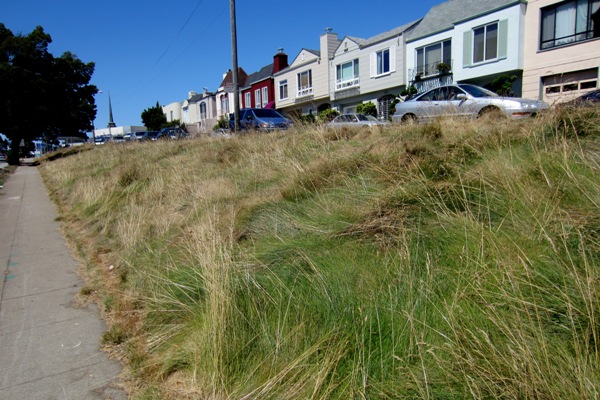
A year later, it was dry and looked more like hay, and I wrote about it again as ‘shaggy grass‘ in 2011.
Since I pass that way a lot, I have often thought of doing a follow up – especially this summer, when the whole thing had an interesting patchy look. It was brown for the most part, but green in the shadow of the big tree growing there.
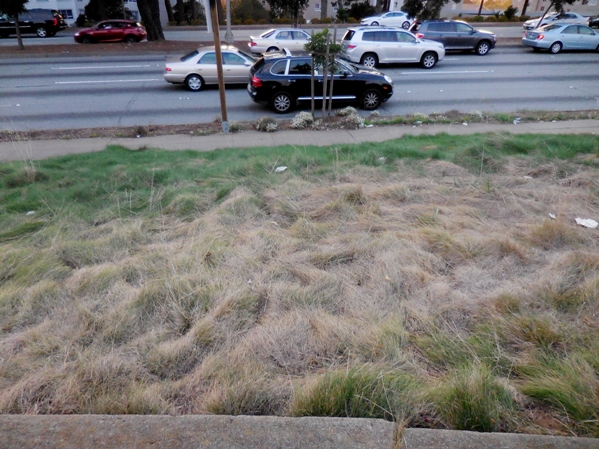
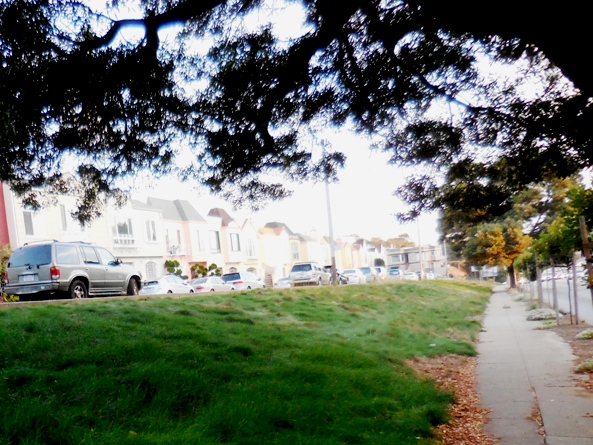
Unfortunately, I didn’t get round to taking a picture until a few days ago, when the contrast was less dramatic. But it’s still evident. This is the grass where it’s dry.
And here’s what it looks like under the tree. I can’t figure if the tree is helping the grass by shading it, or by watering it by harvesting fog, or something else. But within the outline of the tree, the grass is green.
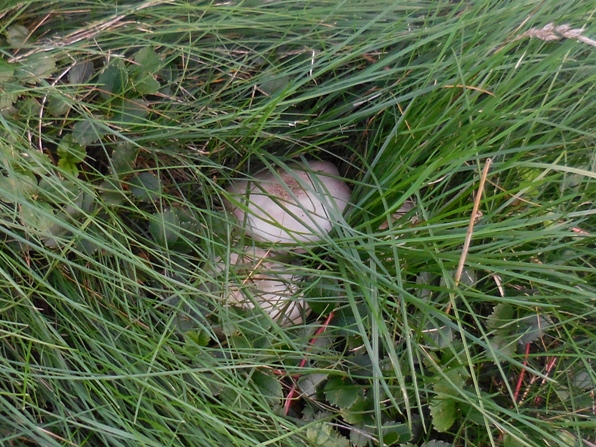
I also found a bunch of mushrooms nestled in the grass, like these here.
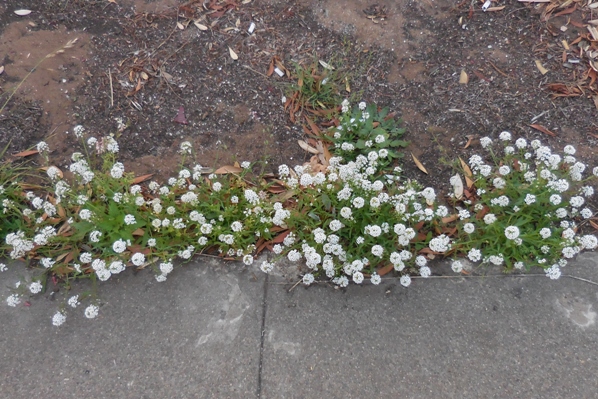
Even at that busy intersection, the scent of the moment was the honey fragrance from the self-seeded sweet alyssum.
I love how nature fills in gaps with life and beauty.
Here’s another picture of the grass under the trees. You can see where it turns patchy outside the tree’s dripline.
I was delighted to see a row of trees planted all along the sidewalk here.
When they’re grown, they’ll help the homes back there, fighting the pollution from the heavy traffic on Junipero Serra. They’ll absorb some of the traffic noise. They’ll provide a pleasing visual barrier.
And they’ll shade the no-mow fescue grass and it will be green.
UCSF held a meeting for public comments on the Draft Environmental Impact Report (DEIR) on its Long Range Development Plan (LRDP) on Sept 22, 2014. About 15-20 neighbors showed up. No one (including me) had any comments ready. The meeting started at 7p.m. and adjourned at 7.15 p.m.
I picked up a copy of the DEIR; it’s roughly 2 inches thick. The electronic version on UCSF’s website is HERE.
UCSF are accepting written comments until October 14th.
It was surprising that no one commented. It was such a contrast with a similar meeting last year for DEIR comments about cutting down trees in Sutro Forest. There, 250 people showed up, 50 spoke (with over 70% opposed), and it ran to 9.15 p.m.
WHAT’S HAPPENING ABOUT SUTRO FOREST?
This EIR was for the Long Range Development Plan, which is mainly about construction and changes in usage in Parnassus as well as UCSF’s other campuses. They have said that Sutro Forest is specifically excluded, since it will have its own Plan and will presumably have another EIR.
(As of now, we understand that UCSF has a new plan for Sutro Forest that focuses on fire hazard and commits to not using herbicides. We actually think the plan will increase, not decrease, the fire hazard by drying out the forest and making it windier. Anyway, the only information we have about the plan came from a Powerpoint presentation. There’s no EIR yet, but UCSF has said the new plan would need a new EIR when they can devote resources to it.)
Meanwhile, what UCSF has been doing is cutting down trees first for “fire safety” and then for “hazard reduction. More trees are expected to be felled before year end. This is considered routine maintenance and doesn’t require an EIR.
As far as we can gauge right now, the LRDP still affects the Forest in three ways:
A new trail is to be built from the Inner Sunset side, which is good; but it is likely to cost trees, which is bad.
They are removing Aldea Student Housing from the space ceiling, with the immediate effect of preserving some buildings scheduled to be knocked down, and a long term impact of – who knows?
They plan to knock down two small office buildings in the forest – just off the parking lots. It’s a Space Ceiling issue.
HOW IS FOREST KNOLLS IMPACTED?
We will possibly be impacted by UCSF removing Aldea Student Housing from the Space Ceiling. The immediate effect is that they will keep three buildings they had planned to knock down.
In the longer term, it could mean expansion at Aldea, which would of course impact our neighborhood, since the only thing between the student housing area and Forest Knolls is a strip of trees – which was thinned last August, so the housing is now clearly visible from Christopher.
At present, UCSF has said the LRDP includes no plans to expand in Aldea.
If I figure out any other impacts, I’ll post about it here.
UCSF sent around this message to all the Parnassus neighbors (broadly defined). The event is open to all.
Next week, the fitness center in UCSF’s Millberry Union is hosting a festival with complimentary workout classes and fitness consultations. The free activities are open to the UCSF community and to neighbors.
September 25, 2014
Millberry Fitness & Recreation Center
500 Parnassus Avenue, Level B1
Body Composition Testing Personal Trainer Consultations Event Specials
Mid-Day Schedule
11:00 am-2:30 pm Free body composition testing and fitness consultations
11:15 am-11:45 am GRIT™ CARDIO
11:50 am-12:35 pm ZUMBA®
12:45-1:15 pm CXWORX™
1:30-2:20 pm BODYFLOW ™
Lesley Aiken of Forest Knolls is starting a new Yahoo group for families with kids who live in Forest Knolls and Midtown Terrace neighborhoods in San Francisco.
It’s intended to bring families of children together to arrange playdates and discuss issues relevant to children in our neighborhoods. (It’s a restricted group, as it should be since it’s about kids. )
STAYING IN TOUCH WITH OUR NEIGHBORHOOD
Whether or not you have kids, if you would like to stay in touch electronically with our neighborhood, we have four ways:
1) Nextdoor group
2) A general Forest Knolls Neighborhood Yahoo Group, and
3) A Facebook group.
4) And of course, this blog/ website. If you’d like to get an email whenever there’s a new post, you can enter your email address in the box at the top right of the page.
[Sorry, sent out a draft with the wrong date. Here’s the correct version.]
We’ve all been reading about the ice-bucket challenge – where you agree to have ice-water poured over you in exchange for a donation to the ALS Association. Inner Sunset neighbor Barbara Oleksiw asked me to let everyone know about the Inner Sunset one, tomorrow.
Take the Inner Sunset ALS Ice-Bucket Challenge *THIS* Sunday, 1-2:30p at the Big Lunch, 9th & Irving
If you’d like to participate but don’t have funds to contribute, please come.
If you’d like to participate and make a donation, please come.
If you’d like to simply watch these ice-crazed stalwarts, please come.
We have a sponsor who’ll donate $50 to *each* person willing to get dunked, but who can’t contribute.
Plus, we have a sponsor who’ll match the funds of *each* person who gets dunked and also contributes.
We’re planning to make this as fun, water-conserving and creative as possible. And, if you’re not interested in getting wet or donating, we invite you to simply cheer us on!
If you haven’t heard of the ice bucket challenge, here’s what Wikipedia says about it: “The Ice Bucket Challenge, sometimes called the ALS Ice Bucket Challenge, is an activity involving dumping a bucket of ice water on someone’s head to promote awareness of the disease amyotrophic lateral sclerosis (ALS) and encourage donations to research. It went viral on social media during July–August 2014. In the US, many people participate for the ALS Association, and in the UK, many people participate for the Motor Neurone Disease Association,although some individuals have opted to donate their money from the Ice Bucket Challenge to other organizations.
“The challenge dares nominated participants to be filmed having a bucket of ice water poured on their heads and then nominating others to do the same. A common stipulation is that nominated participants have 24 hours to comply or forfeit by way of a charitable financial donation.”
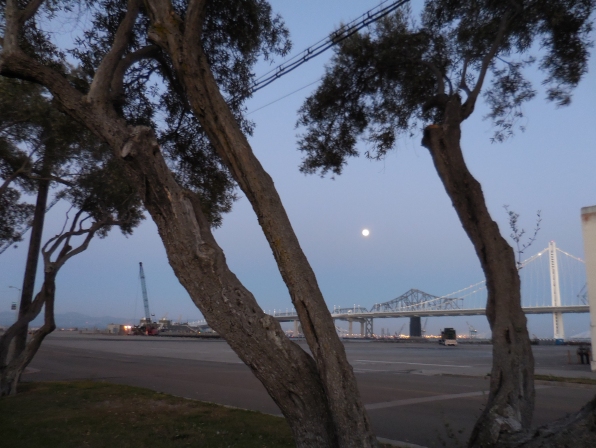
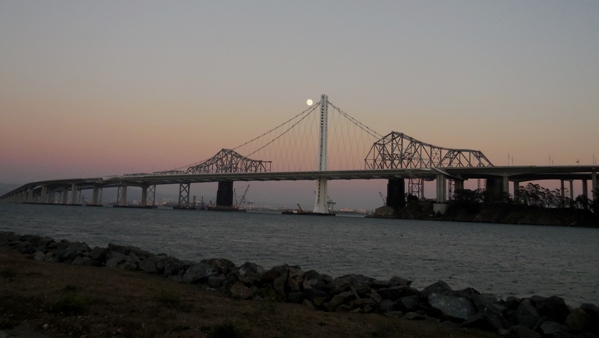
Last Sunday wasn’t a full moon night, but it was close. I found myself on Treasure Island at sunset, viewing the rising moon above the new bridge. The old bridge, with a gap where a span’s been removed, lay behind. I wasn’t the only one who was fascinated by the sight; there were perhaps half a dozen photographers out there, mostly with fine cameras, large lenses, and tripods.
My camera is my trusty Nikon Coolpix. It lives in my pocket or my purse. But whatever the camera, it was hard to go wrong on such an exquisite evening.
In fact, in some ways it’s easier to get a moon shot on a not-quite-full moon night. It’s a little less overwhelming for the camera.
The next night was the Supermoon – and the clouds rolled in to San Francisco. But still, I got a shot from nearby Twin Peaks.
I’d hoped to get one behind Sutro Tower, but the alignments didn’t work out. Another night, another time.
I attended the UCSF quarterly Community Advisory Group meeting on Sept 3, 2014. The two topics of immediate interest to the Forest Knolls neighborhood are Aldea Student Housing and Sutro Forest.
ALDEA
Recently [Aug 12, 2014], UCSF had a meeting specifically to discuss removing Aldea student housing from the Space Ceiling. I reported on that HERE. At this meeting [i.e. the Sept 3rd meeting], they said they will go ahead.
Here’s the background:
In brief – following UCSF’s massive conflict with neighbors about its expansion plans, in 1976 the University of California Board of Regents passed a resolution that introduced a “space ceiling” that prohibited UCSF from expanding to more than 3.55 million sq feet of space in the Parnassus campus. The ceiling (which has been exceeded years ago, but still serves as a target and benchmark) does not apply to housing. However, Aldea Student Housing, which is next to Forest Knolls along Clarendon Avenue, was specifically excluded from the exclusion, meaning that it does count toward the space ceiling. UCSF wants to remove the restriction on Aldea Student Housing.
At the August 12th meeting, nearly everyone present opposed removing Aldea from the Space Ceiling. Here’s why:
Removing Aldea Housing from the space ceiling could trigger an expansion, limited only by funding availability. (Technically, UCSF as a state organization doesn’t even have to follow city codes – though they usually do try to comply.)
It would set a poor precedent in which the Board of Regents could remove any restrictions despite prior agreements with the community.
It ignored earlier commitments. When UCSF built the Stem Cell Research facility, it used about 0.5 acres of the Forest; it was going to demolish two dorms in Aldea Student Housing and return the area to the forest in compensation. Under the new proposal, this would not happen.
As Rick Osmon said in a comment to my earlier report:
“I was at the meeting on August 12. After it became clear that the neighbors who were at the meeting were in agreement that the Aldea housing should not be removed from UCSF’s overall space limits, Lori Yamauchi proposed adding language to the LRDP [Long Range Development Plan that would restrict any increase in density of units at the Aldea housing site. The biggest fear expressed by those at the meeting is that UCSF would embark on intensive development of the Aldea site. The [Associate] vice-chancellor’s proposal was welcomed by everyone I heard speak.”
At this CAG meeting, Associate Vice Chancellor Lori Yamauchi said they will ask the Regents to remove Aldea from the space ceiling. They think only a minority of the community oppose it. However, they were not asking for the repeal of the space ceiling as a whole.
They also said they would not increase the density of units at Aldea beyond existing levels. They only wished to retain the buildings they had earlier undertaken to knock down.
I found this reassuring. However, I met Lori later as we were leaving the building, and mentioned I’d be writing a report to the neighborhood on this website.
“You can say the LRDP has no plans to build more housing at Aldea,” she said.
“No plans to build isn’t the same as will not build,” I said. “Can you give a letter saying will not build?”
“I’m not prepared to negotiate that with the neighbors,” she said. (In all fairness, it was reasonable she wouldn’t give an undertaking then. It was an informal chat, as we were leaving the meeting.)
“But,” she added, “You can write a comment from the neighborhood.” She said they would be taking comments on the LRDP to the end of this month, and on the Environmental Impact Report until October 14, 2014.
You can email Damon Lew at dlew@CGR.UCSF.EDU and Lori Yamauchi at lyamauchi@planning.ucsf.edu
CREDIBILITY
One issue that was discussed was UCSF’s credibility. We’re all supporters of this great medical school. However, we have had numerous occasions when we thought we had a commitment… and found we didn’t.
I don’t think there’s a huge problem with retaining the dorms as they are. But I do think there’s a problem when UCSF undertakes something, and then pretty much decides to waive its decision. Situations do change, and there may be reasons to revisit earlier decisions. But it has to be done in consultation with the broader community.
OTHER ISSUES DISCUSSED
UCSF presented their ten-year capital plan (2014-15 to 2023-24), which included projects greater than $750,ooo in size. It totaled $1.6 billion, and included $460 mn of seismic safety work as well as some major building projects. (The presentation UCSF made, including these details, is HERE.)
They discussed minority hiring goals, and the EXCEL program that trained people from areas surrounding Mission Bay campus. There was concern about the African-American hiring goals specifically, and whether UCSF was doing enough.
They hope to build a new building behind SF General Hospital (which is not seismically upgraded) to move staff currently in the old building.
They discussed the new helipad at Mission Bay, which will be commissioned in October/ November.
They are in talks about the Warriors planned stadium, which will be right behind the Mission Bay campus (and close to the pediatric Emergency Room), regarding traffic flows and security issues.
MOUNT SUTRO FOREST
There’s been another evaluation of the trees for hazard. They said they do a hazard evaluation every two years, and they will be removing trees by year end. They did not know how many trees they would remove. (This would be in addition to around 1200 trees removed in the last 13 months.)
They will putting in signs for mountain-bike riders, informing them that they must yield to hikers and joggers.
A new trail – “The Sunset Trail” is being included in the capital budget. (I think that’s the black line near the top of the map.) It will likely be built this year or next. They did not say how many trees (if any) they would remove now – or later, in consequence of the trail’s existence.
UCSF will be holding a meeting on September 22nd, 2014, to further discuss the Long Range Development Plan.
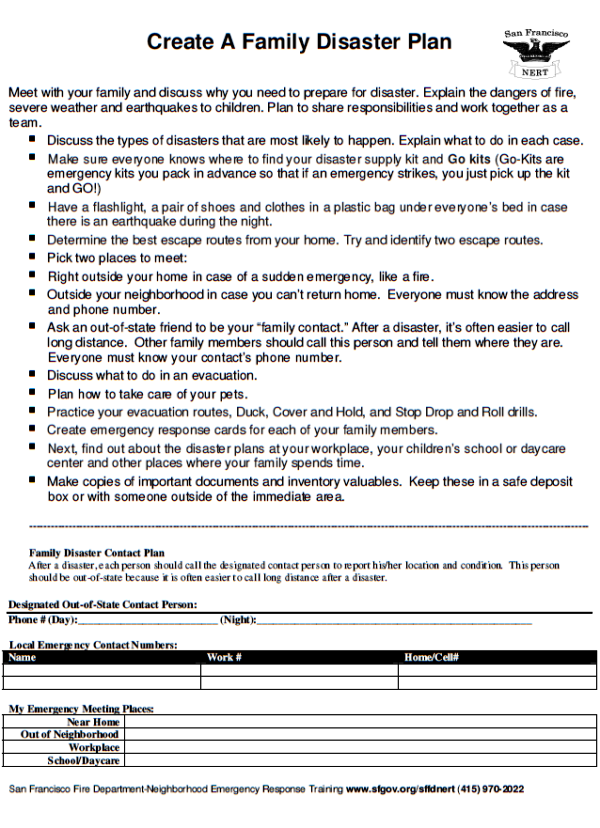
I don’t usually post twice on one day, but I think this is something people may find useful – especially after the recent wake-up call of the Napa Valley earthquake. I was browsing the NERT newsletter, and they had this 6-day preparedness plan for earthquakes.
No one can plan for every eventuality, but it’s reassuring to know one has made a good start. So here it is:
Start small. Just do one thing to get yourself prepared.
Every day!
DAY 1: put an old pair of comfortable shoes under your bed
DAY 2: Get a cardboard box to start your supply gathering
Day 3: House hunt, in your own house. Got a flashlight? Some bottled water? Extra roll of toilet paper? Maybe a radio? Think “what do I need if I get to stay in my home after an earthquake?” Put it in your box.
I was here in Forest Knolls when the Loma Prieta earthquake hit, with small kids at home. The children were watching Sesame Street or something similar. Suddenly, there was a quake. Then the power went out…
Knowing what to do (because it was part of the children’s training!) was valuable.
I received this letter from Diane Rivera, Coordinator Chair of the San Francisco Neighborhood Emergency Response Team (NERT), asking me to spread the word about NERT training.
Please join Mayor Edwin Lee, the Department of Emergency Management and the SFFD Neighborhood Emergency Response Team (NERT) in our efforts to reach all the people who live and work in San Francisco to learn about and register for the NERT training.
We find that citizens will take the NERT training outside of their neighborhoods as it fits into their schedules. Please publish all training dates if possible.
The San Francisco Neighborhood Emergency Response Team (NERT) is free trainingfrom the San Francisco Fire Department in how to help you, your family and your neighbors prepare for and respond to a disaster by working together. The 20-hour training taught by First Responders includes personal preparedness, light search and rescue, disaster medicine, shutting off your utilities, and how to participate as a member of a neighborhood response team.
NERT also offers continuing training for graduates and activities that support building robust neighborhood teams. For more information, visit the NERT website at http://www.sfgov.org/sfnert or contact Lt. Erica Arteseros at sffdnert@sfgov.org or 415-970-2022.
UPCOMING TRAINING CLASSES
(The schedule is updated on the NERT website training page whenever a new class is added.)
Numbers 1 and 2 are the full series of NERT training classes: six classes, given as 3 full-day sessions (at Civic Center) or 6 evening classes (at Duboce). Number 3 is a one-time, 2-hour workshop (at Noe Valley).
1) Civic Center,San Francisco Federal Bldg. 90 7th Street
September 23, 8:30a-4:30p: Class 1 & 2
September 30, 8:30a-4:30p: Class 3 & 4
October 7, 8:30a-4:30p: Class 5 & 6
2) Castro-Duboce Triangle – Davies, N. Tower Auditorium, Duboce Ave @ Scott St
October 9, 6:30p-10:00p: Class 1
October 16, 6:30p-10:00p: Class 2
October 23, 6:30p-9:30p: Class 3
October 30, 6:30p-10:00p: Class 4
November 6, 6:30p-9:30p: Class 5
November 13, 6:30p-10:00p: Class 6
3) Personal Readiness for a resilient Community: ONE TIME workshop for you and your neighbors!
Thursday October 23, 2014, 7:00pm-9:00pm
Noe Valley, St.Philip Church & School, 775 Diamond St @ 24th St
What’s in it for you?
You will learn the basics to take care of yourself and others. SFFD NERT and SAFE want you to have skills to be prepared for emergencies big or small, and get to know your neighbors on your block to maximize resiliency after a disaster.
Risk Awareness
Disaster supplies
Personal/Family Disaster Planning
NERT Overview
Disaster Pre-Planning – building community one block at a time
We’ve always known it’s a landmark… but look, Sutro Tower is an airmark too!
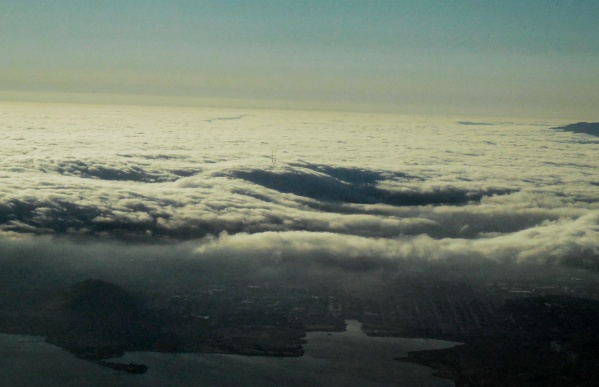
Recently, I made a trip to Seattle. As the plane took off over San Francisco, a layer of fog covered the city, and I got these cool pictures through the window.
Thanks to Sutro Tower, I knew exactly where we were.
There’s Mount Sutro Forest under there, functioning as a cloud forest and catching the moisture from the fog. And of course, Forest Knolls, enjoying a typical San Francisco summer.
About a month ago, I’d posted about a UCSF meeting regarding its plans for the Aldea San Miguel student housing. (This is the UCSF area off Clarendon Avenue just up the hill from Forest Knolls – see map at the bottom of this post.)
I attended the meeting, in the beautiful Spanish-revival UCSF Faculty Alumni Building. The gathering was relatively small. Damon Lew of UCSF said they had sent out 2,000 postcards notifying people. I guess it’s summer.
BACKGROUND
At present, Aldea is currently included in the overall “space ceiling” that restricts UCSF from expanding over 3.55 million square feet in the Parnassus area. (I wrote about those details in an earlier post, HERE.) Now UCSF wants to remove the 130,000 sq feet of Aldea housing from the 3.55 mn sq feet space ceiling. It argues that other university housing is not included in the space ceiling, and Aldea is an anomaly that could be rectified. (UCSF has actually exceeded the space ceiling for years, but seems to use it as a sort of benchmark and target.)
From what I understood, UCSF wants:
Initially, to preserve 3 dorm buildings it wasscheduled to demolish by 2024 in order to reduce square footage and bring it closer to the space ceiling. It represents 42 units of housing.
Later, it could replace them (and others of the 12 buildings at Aldea) with larger and more modern housing units – or, if it’s outside the space ceiling, maybe even with offices or other work areas.
COMMENTS FROM THE PUBLIC
Here are some of the key comments:
Dennis Antenore, a UCSF Community Advisory Group member, said he didn’t support removing Aldea. However, he thought if the community fought it, there was a real threat that the UC Board of Regents could decide to abolish the Space Ceiling altogether. If UCSF recommended that, the Regents would undoubtedly vote in favor.
Walter Caplan of the Forest Knolls Neighborhood Organization pointed out that our neighborhood would be directly impacted by anything that was done at Aldea, and he opposed removing Aldea from the space ceiling. He considered removal essentially giving UCSF a blank check for expansion in that area.
UCSF’s Lori Yamauchi responded by pointing out that even with the space ceiling, it didn’t limit Aldea to its current size; they could demolish elsewhere and expand in Aldea.
UCSF’s Barbara Bagot-Lopez said that when UCSF built housing elsewhere, it did so in consultation with the neighbors. As a state institution, they are not bound by city regulations about height limits, but they did observe them anyway out of respect for the community. So if they did decide to expand in Aldea, they would do the same thing.
Craig Dawson (Sutro Stewards, and also a member of UCSF’s Community Advisory Group -CAG) opposed removing Aldea from the space ceiling for several reasons. First, it would affect UCSF’s credibility; Aldea was included in the space ceiling for a reason, even when other housing wasn’t. Moreover, the demolition of 2 Aldea buildings were specifically included as an offset to the new Stem Cell research building, which took in 0.5 acres of the Forest. Finally, he said, it’s not a suitable place to expand housing, with no public transport or neighboring community. He also felt UCSF had not kept to the undertakings made in the previous Long Range Development Plan of 1996.
Lori Yamauchi disagreed vehemently; she said UCSF worked in good faith with the community, and though they may not have done everything they said (mainly demolition of some buildings), they were working to achieve the same goals.
Serena, a student of UCSF who lives at Aldea, emphasized how important housing was to students. She left a well-paid Federal job and came to San Francisco a full three months before her course started, only to ensure she got into housing. She pointed out that medical students make good neighbors, and add value to society. We should be supportive.
Several in the group agreed with her on both counts.
Bob (didn’t get his surname) asked what UCSF meant by “community.” Did it consider people like him, who were just residents of the area?
I thought that was an excellent question. UCSF calls the Community Advisory Group the “backbone” of its community engagement – but that’s a hand-picked group, many of whom have been on the CAG for years if not decades. It also refers to neighborhood organizations, but those often have the same structure. It’s important, in my opinion, to get the voices of the broader community – people who may not have the time to attend numerous meetings over many years, but nonetheless care about and are impacted by UCSF decisions.
Another person whose name I didn’t catch thought UCSF should keep its promises to neighbors, and consider the ripple effects of its actions on the neighborhoods – for instance, making parking impossible to get.
I am fine with delaying the demolition of the 3 dorms and preserving the 42 units beyond year 2024, but removing Aldea from the Space Ceiling is too open-ended of a change. From UCSF’s viewpoint, it probably is not worth the loss of credibility nor the potential conflict with the neighborhood. I also think it’s probably true that the Regents would agree to whatever UCSF proposes. But in my opinion, it’s for UCSF to avoid proposing something the community opposes. It shouldn’t be our responsibility to calculate whether the Regents would or wouldn’t support us.
I was surprised (and rather flattered) to find the photograph from our Forest Knolls site used on the opening page of UCSF’s presentation! For the record – I have no objection to their using this image.
SENSE OF THE MEETING
This is my sense of the meeting as it ended:
Almost everyone was opposed to removing Aldea from the space ceiling; even Dennis Antenore, who said the community should not oppose it, was not in favor. He just thought it might be a compromise.
Everyone understood the need for housing, especially below market-rate housing, for students and faculty near their place of work. Post-docs and doctoral students are paid between $32,000 and $45,000 annually – not enough in San Francisco’s rental market. It also reduces the need for commuting and thus reducing congestion and energy needs.
There was little opposition to retaining the 3 dorms scheduled for demolition.
There were concerns about UCSF and its undertakings to the community.
UCSF should not rely only on the CAG for its definition of “Community” but should broaden the viewpoints represented.
SEND COMMENTS AND OPINIONS
UCSF is in the process of making its Long Range Development Plan (LRDP), about which I posted HERE and HERE. It covers all the physical changes they plan for the Parnassus area (including of course the Aldea segment). The EIR is due out this Friday, Aug 15th, 2014. The UCSF website with all the LRDP information is HERE. They will be accepting comments on the LRDP and the Environmental Impact Report (EIR) on it to October 14, 2014.
You can email Damon Lew at dlew@CGR.UCSF.EDU and Lori Yamauchi at lyamauchi@planning.ucsf.edu
Forest Knolls would be impacted by changes at UCSF’s Aldea San Miguel housing
UCSF has announced a meeting to talk about its plans for the Aldea San Miguel campus housing.
This is a cluster of wood-shingled buildings nestled at the foot of Sutro Forest, amid tall trees and landscaping. The house of the UCSF Chancellor is also in the same complex. It’s a charming place with almost a mountain-resort feel to it. It’s adjacent to our neighborhood, lying between Cole Valley and Forest Knolls and is approached from Clarendon Avenue and connects to Parnassus Avenue by Medical Center Way, a short winding route that resembles a country byway.
BACKGROUND
UCSF is in the midst of its Long Range Development Plan, which will be valid for 20 years. They expect to adopt it in November 2014.
In the 1970s, UCSF made an agreement not to expand in the Parnassus area. The Regents voted to impose ‘space ceiling’ that limited their space in the Parnassus areas to and also not to acquire any properties in the surrounding areas. (I attended a meeting in Feb 2014 and reported on that HERE.)
Here’s some background from one of my earlier posts.
“Back in 1976, UCSF had a strategy of stealth acquisition. It quietly acquired a bunch of houses (mainly in the 4th Avenue and 5th Avenue area in the Inner Sunset), used some eminent domain, and planned to knock them down and expand. It was trashing the neighborhood, and the neighbors revolted. The battle was bitterly fought, and went all the way up to Sacramento. When the smoke had cleared away, UCSF agreed to limits to growth in the neighborhood. The UC Regents passed a resolution. This had several important impacts on Forest Knolls.
It agreed to maintain the 61 acres of Sutro Forest as an Open Space. They weren’t going to build on it.
They imposed a limit – 3.55 million — on the total square footage in the Parnassus area. If they built something new, they would knock down something else.
They defined an expansion restriction area in which they would not acquire properties (they cannot accept gifts of properties in this area either. This restriction area – the map in the photo above – includes Forest Knolls (the line ends at Clarendon).
Recognizing that the influx of people (with the transport requirements and other pressures they bring) was also impacting neighborhoods, they included a goal of limiting the population to 13,400.”
WHAT’S UP NOW?
In fact, UCSF soon exceeded the space ceiling. They’ve also exceeded the people limit. (Details HERE.) But they have kept to points 1 and 3, maintaining Sutro Forest as open space, and not acquiring properties in the restriction area.
Student housing was explicitly excluded from the Space Ceiling, with the exception of Aldea Student Housing. Now, UCSF is considering excluding that, too.
What does that mean? I don’t know for sure. I’ve heard people say it could mean knocking down the old dorm buildings, and replacing them with something more modern. Probably not prettier, if the Hall they built a few years ago is any indication. Could it also be bigger? I don’t know. It depends on how they interpret their earlier undertakings – or how they choose to reinterpret them.
Will it impact the forest? It’s possible. In the last “fire safety” action, UCSF removed around 1,000 trees and all the understory on areas around the Aldea campus. This has made the forest in these areas much drier and less healthy, especially after drought conditions.
Will it impact Forest Knolls? Now that the forest between Forest Knolls and Aldea has been thinned to the point that Aldea is easily visible from Forest Knolls, whatever they do in Aldea will have more visual (and audible) impact on our neighborhood. What further impacts it may have I’m not sure.
Here’s the meeting announcement from UCSF. If you have concerns, it may be worth attending.
UCSF’s last Long Range Development Plan (LRDP), created in 1996, was designed to guide the university’s physical development through 2012. UCSF has embarked on its next LRDP, which has an expected planning horizon of 20 years. Community involvement is a key facet of this planning process.
This meeting will focus on the UCSF Aldea San Miguel housing complex. Information regarding past agreements with the community and current proposals within the draft LRDP will be discussed.
Date: Tuesday, August 12, 2014 Time: 6:30pm Location: Faculty Alumni House, 745 Parnassus Avenue @ 5th Avenue, San Francisco, CA
UCSF strives to ensure maximum public involvement in this important planning process. With an open and interactive process — identifying the best ideas and ensuring that all points of view are considered.
The UCSF Faculty Alumni House can be accessed by several MUNI Lines: #6, #43 and N-Judah. Parking is available in the Kirkham Avenue parking lot near the corner of Kirkham and 5th Avenue.
UCSF fully ascribes to the Americans with Disabilities Act. If at any time you feel you have a need for accommodation, please contact UCSF Community & Government Relations at 415-476-3206 or community@cgr.ucsf.edu with your suggested accommodation.
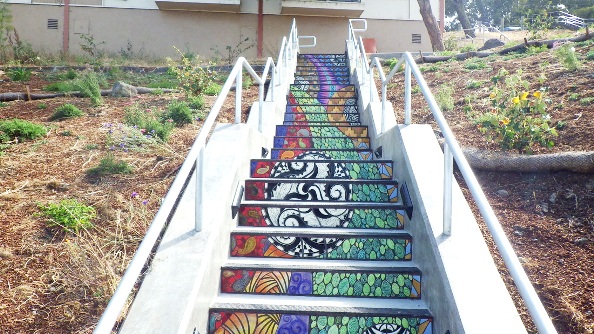
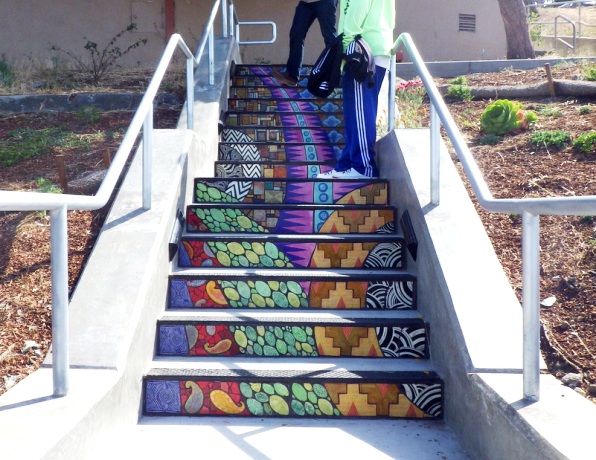
I’ve written here about the Hidden Garden tiled staircase that was completed some months ago. Before that, there was the first of its kind in San Francisco, the magnificent 16th Avenue Tiled steps, which was completed in 2005. Recently I learned, (on Facebook!) that San Francisco has a third mosaic stairway. Unlike the other two, which are quite close to our neighborhood, this is over at Innes Street, in the Bayview at Innes and Northridge.
Tony Holiday, who hikes around San Francisco and blogs at Stairways Are Heaven, attended the opening ceremony. This account below is a summary from his blog post, New Tiled Stairway. (Go there for more – and higher-resolution – pictures of this and other walks. His account of Forest Knolls stairways is HERE.)
There’s a new tiled stairway in San Francisco’s Bayview/Hunters Point neighborhood called “Flights of Fancy.” Learned about it from the Hidden Garden Steps Website (16th Ave. tiled stairway in the Golden Gate Heights neighborhood, Inner Sunset) where there are some photos. There’s some interesting info about this latest stairway art project on SF Department of Public Work’s page.
San Francisco’s third tiled stairway is named for Dr. Arelious Walker, a pastor and author who’s known for many good deeds in the Bayview community. I quote from an Internet article:
“One of the most distinguished honors a city can pay tribute to its greatest contributors is naming a street in their honor. Usually when that happens the person is deceased but in this case an exception was made and the great city of San Francisco named in his honor the street “Arelious Walker Drive” in the BayView Hunters Point and New BayView Districts. Dr. Walker is a Community Champion. His ultimate dream is to build TRUE HOPE SQUARE, a housing development with a senior citizens home, child daycare center, and a special home for those men and women that do not have any place to go when they get saved. Dr. Walker is constantly fighting to clean up the neighborhoods, keep affordable housing in every neighborhood, and to keep his dream alive so that it may come to fruition.”
During a Bayview “Sunday Streets” a few years ago I had a great time exploring some of the neighborhood’s stairways and Hilltop Park (with the big sundial) but had not gone quite as far east as is the new stairway. I’d heard of Innes St. in the Bayview as it runs off Third St. and is on the T-Third Metro line, so I looked up Innes on Google Maps to see if it runs through to Arelious Walker where the stairway is; it does not. At Innes near Hudson, this seemed a rather long walk from the T-Third. I was, however, able to attend the opening celebration with a friend who has a car. There’s a very nice city-and-bay-view from the top of the stairs and plenty of other stairways in the neighborhood that snake up to and around the residences. This area is near India Basin Shoreline Park.
While here, however, I noticed that the extremely familiar #19 Polk bus (that also crawls over Potrero Hill) stops right at the foot of the stairs. So I could’ve taken this bus without long waits for a “neighborhood bus” (as in the #36 Teresita and #37 Corbett, for example).
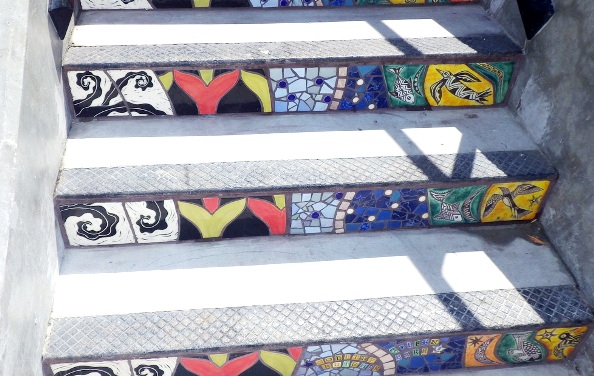
Here’s some detail from the foot of the stairs.
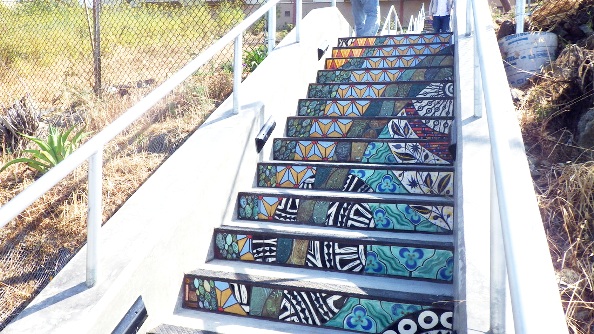
Climbing up…
And further up…
Middle steps…
It turns here.
Go see this in person!
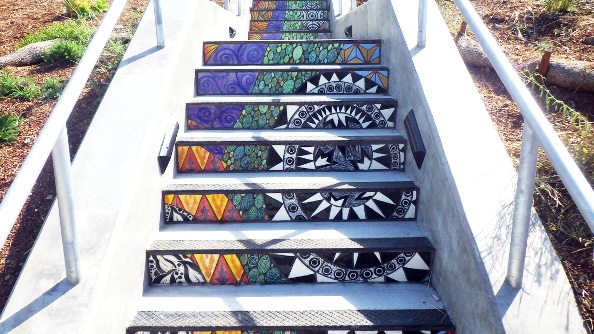
Nearing the top here…
A closer look at the designs…
Here’s what it looks like from the foot of the staircase.
I was able to get a shot of the gorgeous (and delicious) cake before it was cut.
Before the ribbon was cut, attendees were treated to some bongo playing and several short intros to — and speeches by — people who helped make this artwork possible. The plaque is at the foot of the stairs, attributing “Flights of Fancy” to artists Aileen Barr and Colette Crutcher. (SFAC = San Francisco Arts Commission.)
“The artists were inspired by decorative patterns drawn from various cultures: Adinkra cloth from Ghana, Native American painted potter; Central American textiles; Japanese and Indonesian fabrics; Middle Eastern tile patterns and paisley designs from India.”
Full moon, clear night! How often does that happen in San Francisco?
And I have a new camera, a Nikon Coolpix. It’s a pocket camera (literally, it often travels in my pocket). But it is a whole lot better in low light than the old Canon.
One of the joys of our neighborhood is that Twin Peaks is so near by. I got there just after sunset, as the city lights started to twinkle.
Others were there, too, taking photos with everything from smartphones to impressive cameras with tripods. It’s a neat thing that the full moon always rises around the same time as the sun sets.
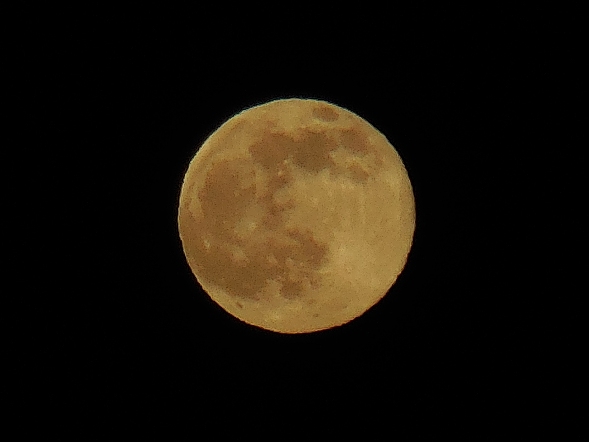
And to my delight, my camera actually could take a picture of the full moon. This is my best ever shot with a pocket camera. It’s so much better than the one I took through binoculars last month!
A few days ago, we went for a walk to Stow Lake. Golden Gate Park is so near Forest Knolls that the outing needs no planning – jump in the car and in ten minutes you’re there. On this warm Friday afternoon, it was crowded in a pleasant way with both with people and with birds. I have a new camera (I’m back to a Nikon Coolpix – wasn’t that happy with my Canon)and wanted to see what a pocket camera could do for bird pictures. It felt like the birds were less shy than usual, or maybe the crowd just provided a distraction so any one person didn’t bother them.
Night heron holds a pose
This night heron was hanging out near the water. This is the same species as the baby birds in the trees that were trimmed in Berkeley. (Those have, happily, been saved. Some day, they’ll be handsome adults like this one.)
Redwinged blackbird foraging
I also saw more red-winged blackbirds than usual, and this one was so busy eating seeds near the path that it waited to the last minute to fly away – and came back the minute we’d passed by.
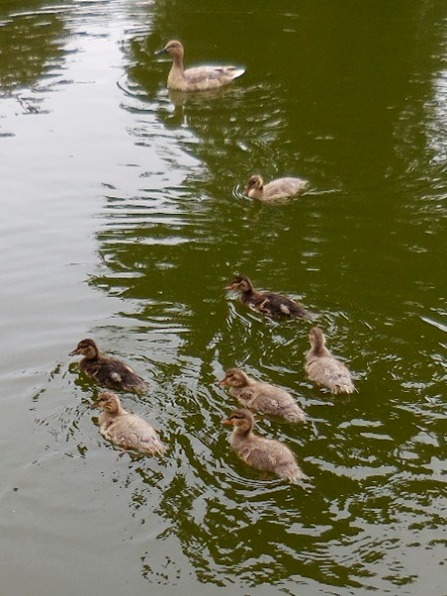
Seven half-grown ducklings still hang out with mom
These half-grown ducklings had outgrown the brown fuzzy stage, but still attracted attention of adults and kids alike.
Baby geese sleep while adults stand guard
The Canada geese had young ones, too. I love how they always have a couple of geese on guard while the flock feeds, or in this case, sleeps.
Male wood duck, Stow Lake, June 2014
There was a dramatic and handsome male Wood Duck. I looked at my bird book when I got back, and realized I’d seen him (or maybe another like him) almost exactly a year ago. The picture I got was blurry, but I’m posting it here anyway. At least it’s recognizably a wood duck! I didn’t see a female. Some years ago, I did see a female wood duck at Stow Lake, but she was hanging out with a duck of a different species.
American Robin listening for food
This American robin was apparently hunting.
Muscovy bedtime
By the time we finished our walk, the Muscovy ducks had decided to call it a day. They were sleeping under a bush But the night herons were alert. As we prepared to leave, this guy stood like a statue on the boathouse .
SFFD NERT and SFSAFE want you to have skills to be prepared for emergencies big or small, and get to know your neighbors on your block to maximize resiliency after a disaster. The San Francisco Neighborhood Emergency Response Team (NERT) is free training from the San Francisco Fire Department in how to help you, your family and your neighbors prepare for and respond to a disaster by working together.
NERT will be holding several new trainings in various neighborhoods in San Francisco during the month of June and July 2014. We find that citizens will take the NERT training outside of their neighborhoods as it fits into their schedules. Register on Eventbrite or call (415)970-2024 In addition, NERT will hold a Personal Readiness Workshop in the Ingleside and the Richmond Districts in June 2014.
The regular training sessions are once a week for 6 weeks. The 20-hour training taught by First Responders includes personal preparedness, light search and rescue, disaster medicine, shutting off your utilities, and how to participate as a member of a neighborhood response team. NERT also offers continuing training for graduates and activities that support building robust neighborhood teams. For more information, visit the NERT website at http://sfgov.org/sffdnert, or contact Lt. Erica Arteseros at (415)970-2022 or sffdnert@sfgov.org.
Bernal Heights
St. Kevin Church
702 Cortland Ave @ Ellsworth St.
Tuesdays
June 10 ~ July 15
6:30p-10:00p
RSVP for New Student – http://bit.ly/1j8BdER
RSVP for Recert – http://bit.ly/1kT8YcD
Nob Hill
St. Francis Memorial Hospital
900 Hyde St, Lower level, near Bush St.
Thursdays
June 19~ July 24
6:30p-10:00p
RSVP for New Student – http://bit.ly/1tahozD ;
RSVP for Recert – http://bit.ly/RUD317
Potrero Hill
St. Teresa’s Church
19th St @ Connecticut St
Wednesdays
July 16 ~ August 20
6:30p-10:00p
RSVP for New Student – http://bit.ly/1onD48w
RSVP for Recert – http://bit.ly/1oNQmyQ
And here are the one-day workshops:
Wednesday June 4, 2014
Supervisor Cohen hosts Sunnyside Community Center
1654 Sunnydale Ave
6:00p-8:00p
Enroll – http://bit.ly/1g1oi8m (Sorry, that was over before I got this posted)
Wednesday June 11, 2014
Supervisor Mar hosts Richmond Library Branch
351 – 9th Ave
6:00p-8:00p
Enroll – http://bit.ly/1gRWsEC
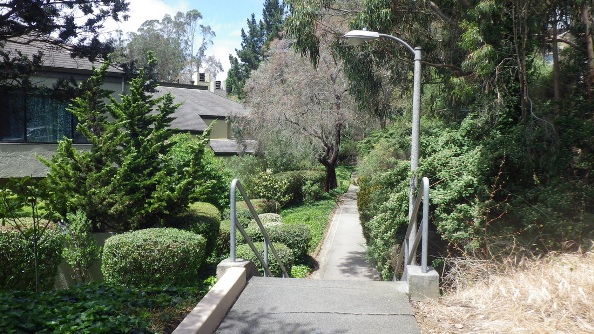
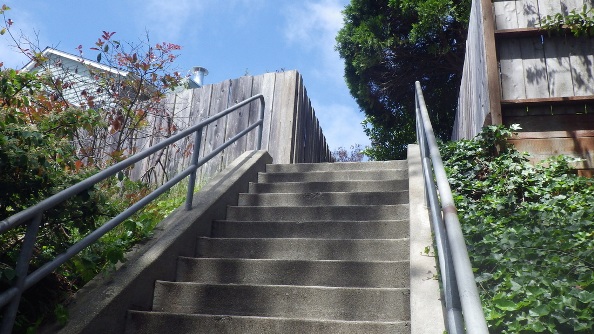
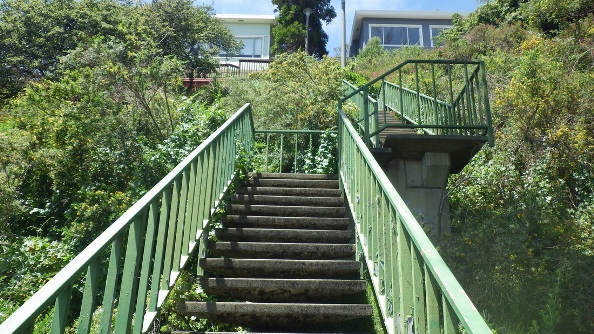
One of the charms of our neighborhood are its stairways – or “lanes.” We’ve written about them before, HERE. Recently, hiker Tony Holiday who blogs at Stairways are Heavenposted about a walk that started with Forest Knolls. His photo essay is partially republished here with permission and minor edits.
PARTIAL SUTRO STAIRWAY WALK by TONY HOLIDAY
San Francisco’s Mount Sutro has several stairways with over 100 steps. The Medical Center Way stairs that ascend from behind the hospital buildings on Parnassus total about 136. Farnsworth Lane: 149. Around on the south, east, and west sides, the Forest Knolls neighborhood has Ashwood (109 steps), Blairwood (337), Glenhaven (167), and the longest, Oakhurst Lane (353-ish).
It’s 17 steps down from Clarendon and a walkway to start.
Ashwood climbs between homes and a school [Clarendon Elementary]…
… and leads up to Warren in Forest Knolls.
That’s the school to the left.
Nearing the top here…
…Looking down from near the top of Ashwood.
At the top of Ashwood Lane, Glenhaven Lane, my next to-do stairway, necessitated a short walk to the east. Here’s Glenhaven in distance at the end of Oak Park Dr.
It’s a garden by the steps.
Glenhaven climbs to Christopher & Crestmont.
Here’s Sutro Tower viewed from Glenhaven Lane.
At the top of Glenhaven, I was planning to descend Blairwood Lane from its top at Crestmont. However, before reaching this, I got distracted by the rough dirt trailhead from Christopher & Crestmont and went up into Sutro Forest .
[You can see the rest of Tony’s hike – and more photographs – on his blog,HERE.]
The moon shines bright, which isn’t so usual in San Francisco. Very often, we have fog instead. It’s moody and wonderful but doesn’t give a clear look at the moon. Tonight’s clear (if you’re still up, take a look!)
I couldn’t help pulling out my camera. It’s a little Canon point-and-shoot, maybe just a notch above an iPhone in ability, and it doesn’t much like low light conditions. In fact, my late lamented Nikon Coolpix did a better job with moon pictures. Like this one, from April 2010.
Forest Knolls Moonrise
I even learned to get full-moon pictures with that (point it at the moon, make sure there’s nothing else in the field, and – for some reason – set it to flash).
This camera doesn’t do it. Here’s what I got tonight.
It was the more galling because binoculars that show the moon beautifully, down to the Mare Imbrium and the Crater Copernicus. So it was frustrating not to even get the markings one sees with the naked eye.
Until I tried taking a photograph through the binoculars. I lined up the camera lens and the eyepiece (which matched pretty well in size), focused and clicked. Here it is – not a sharp brilliant shot like those on Flickr, but probably the best moon picture I’ve gotten so far. I’m pleased. I think it’s okay for a PAS camera without an actual telephoto lens.































 FOREST KNOLLS NEIGHBORHOOD