Medical Center Way closed 26 & 27 Nov 2010

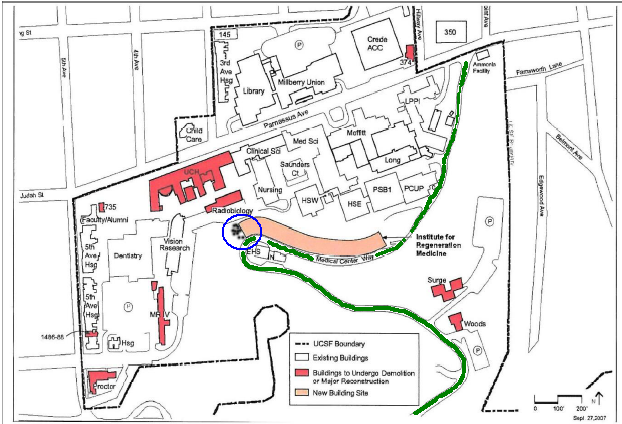
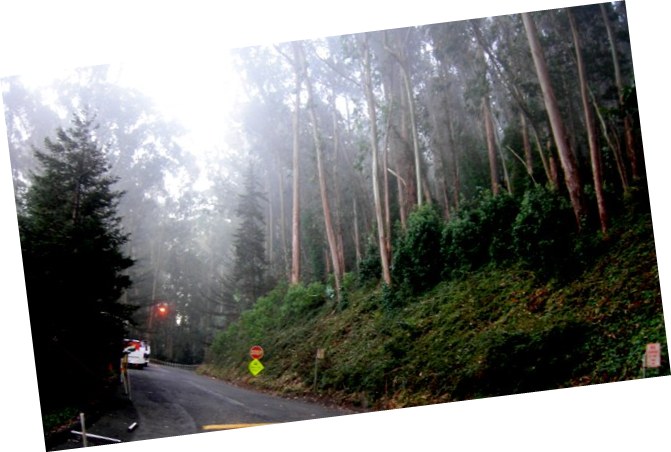
UCSF has sent out a notice that the newly re-opened Medical Center Way (i.e. the pretty Sutro Forest short-cut from  Clarendon to Parnassus) will close for two days.  From 8 a.m. to 5 p.m. Friday and Saturday, 26th and 27th November, the road will be blocked to traffic to allow heavy machinery through. They plan to re-open the road that Sunday morning. (In the map below, the green line indicates Medical Center Way.)

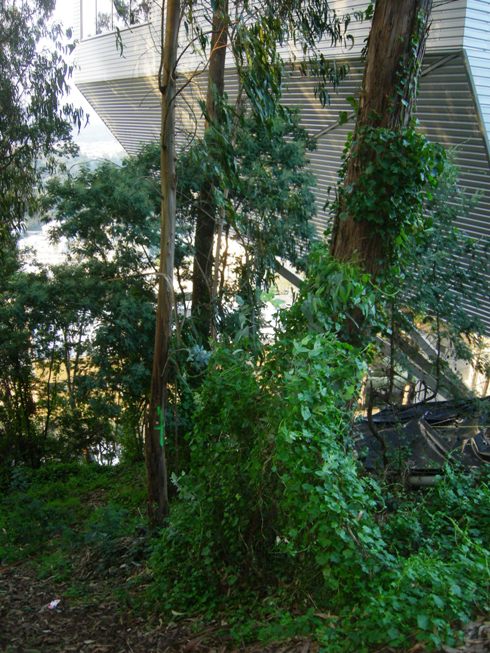
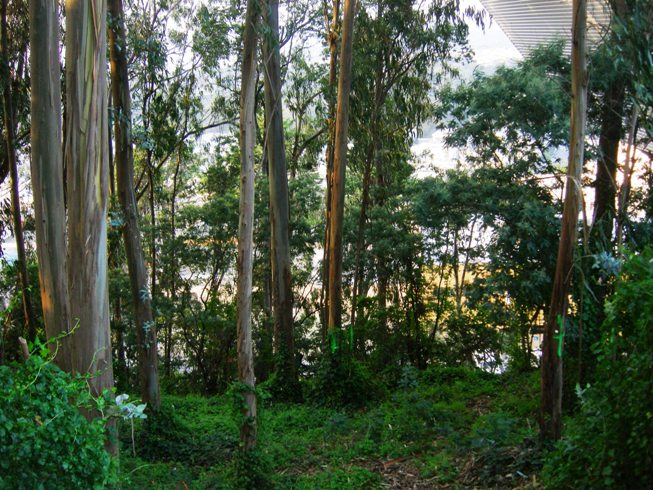
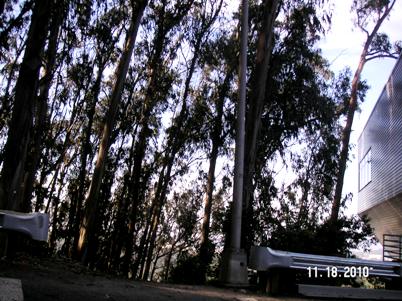
UCSF is removing 11 trees from the Western end of the new Regenerative Medicine Building (the “Stem Cell Research Building”). That’s the blue circle in the map above. The trees have been declared hazardous.


[Edited to Add Follow-up]

The trees have been removed; the road is open. Here are the Before and After pictures:

Bookshop West Portal & Simon Winchester

Bookshop West Portal (which I’ve written about in my earlier article on West Portal) often arranges author readings. This Friday evening, it was Simon Winchester talking to a standing-room only audience.

The best-selling author, Simon Winchester. In our little neighborhood independent bookstore.

Simon Winchester

Not only does Winchester write fascinating, well-researched non-fiction, he’s an entertaining speaker and raconteur. He was promoting his new book,  Atlantic. Instead of reading from his book, as authors commonly do, he told us stories: The story of how he came to write the book; the story of how he decided to structure it (it’s based on Shakespeare’s  ‘Seven Ages of Man‘); and then several stories from his book research, from places as far-flung as the Faeroe Islands, Tristan da Cunha (where he’s not allowed to land), and the Skeleton Coast. In between, he recounted how acetone was linked (via World War I, Chaim Weizmann and the Balfour Declaration ) to the founding of Israel.

Afterward, he autographed books for people. It was a great evening.

Bookshop West Portal also made an announcement about its knitting classes (and Simon Winchester has a funny story about knitting, too). The instructor’s holding some special classes for those who want to knit gifts such as scarves and fingerless gloves.

If you want to be kept informed about all the interesting authors and activities at a store only 2 miles from us — get on their email list. I’ve found this a pretty useful and painless way of staying in touch.

UCSF Parnassus Updates

UCSF’s Parnassus campus lies just on the other side of the hill. We were not aware of the existence of the “Parnassus CAG Action Team” – a sub-committee of the UCSF Community Advisory Group (CAG) – until now. On Nov 8th evening, there was a meeting to update people on several matters.

The Agenda items that were directly of interest to Forest Knolls/ Sutro Forest:

1. Clarendon Connector Trail. There is still a plan to punch a trail to Clarendon through the screen of trees that lies between Christopher and the Aldea campus. (The blue line above Christopher Drive in the map below.) We protested that the screen had already been thinned by the actions of SFWD:  A Gash for the pipeline had been cut through the trees  to the water tank; and all the trees removed behind the new Pump Station. Putting a trail through this already tattered screen of trees would be counterproductive.

[ETA: The map here is being removed, but will be replaced later … see here for the reason why.]

The justifications used were confusing.

  • The first reason was to route trails away from the UCSF campus. But the alternative is for hikers to just walk along Christopher Drive for a few yards, it doesn’t go into the campus. Second, two trails already originate on the campus: The Fairy Gates trail starts right outside the Chancellor’s House; and the East Ridge trail opposite the new Community Center. There’s no plan to close off those.
  • The second justification is that it brings hikers closer to the highest point of Clarendon Avenue, where it’s safest to cross the street to the trails on the other side because hikers can see cars coming up the hill in both directions. (It’s marked “Safe” in red on the map. ETA: Correction – the “Safe” point is not the highest point, but the place where the road narrows to half its width). But it doesn’t do that either. It only brings hikers to the same place they’d get to from Christopher.

Craig Dawson (of Mount Sutro Stewards) said they would plant the sides of the trail to conceal it from the houses along the road. We are unsure about this; the “screen plantings” meant to screen the Aldea campus from Clarendon have not been very successful, and the chain link fence remains visible there. He also said the perception of thinning — apart from the area around the pump station, and the pipeline Gash — was because ivy had been removed from all the eucalyptus trees.

2. The Community Center (to be called The Aldea Center) on the campus is expected to be ready by this summer. It will be used by Aldea tenants, the University Community, the Mount Sutro Stewards, and to a lesser extent by Neighborhood groups. A few parking spaces will be associated with it; but the main access is expected to be by Shuttle bus or hiking in.

3. The Native Plant Nursery (now called the Aldea Seed Propagation area) is planned to go ahead; the idea is to grow plants for the Native Plant Garden at the summit, and maybe for other locations. This is the pad surrounded by chainlink on the Aldea campus. It was supposed to be “planted to blend in with the forest” as promised in an agreement with the community in January 2000 and reiterated in August 2009. UCSF’s Maric Munn said there are no plans at present to do that, but use as a nursery doesn’t prevent it in the future. Apparently UCSF’s  legal department has said that since no permanent structure is planned, it can be made part of the Open Space Reserve.

4. Bulletin Boards. Two bulletin boards, with maps and rules, are to be posted somewhere in the forest (not on the campus as originally discussed at the Agenda Planning meeting). One may be at the summit; another possibly on the historic trail.

5. Bike cage. A new bike cage is to be built on Parnassus Avenue outside Milberry Union, to provide bike commuters with safe storage. Three trees in the area will be preserved. UCSF has a $50K grant for this from SFMTA, and will match it with $50K of its own; vines will be grown over the front to improve its appearance.

6. The 68,500 square foot Regenerative Medicine Building (Stem Cell Research building) at the bottom of Medical Center Way is nearly ready; move-in could be in a week. It has a green roof, currently grass, but may be landscaped with other plants later. This building will have 250 people working there. UCSF has a 3.55 million square foot space ceiling for Parnassus; it was already 4% over this and planned to reduce that excess to 2%. Instead, it’s 6% over. This will have to be resolved in the new Long Range Development Plan, which will run to 2030.

———

Other neighbors’ concerns:

Traffic and congestion on Parnassus. Despite meetings and discussions and decisions, nothing had been implemented. Someone pointed out that unresolved issues remained from all the previous discussions and should not just be rolled over into the new Long Range Development Plan (to run to 2030).

Tree felling on Stanyan in connection with the Historic Trail opening. A number of trees have been cut down on the side of the forest behind Stanyan. Craig Dawson pointed out this was Rec and Park responsibility, and thought it might be in response to neighbors’ concerns about hazardous trees, expressed at meetings about the Historic Trail.

UCSF, plans, and the Long Range Development Plan. This is about to start now; the next meeting of the Community Advisory Group is on November 29th at 6.30 p.m. at Milberry Union.

Forest Hill Tree Tour with Mike Sullivan

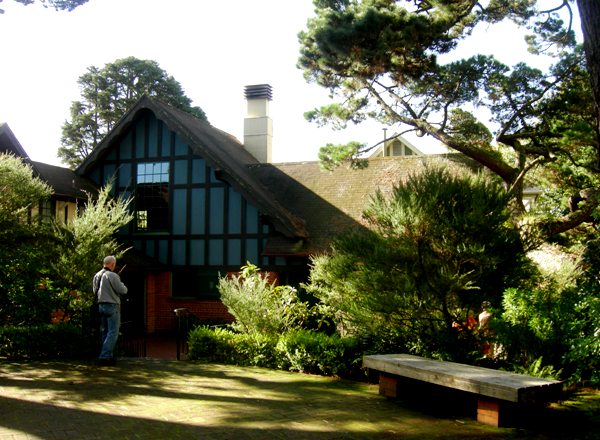
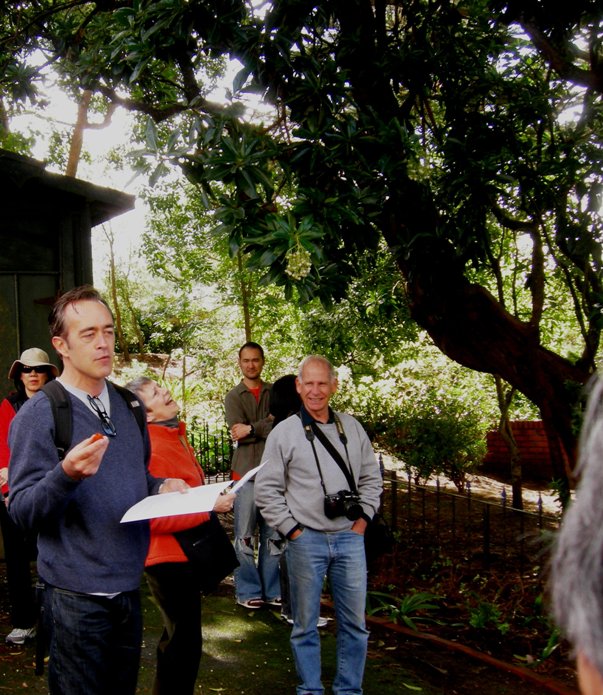
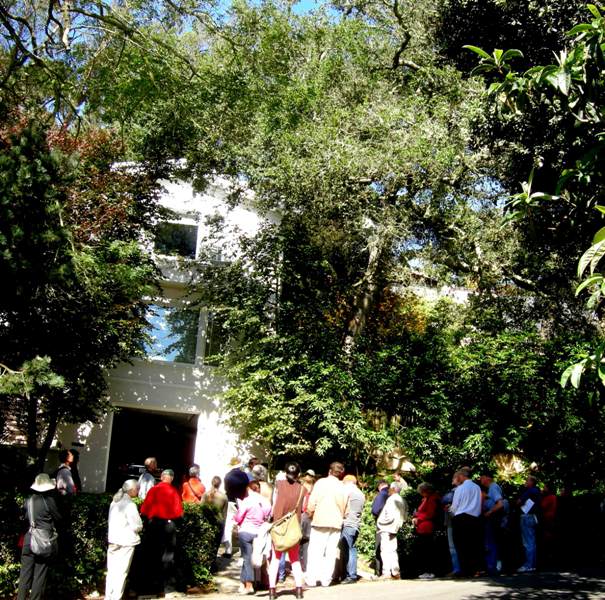
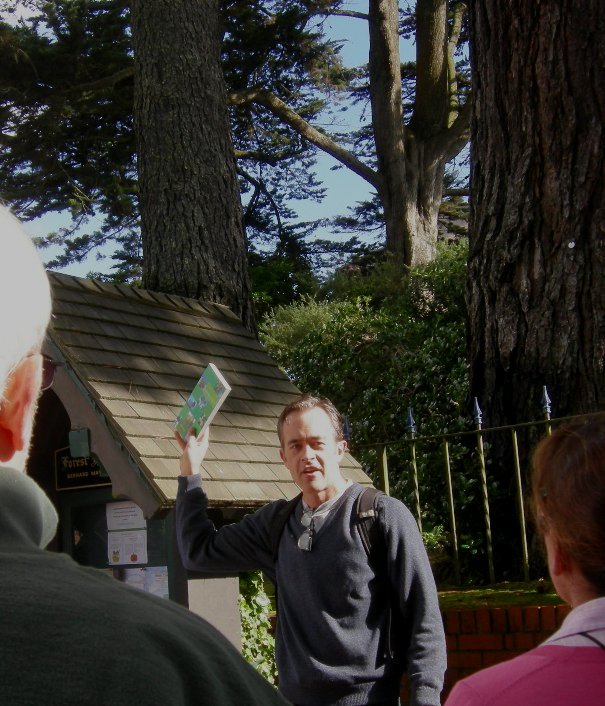
The San Francisco Forest Hill tree tour last Sunday, led by Mike Sullivan, had a great turnout. “I thought there’d be about ten or twelve,” said my companion. In fact, there were perhaps three times that number. The tour started at the Forest Hill club house, which is surrounded by big old Monterey cypress. It’s a strikingly pretty place;  the Bernard Maybeck architecture and the tall trees give it a medieval air.

Forest Hill Club House - Maybeck

Mike had autographed copies of his book available for sale; since I’d already got one and blogged about it, I passed. Otherwise, it’s an opportunity I’d have grabbed.

We moved on to a strawberry tree just up the road. It’s native to Southern Europe —  and surprisingly, southern Ireland. Mike explained that most likely, they had a wider range before, but climate change had pushed them southward. This was a common pattern: It explained the distribution of Monterey pine, in small pockets as far apart as the Monterey peninsula and San Luis Obispo. Trees changed their home ranges in response to changing climatic conditions.

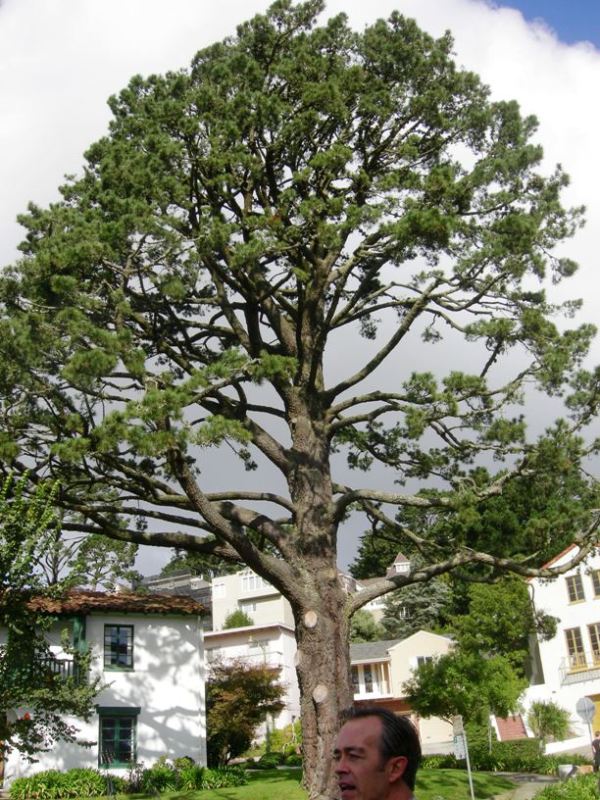
The next tree we saw was one I’ve been planning to photograph for a Memorable Trees post. It’s a Monterey Pine that towers above a white Spanish-style house. The  house is handsome, but this tree is what makes it memorable. The tree has an almost manicured appearance. It’s been well-cared for and expertly pruned.

ARAUCARIA AND CONTINENTAL DRIFT

It’s almost impossible to think about memorable trees without considering the weird Araucarias, a age-old genus of living fossils that knew the dinosaurs. (Flowering plants didn’t. The dinosaurs lived in a world of horsetails and treefern — and araucaria.) They have wonderful names like bunya-bunya and monkey-puzzle and Norfolk Island Pine (though they’re not at all related to pines).

They come from the Southern Hemisphere, from places as distant as  New Zealand to Chile in a scattered  distribution.  Mike’s explanation was continental drift: these trees were around before the continents split up, and traveled with the land masses as they moved.  San Francisco has a number of them, of various kinds (including two of the Memorable Trees I posted about earlier).

NEIGHBORS AND STORIES

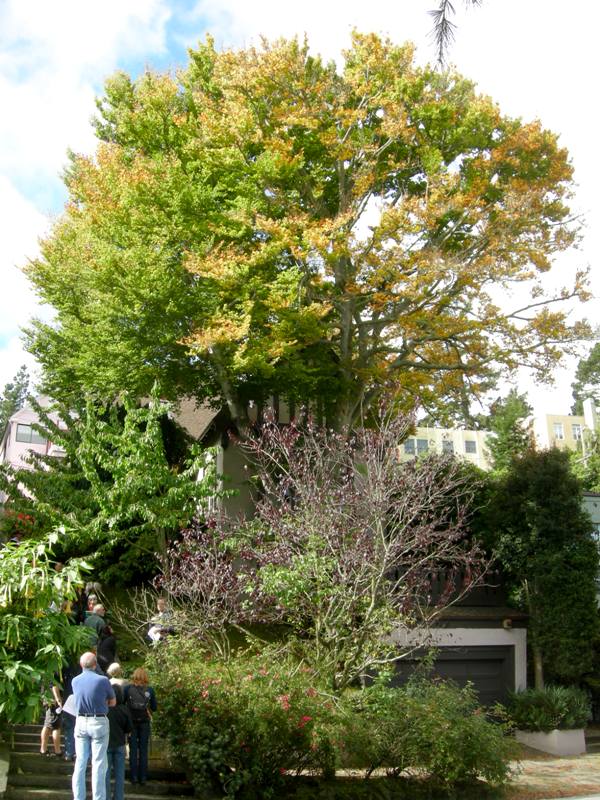
Most of the trees we saw were on private property, and some of the neighbors came out and told us about their trees. The owner of an English birch beech that I’ve often admired said the big window opposite the tree brought it right into the house, so it felt as though their living room was part of the tree.

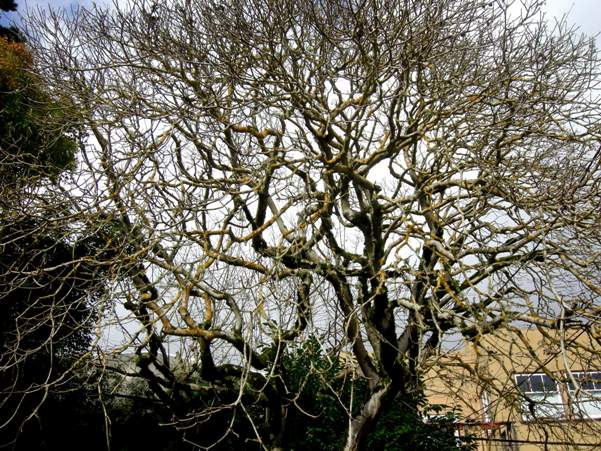
Elsewhere, someone invited us into his backyard to see a large buckeye, which was already bare – it shed its leaves as early as July – showing off the twisty branch structure. Mike told us that another buckeye is the subject of the only tree easement in the city — one that was saved from destruction when a builder bought the land on which it grows. Friends of the Urban Forest holds that easement.

Another neighbor told us about selecting sourwood trees – possibly the only ones in San Francisco – for the spot outside his home. Mike told us that the wood actually was sour, and jam could be made from the fruit. Later, we stopped to admire a rather large and twisted coastal live oak.

[Edited to Add: Forest Hill is proud of its trees; each one is tagged with a little metal accession number, and listed in a database. Someone explained that the neighborhood association cares for the trees; and will help a home-owner who wants to plant a tree to do so, free of charge. I have to say I was extremely impressed.]

One group of neighbors were trying to get support for a tree removal: A group of tall, stately, and possibly dangerous Monterey pines. They wanted to take down these trees, and replace them with smaller, younger ones.

WHAT NOT TO PLANT

One aspect of the tree tour didn’t appeal to me personally: Continual inputs about why various trees were bad. Invasive roots. Brittle wood. Dripping stamens and berries. Sensitivity to freezes. Pest vulnerabilities. (To be fair, most of these  comments did not actually come from Mike.)

I think I’d want to know all these things if I were actually trying to select a tree for a street (a process Mike noted was extremely site-specific, depending on the micro-climate, the underlying soil,  and the preferences of the owner).

But in the context of a tree-tour, a bit of a downer.

MIKE’S WEBSITE

In addition to his book, The Trees of San Francisco, Mike maintains a website at www.sftrees.com — including a list (no pictures, unfortunately) of interesting street trees by neighborhood, as well as ‘Mystery trees’ he wants to identify. It also has occasional updates about the particular trees mentioned in the book.

FRIENDS OF THE URBAN FOREST

The tour, which was free, ended with an appeal for support for Friends of the Urban Forest. This marvelous group helps plant street trees all over San Francisco.

Our Local Halloween Pumpkins

Our neighborhood pumpkin patch is at the foot of Warren Drive in Forest Knolls, at 7th and Lawton. For Halloween, the open space has been transformed into Clancy’s Pumpkins.

When I went down there to take some photographs, I found it was more than just a pumpkin sale.

The atmosphere was festive, with  kids running around, some in costume, looking for the Perfect Pumpkin.

It had  halloween decorations, a little zoo with white rabbits and white turkeys, and bales of hay stacked into mini-forts.

Of course there were loads and loads of orange pumpkins, with stocks waiting behind the scenes to replenish the stock that was sold.

And coming soon, I presume: Clancy’s Christmas Trees. Since the sign’s already up, though lined with pumpkins.

A Real Tree Tour – Oct 31 2010

Mike Sullivan, author of the book The Trees of San Francisco that I wrote about, is giving a tree tour under the auspices of Friends of the Urban Forest (FUF). This is a fairly strenuous walking tour (unlike the Landmark Tree tour, which used a fairly large bus) and it’s in Forest Hill. Here’s the information from the FUF website:


Free Tour of Forest Hill

When:  Sunday, October 31, 11am – 1pm
Description: Join us for a tour of landmark trees in the Forest Hill neighborhood led by Mike Sullivan, long-time tree tour leader, former FUF Board Chair, and author of The Trees of San Francisco. Forest Hill is one of San Francisco’s “best-treed” neighborhoods, and this will be the first-ever FUF tour of that neighborhood, so be sure to make this one! Meet at 381 Magellan (near Montalvo) in front of the Bernard Maybeck-designed Forest Hill Association Clubhouse.
Note: we will be traversing several staircases in the neighborhood, so be prepared for some strenuous walking.
Costumes optional.
This should be a great tour. Forest Hill has some really special trees.

Twin Peaks, Fog, and Invisibility

In the last week, we’ve had some dense fog, and Twin Peaks is a great place to watch it scudding in on the wind. I was up there the other day, slowly circling the peaks, when a woman in a car pulled up beside me and rolled down her window.

“Does this road only go to the lookout point?” she asked. I explained that it continued down to residential areas on the other side. I don’t blame her for asking. The fog had settled in, transforming the place into an isolated gray mountain, with little indication we were in a city. We could have driven into … the Twilight Zone.

This nearly-invisible person is walking safely on the other side of the wall


One indication we hadn’t:   joggers, dog-walkers, and bike riders. There weren’t many up there, with all that fog, but there are always a few – diehards or fog-lovers.

To them, I have a request: Please wear bright light colors, preferably with reflectors, especially toward evening. Twilight sucks all the colors out, and the fog even more so.  The dark red hoodie isn’t bright in fading light, it’s nearly black. The person in navy blue was nearly invisible, so also the bike-rider in gray. If I can’t see you easily… All it takes is one careless or distracted or confused driver to ruin your whole entire day. Please stay safe.

Reopened: Medical Center Way

Medical Center Way is open again. This is the lovely mountain road that goes through Sutro Forest, connecting the UCSF Aldea student housing to Parnassus (and is the shortest route from Forest Knolls to Stanyan). I’ve heard it called the prettiest road in San Francisco, and people have told me they take that route just for its beauty. Certainly I’ve trundled down the half-mile stretch between Johnstone and the dog-leg above Parnassus  at 15-20 mph, taking in the splendour of the trees and the scent of eucalyptus. It’s looking shorn now; a lot of the understory growth has been cut back, and some of the trees are gone. But even if not the lush wild place it was before, it’s still lovely.

A spaceship in the forest?

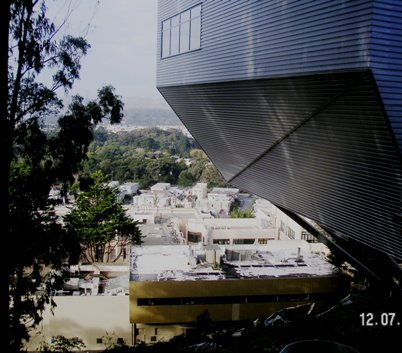
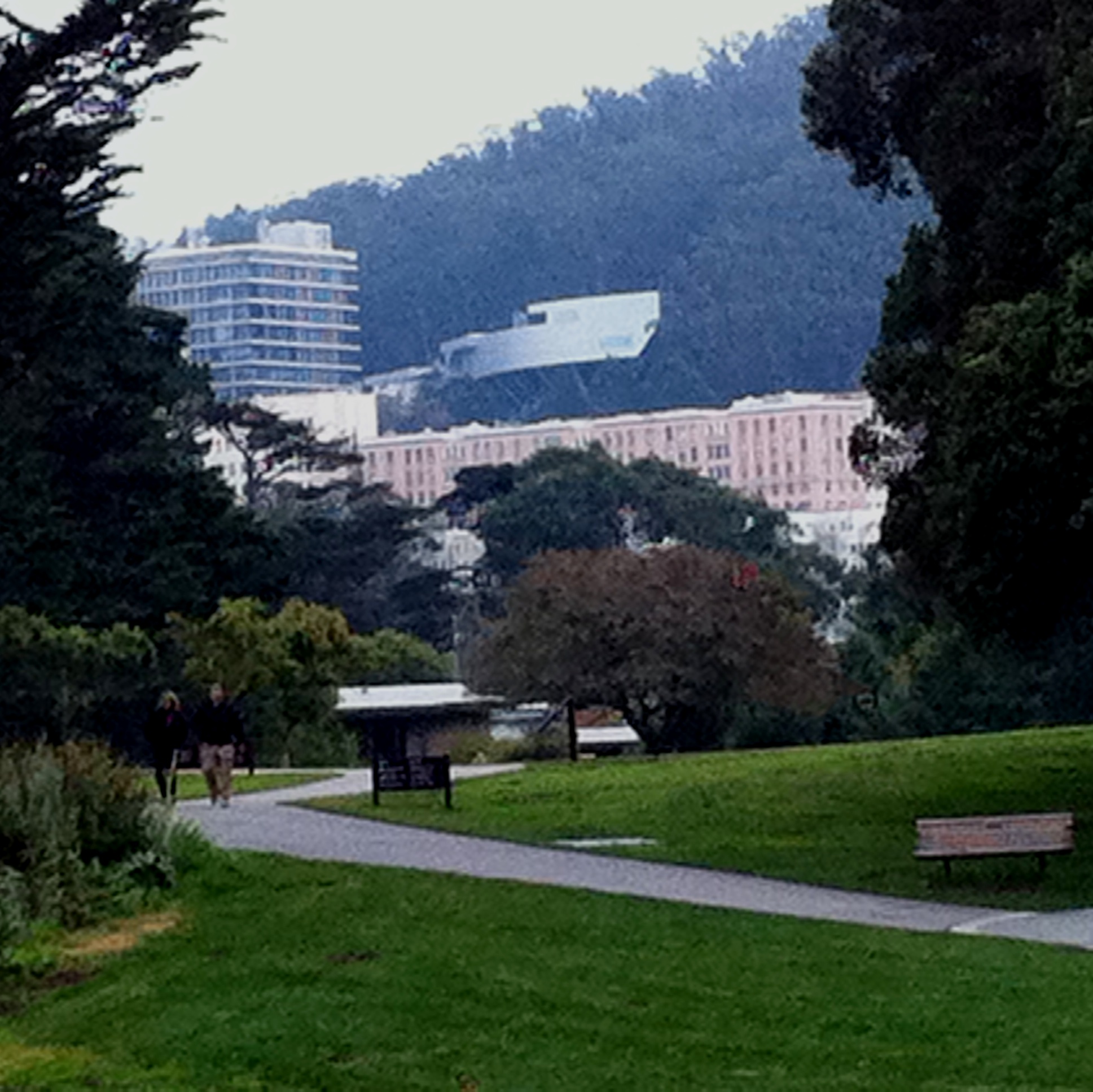
It had been closed for nearly a year, for the construction of UCSF’s stem cell research building (or rather, The Center for Integrative Medicine). That building looked amazing in the drawings, and fantastic from Golden Gate Park: like a spaceship that had landed in the forest. And someone else, gazing at the building said, “It looks like it’s been CGI’d into the forest.” (If anyone has a better picture, please send it! This really doesn’t do it justice. ETA: Thanks… this is a lot better.)

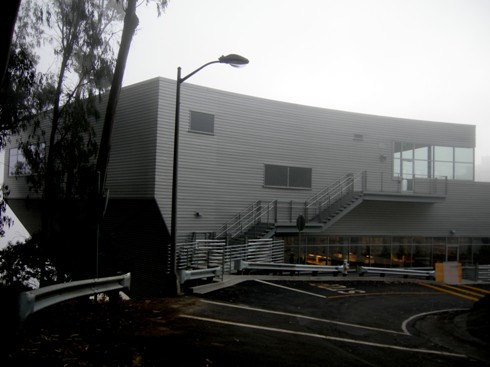
Close up, not so much. Snaking along the lower reaches of Medical Center Way, behind the hospital on Parnassus, it’s sheathed in what looks like aluminum siding. “Like a trailer abandoned by the roadside,” sniffed my companion. It does have a rather boxy, automotive appearance, like an RV or a railroad car. This is a pity, because the actual structure has a lot of interest.


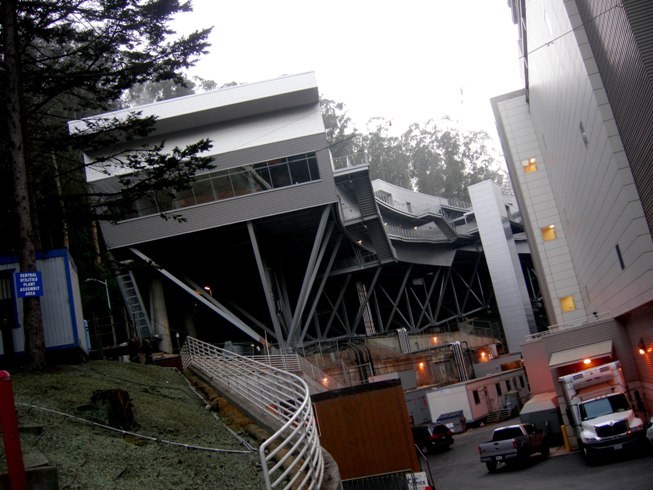
That’s visible from the loading dock side, which isn’t technically a public access area. The box curves along the road, and it’s balanced on a network of struts that isolate it from its base in case of an earthquake. With the tall trees behind and beside it, it looks somewhat surreal.

[ETA 2: Here’s another article on the building, with a lot of architectural details. I notice they’ve used our spaceship metaphor. The sincerest form of flattery! And this article is from UCSF itself.]

Cat Found in Sutro Forest

We’ve been sent a report on a new cat that has shown up in the forest in the Belgrave/ Stanyan area. It’s probably someone’s pet. We don’t have photos, hence the public domain drawing on the right; but here is the description:

“It’s clearly some sort of purebred Siamese, maybe a lynx point? Big tawny body, very Siamese face and large ears. I was wondering if you’ve heard about any lost cats? This cat must have belonged to somebody. If you hear of anything, please let me know. I’ve just spotted it once, but the construction workers have spotted it a few times. The cat seemed quite fearful, sort of slinking along atop a fence, then down into the woods.”

(There’s construction work going on at Belgrave; a home-owner on the forest edge is doing a major re-model.)

If it’s your cat, contact us at fk94131 at yahoo.com and we’ll try to put you in touch with the people who’ve seen it.

Viewing the Blue Angels

One of the neat things about our neighborhood is that it’s so close to Tank Hill and to Twin Peaks, both excellent viewing platforms for anything happening on the Bay – flying exhibitions, firework displays, or fog flow.

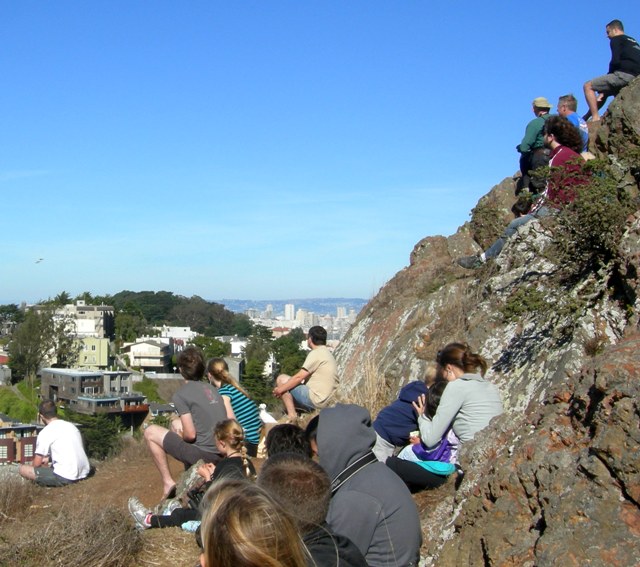
On Saturday, armed with binoculars and pocket-camera, I went up to Tank Hill for the Blue Angels. The place was quite crowded, though some people, misled by the warm day, were driven off by the strong wind before the show ended. I’d worn a windcheater, so I was fine; it was the t-shirt crowd that were cold.

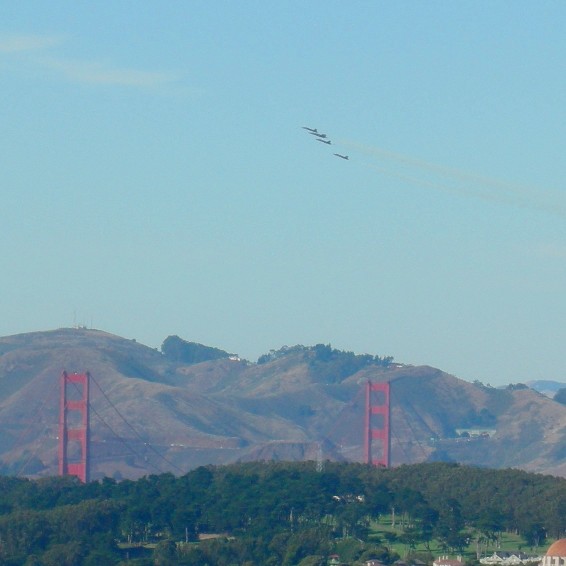
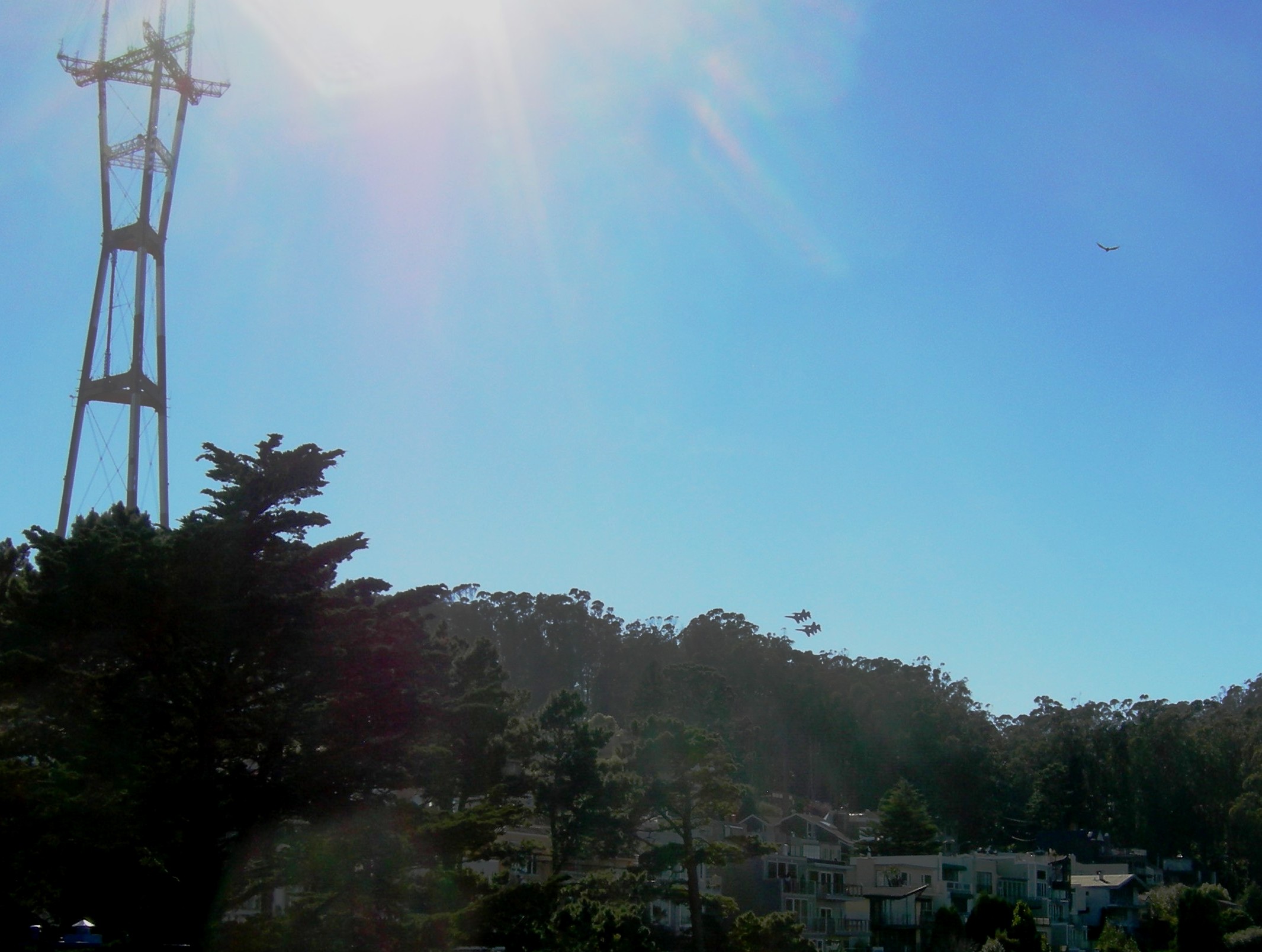
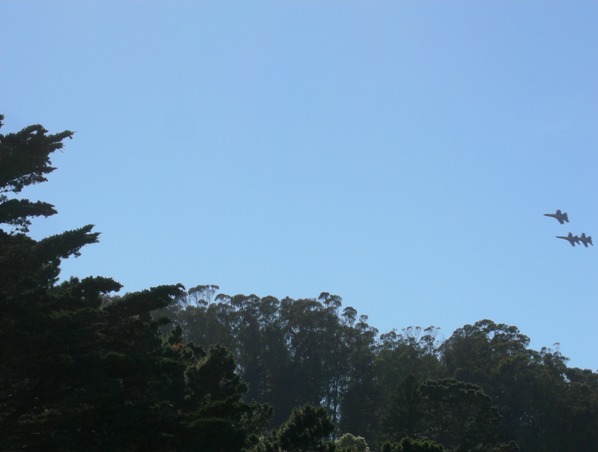
It was great. Not only could we see all the way over to the Golden Gate Bridge and the Bay, we could see the planes come by our own Sutro Forest.

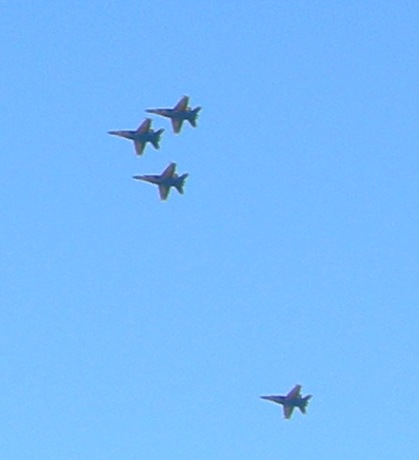
On Sunday afternoon, I actually went into the forest, even though very little of the airshow is visible from there. But a couple of times, the planes come blasting past the forest, behind the eucalyptus. There’s something surreal about it – the contrast between the very sylvan forest and the power and thunder of the most artificial thing – a jet aircraft. I got a couple of poor-resolution photographs, but a spectacular experience.

UCSF’s Temp Cellphone Antennae

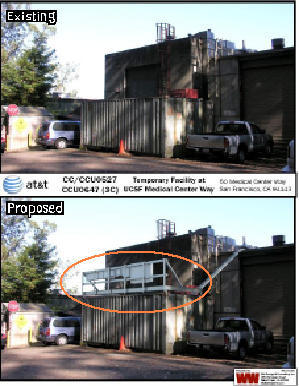
In order to improve AT&T cellphone coverage in the shadow of Mt Sutro, UCSF is adding two temporary cellphone antennae: One at 400 Parnassus Avenue (which is down on their campus) and the other about halfway up Medical Center Way, quite near Edgewood Avenue. They’ll be on the roofs of existing buildings, and no trees will be felled on Medical Center Way to accomodate the antennae. It’s not overly visible (see the picture for a simulation, taken from UCSF’s Q&A pages). The temporary antennae will help AT&T coverage immediately.

A permanent installation is planned in about a year; that may be larger, and cover three providers. UCSF is looking at AT&T, T-Mobile, and Verizon.

Damon Lew, from UCSF’s Community Relations Office, sent out this message:

“To improve cellular phone service for doctors, nurses, patients, visitors, and staff of the UCSF Parnassus Campus, temporary cellular antennas will be installed on the Ambulatory Care Center at 400 Parnassus Ave. and on the Environmental Health & Safety facility at 50 Medical Center Way. Permanent equipment will eventually be installed to maintain good cellular telephone coverage and we will keep the community informed as the project proceeds. Installation of the temporary cellular antennas is scheduled to begin October 11…”

More information about this project can be found here:  http://community.ucsf.edu/pdf/Parnassus_Campus_Temporary_Microcellular_Sites_Questions_and_Answers.pdf .

If you have further questions about this project, please contact me at dlew@cgr.ucsf.edu or (415) 514-2651.

Muni, Clipper and Me

On Saturday  (2 Oct 2010) I took the Muni downtown from Forest Hill Station. I do this often enough that I know the drill, but seldom enough that I don’t carry a pass – or have the correct change. I always need to use the change machines.

But on Saturday they were out of service. Every single one was blocked with yellow tape. I looked at the station-master in puzzlement. She waved me over to new ticket machines on the other side of the station. Those didn’t need the exact change, they worked with credit cards. And they issued paper tickets at $2 for a single trip, $4 for a return fare.

Whatever happened to the transfer with the 90-minute validity? I wasn’t sure.  (It was academic, anyway. I was meeting friends for lunch; it would take more than 90 minutes.) After a little fumbling, I got a return ticket. It had a nice picture of the ballpark on the front.

On the back were a couple of icons indicating how to pay (just tap your card on the reader); and some fine print.

I couldn’t figure out what was meant by “A 90-minute transfer will be calculated automatically from initial time of entry.” I went looking on the SFMTA website, but that was some miles away from being crystal clear…

By contrast, here’s what the old-now-obsolete transfer said on the back:

That’s crystal clear.

So anyway, I called 311, and within a minute or two (at 11.30 at night!) got a helpful lady who assured me that I could use the colorful-but-baffling ticket in exactly the same way as the old Muni transfer. It really was valid for 90 minutes from the time of entry, so if I took a short trip downtown, I didn’t have to buy a return ticket.

I’ll be trying it out one of these days, and will update this post then. I might even break down and get a Clipper card. It’s the San Franciscan thing to do. [ETA: It works. It’s valid for 90 minutes, no problem.]

(Other than that confusion, things were going reasonably well. Transit staff were on duty everywhere telling people what they needed to do.)

Tree-hunting in San Francisco

I’m not going to call them “Landmark Trees” since that term’s already taken. I was thinking of “spectacular trees,” but Donna in comments asked, What defines a spectacular tree ? That’s an important point. Size? Location? Species? Appearance? There’s no easy way to say.

So what I’m going to call them is Memorable Trees. They’re the trees one notices and remembers. We’re lucky we have many of them around. Here are a few, all from around the West Portal area. They’re all, as far as I know, on private property. I hope their owners find them as remarkable as I do.

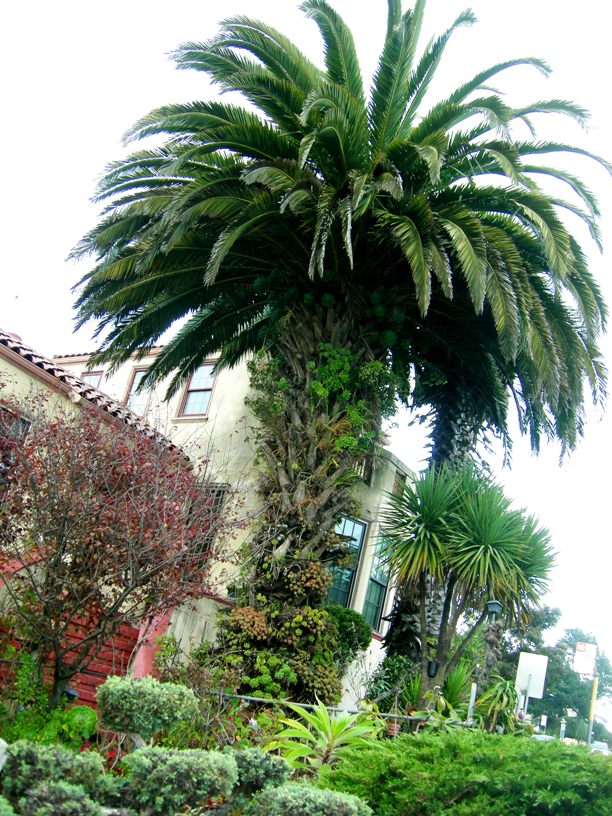
This palm tree is one of several on Portola Drive. They’re so unexpected in this foggy part of the city, but they seem to be thriving. This one in particular is amazing because its trunk is covered in other plants, mainly succulents. It’s not just a tree, it’s a garden in itself.

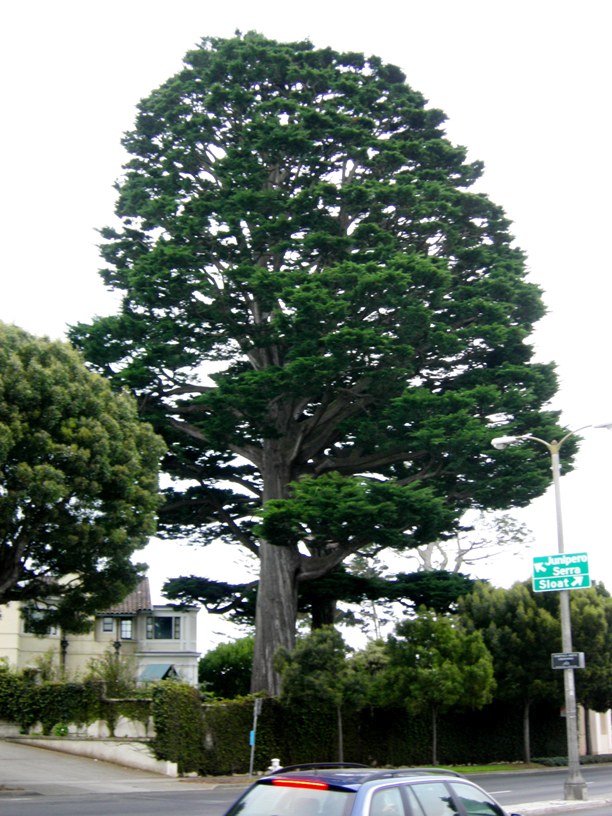
This humongous tree is on Portola, too, just before the Junipero Serra/ Sloat split, at the entrance to St Francis Wood. And what better guardian could the neighborhood have?

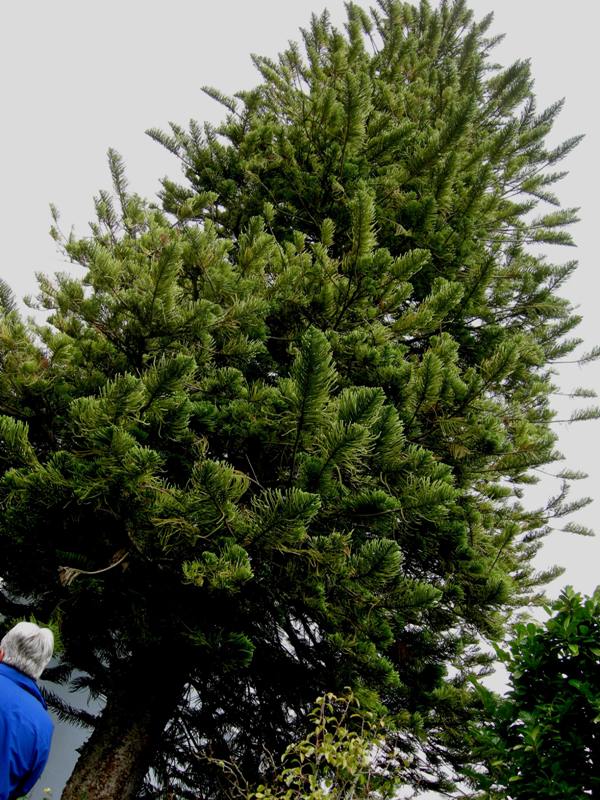
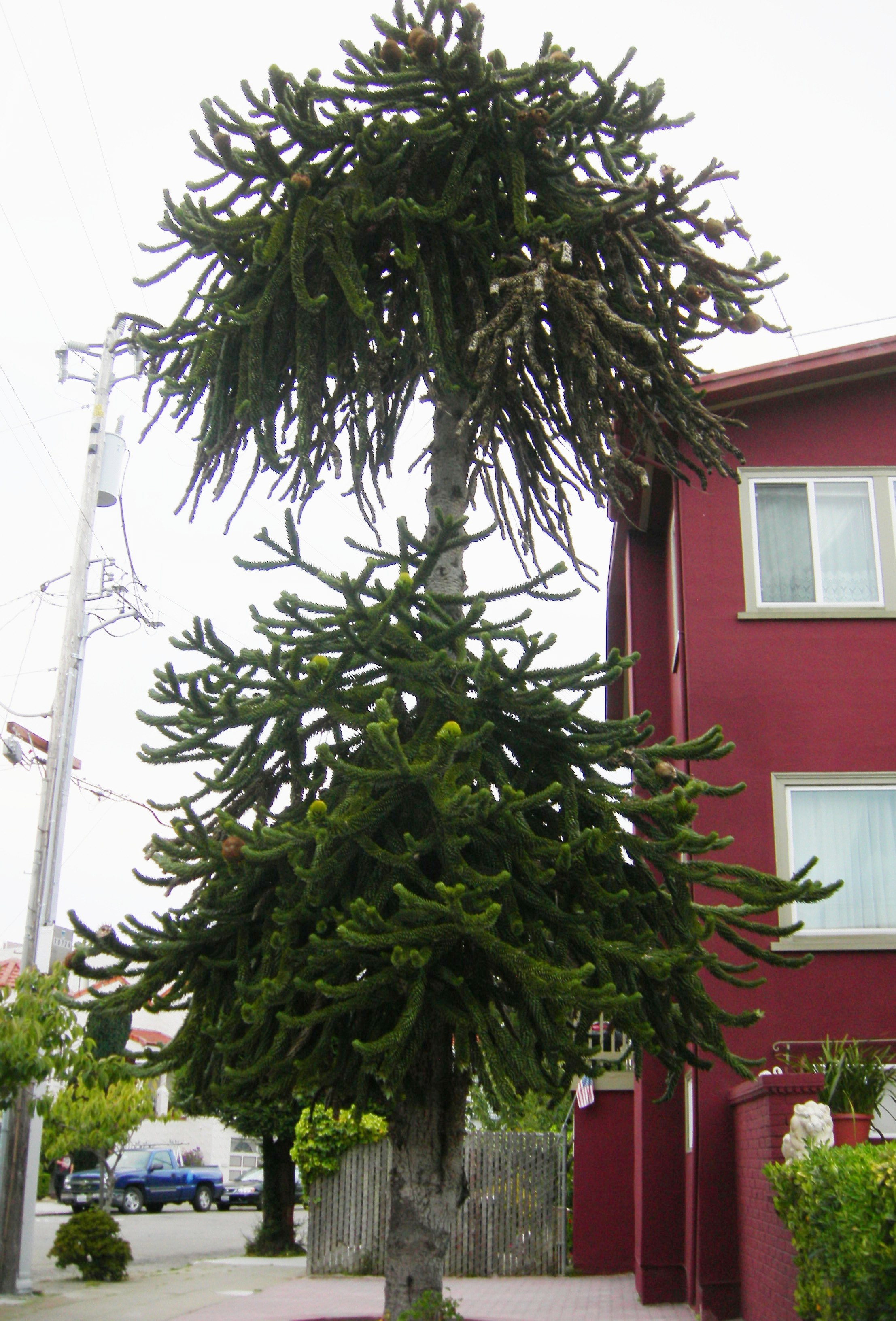
I’ve long been beguiled by this tree’s dramatic and unusual shape. An araucaria of some kind?  It has big spherical fruit. The owners like it (I complimented them on it when they were re-doing their yard). But I can’t see where its water is coming from, surrounded as it is with brick and pavement. Hope it lives long and prospers.

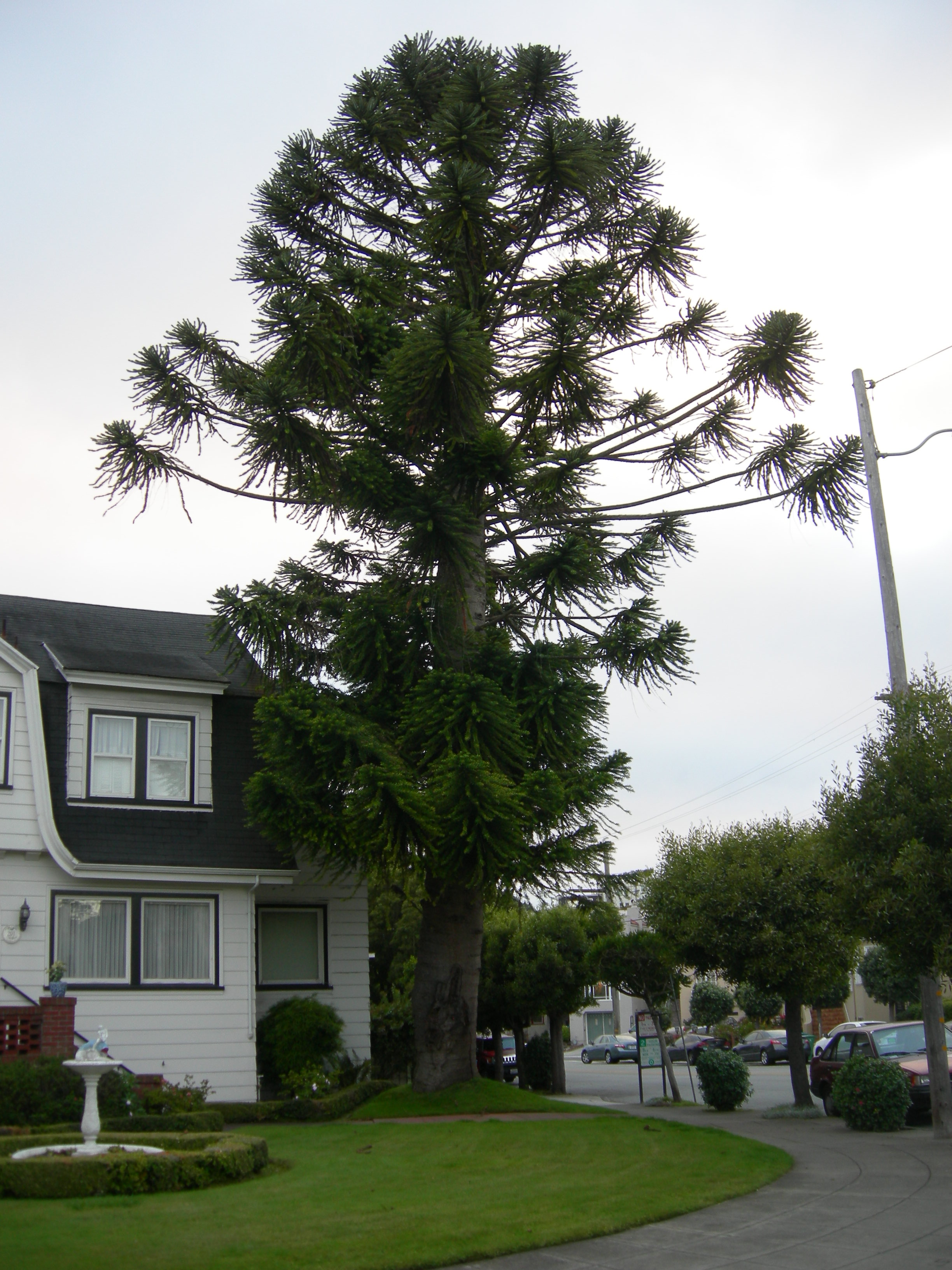
This is another dramatic tree on Wawona. I love the contrast of the very traditional European-looking house with fountain and trimmed lawn, and this unusual tree.

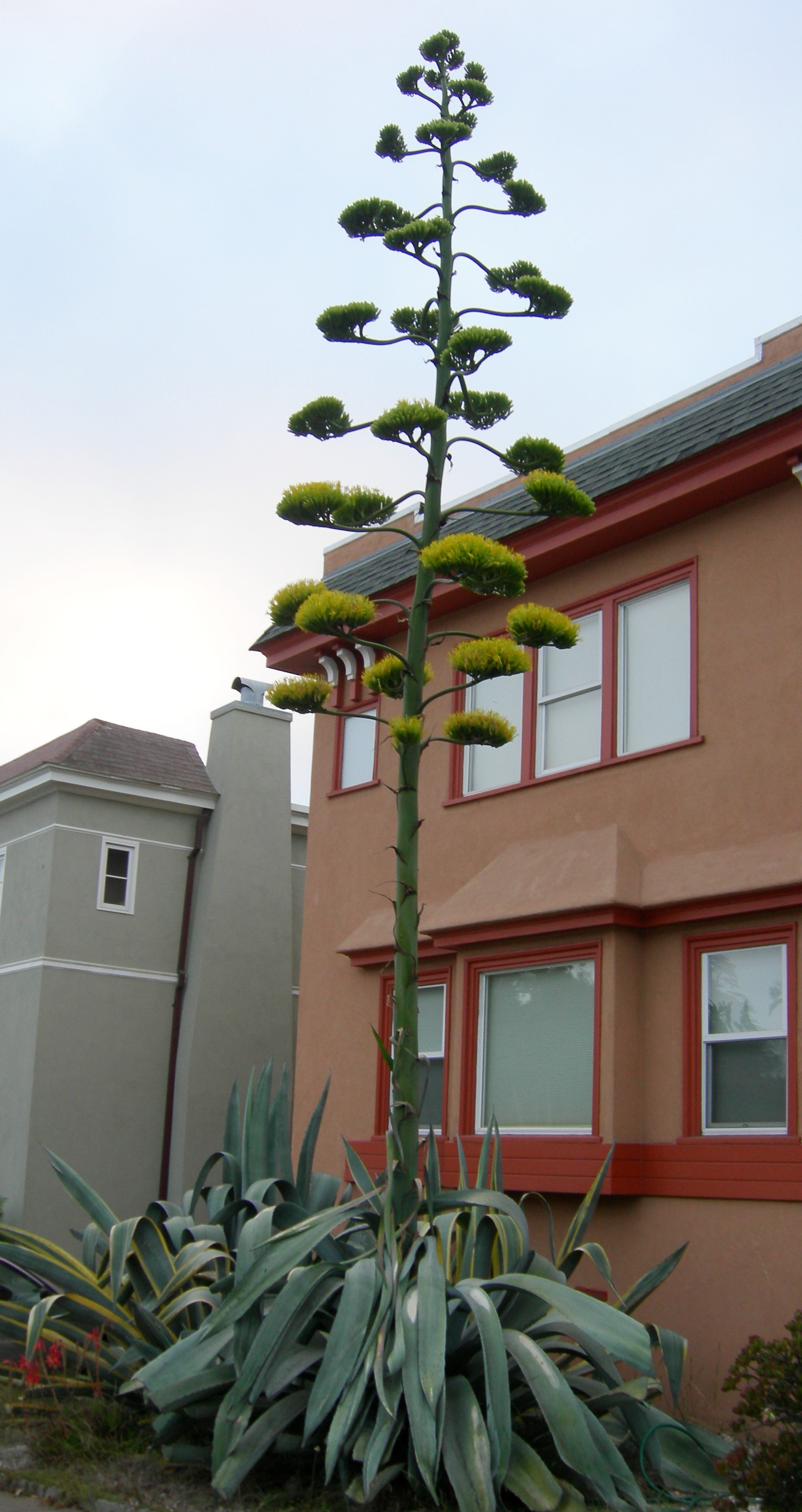
And the final picture for today (also from Portola)  isn’t a tree at all. It’s a flower spike taller than a double-storied house.

Critter-Spotting on a Foggy Night

A foggy night in a city that knows how to keep its secrets… and me, prowling along in my little car, hoping it would share them. Not the kind of secrets found in City Hall or downtown in the dark alleys… critters.

Foggy nights are often good for critter-spotting. On Panorama Drive, I saw a trio of raccoons chase each other across the road and disappear into the shadows between two houses. And then, on Twin Peaks, which was densely swathed in fog, a barn owl!

I’ve been wanting to see one, ever since learning that they do inhabit San Francisco. This one was sitting by the side of the road, like a large white cat wanting to thumb a ride. Cursing myself for forgetting my camera, I stopped the car and put my flashers on to watch it.  I was afraid someone coming fast round the bend might take it out, and wished it would move. It walked down the road a bit, which didn’t help. Two cars went around me.  Then the  owl took flight, just a few feet, but thankfully onto the hillside.

I went home for my camera, but the owl had moved on. At least it wasn’t roadkill.

On Sutro Tower

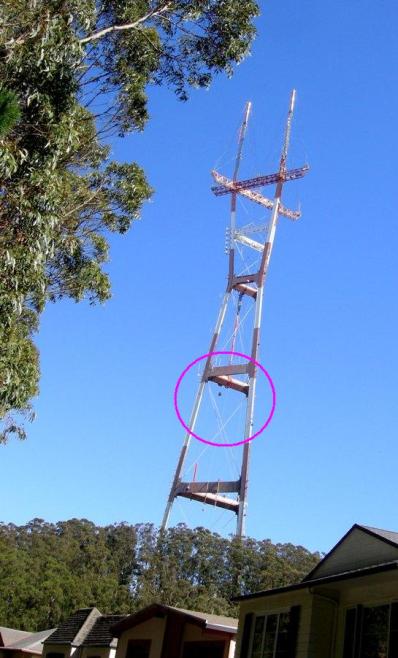
It sometimes happens in Yosemite. You look up at a sheer cliff, rising straight up from the valley, and realize … that small moving black speck? It’s a person up there!  The other day, looking up at Sutro Tower, I had a similar feeling. There was something small and black suspended from it, moving.

Sutro Tower, with worker

As I continued to look, I realized it was indeed a person,  riding in a basket or gondola or whatever it’s called, suspended by ropes high above the city. I’m sure he (or she) was getting slammed by the wind. But what a view!

Worker on Sutro Tower

Furry Grass Near Forest Knolls

I thought I was the only one who’d noticed the fabulous grass on the roadside between  Junipero Serra and Randolph, next to a gas station. It’s an intense green, and instead of being mown short, it looks like long green fur. I pass it frequently on my way back from a southbound trip, and I always admire it. It’s such an unlikely location for such a beautiful planting. There’s a constant flow of traffic, and a few years ago, a shooting.

But of course I wasn’t the only one who’d noticed, and I was delighted to see an informative article in the Chronicle (in Pam Pierce’s column) in response to a reader query. It’s a fescue sod planted by the San Francisco Water Department’s Jerilyn Downing about 10 weeks ago. It doesn’t require much water once it’s established (it did have to be irrigated quite heavily initially), and it’ll only be mown twice a year. Ms Downing recommended a UC Davis publication on no-mow fine fescues by Ali Harivandi. (It can be downloaded as a PDF file: #8391 in UC Davis’s catalog.)

I thought I’d get a photograph for this post. There’s no parking right there, but I made a right turn onto Randolph, found a place to squeeze my car in, and wandered along the street. It looks wonderful. I really hope it works out. But a few weeds are finding their way in already. It may be at its loveliest right now.

So next time you’re coming back from Serramonte or Pacifica or the airport, and the light changes against you at the intersection of 19th and Junipero Serra – rubberneck the grass.

#############

[ETA August 2011: There’s a followup story, a year later, on this site.]

#############

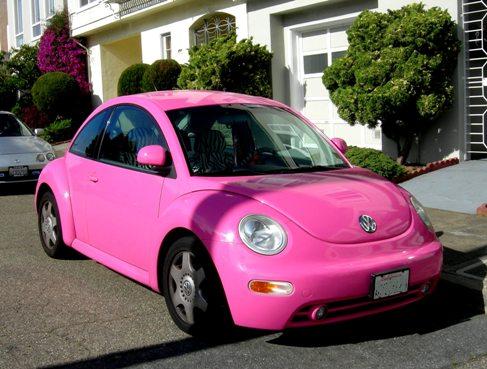
[Edited to add: Oh, and as a bonus – while I was photographing the grass, I encountered the pinkest car I’ve ever seen. And it had zebra-patterned upholstry…]

Mount Sutro Cloud Forest Hike

It’s been a foggy summer, and here in the Fog Belt, it’s been like living inside a cloud.

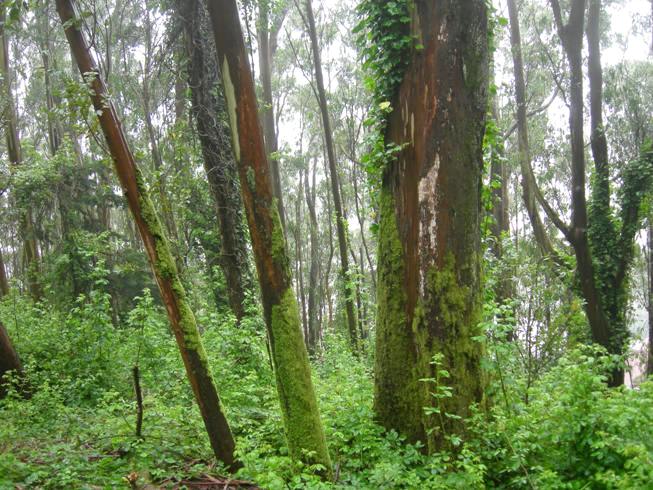
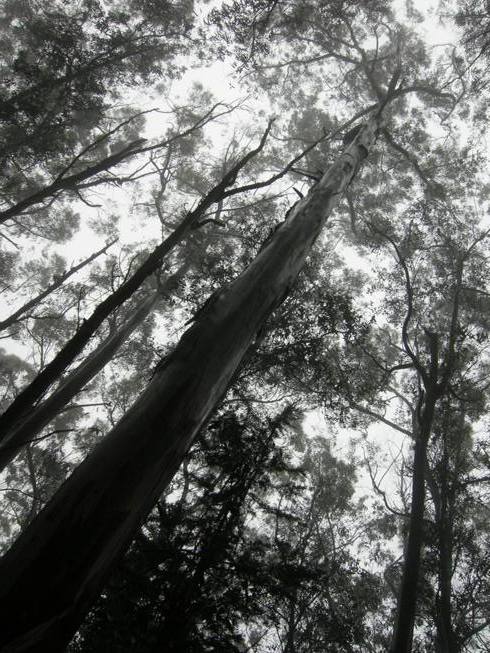
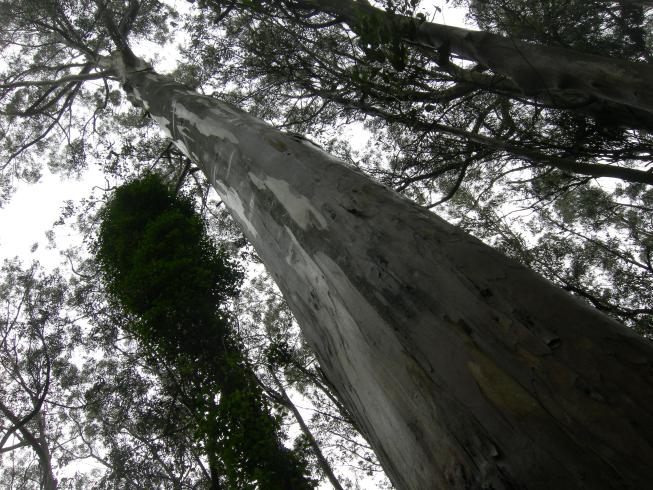
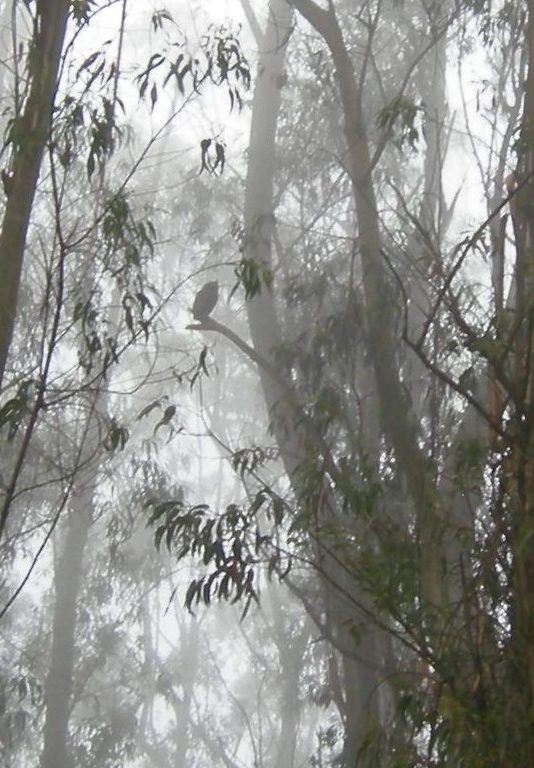
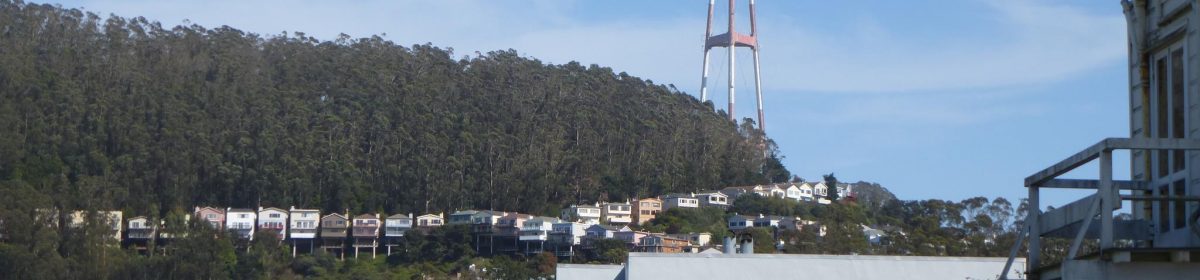
It’s the perfect time, if you like mysterious ethereal forests, for a walk in our neighborhood Cloud Forest. On a foggy day, it may be the most beautiful place in all of San Francisco .

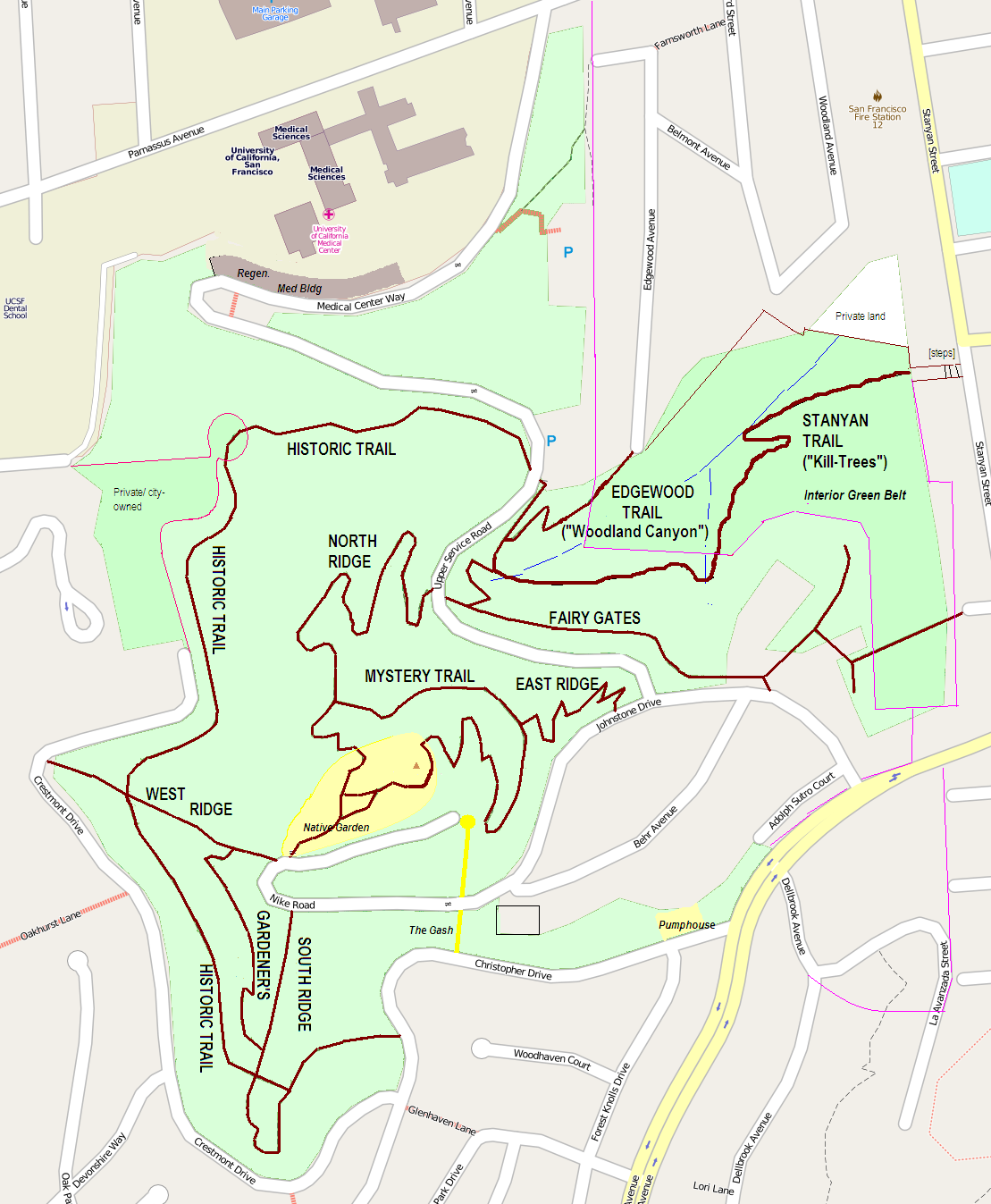
So for those who haven’t done it before… here’s my personal guide to the forest.

There are several ways to approach the forest from our neighborhood, but I’ll divide them into the Adventurous and the Easy. On foggy days, you could describe them as Wet and Dry. Generally, there’ll be few people on either set of routes (though maybe a few more on the Easy ones).
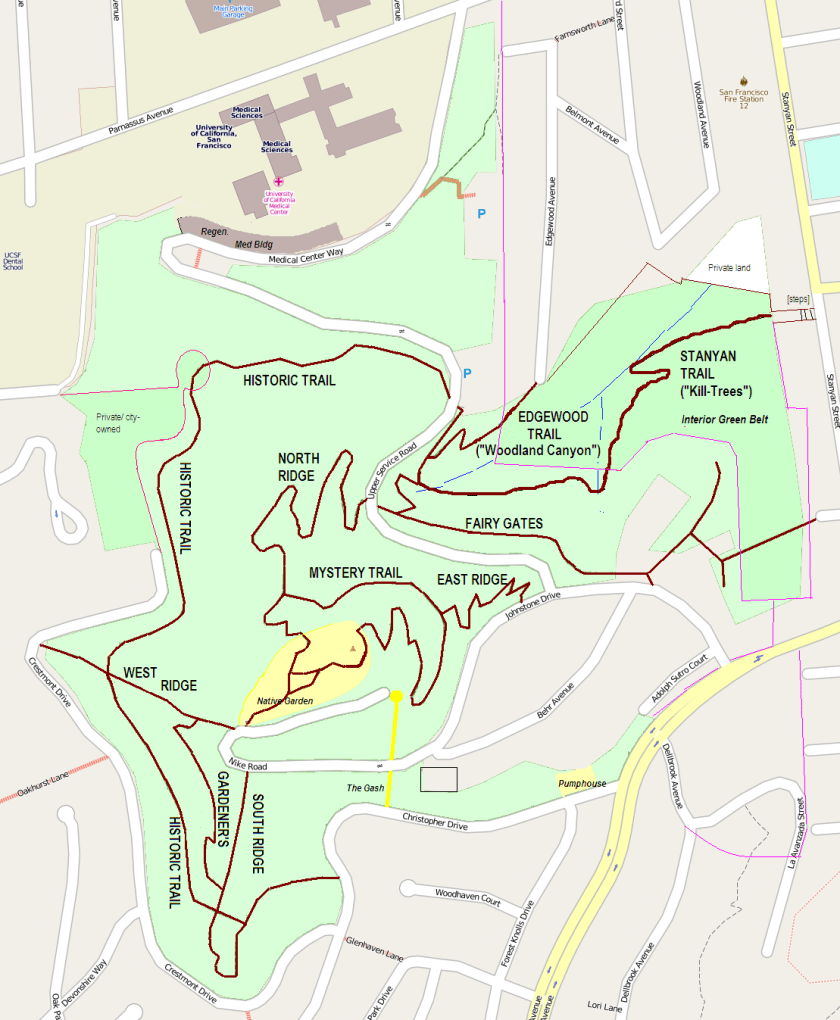
If you double-click on the map above, you get a larger one that can be printed out. (There’s also a Sutro Forest trail map as a PDF file at Pease Press Cartography.)

THE ADVENTUROUS ROUTES

The two routes that lead directly from Forest Knolls are what I call adventurous, for two reasons.

First, access is very steep, especially for the first part of it. It involves scrambling up a trail. It’s not inaccessible by any means – I’ve been up there with neighbors in their sixties. But … it’s not a walk in the park. Also, it’s easier going up than coming down it, so you might plan a route that returns by a less steep path.

Second, on foggy days, it leads into the deepest Cloud Forest. This is actually my favorite part, but it’s Wet. The ground can get very slushy indeed, and I often return with much mud on my shoes and jeans.  Sometimes, the narrowest trails can become boggy.

The first route starts with a few steps opposite 365 Crestmont. On the map, it’s the West Ridge Trail. It’s narrow and you may need to go carefully, moving back blackberry stems as you go. (And be aware there may be poison oak around.)

The second is the access to the South Ridge, opposite 101 Christopher, between the lamp-post and the chain-link fence (fenced radar site) hidden among the bushes. It may even be a little steeper.

There’s also another access point on Crestmont, about halfway between these two, but I think that’s maybe unofficial. It seemed to have more poison oak, too. And finally, I have sometimes scrambled up the Gash left by the SFPUC’s water-pipe replacement (on Christopher) but I don’t recommend it because it’s very steep.  It brings you to the Aldea campus.
THE EASY ROUTES

The “dry” routes, which are still lovely but don’t feel as wild, start out in the Aldea Student Housing. If you want to drive up, you can sometimes find parking on Clarendon Avenue next to the campus. There’s no public parking on the campus itself.

Here again, there are two options.

1)  If you go uphill on Johnstone and then along  Behr, you will come to a chain blocking vehicle access. That’s the Nike Road, and it’s wide and paved. If you follow it to the top (this is a pretty short route) , you will find the Native Garden, officially the Rotary Meadow. It’s about 3 acres of shrubs, (which are green this time of the year) and grass (which is brown). It has  wide gravel paths, and is surrounded by the forest. You can investigate some paths with an easy out if it becomes too steep or slushy.

2)  The second option is the Fairy Gates trail, which starts on Johnstone, right in front of the Chancellor’s House. (That’s the very elegant house opposite the lower intersection of Johnstone and Behr. Do stop to notice the stand of redwoods right there…) This trail is pretty dry, not too steep, and quite broad except where it goes between two rocks (the “Fairy Gates”). It used to be more wooded in feeling, but some trees have been removed on either side and it’s now very open except at the beginning. It offers views of the forest in the ravine below, and has nasturtiums blooming along parts of it. It ends on the road through the forest, Medical Center Way. Though that is open to traffic, it has sidewalks. Also, not much traffic goes that way, especially not now when the bottom end is closed for construction. [ETA: It’s reopened. Watch out for cars, but there’s still not much traffic.]

If you feel like checking out the forest a bit more, the bottom part of the Historic Trail is also relatively dry, though if you follow it to the top it takes you back into the clouds. The Edgewood Trail will take you down  into the Edgewood neighborhood. It’s steep but not very muddy. This area has some huge trees and interesting terrain.

3. [ETA June 2011:  There is a new trail now from Stanyan (just above 17th) that climbs up to Medical Center Way. Of course, you can also take it in the opposite direction. Though it’s a climb, it’s quite broad and easy to hike. Its bottom end starts with a wooden staircase between two houses; the top end connects to Medical Center Way.]
OTHER TRAILS

These are many other trails, of course.  Exploring the whole mountain probably wouldn’t take more than 3-4 hours. The rule of thumb is that in areas where the forest canopy is open and the undergrowth thinned, the trails tend to be dry (and sometimes slippery with dust and dry leaves). Where it’s closed, and the undergrowth remains, it’s usually damp or wet (and sometimes slippery with mud). Dress warm on foggy days, and expect it to be quite cool even on warmer ones. I always wear long sleeves, jeans, socks and walking shoes I can get muddy. (It also helps in case of poison oak… haven’t been hit by it yet, in all the time I’ve wandered around in there.) There’s a checklist here.

Despite all these warnings, this is a pretty accessible forest. To me, it’s completely worth it to be among those tall trees, their tops in the gray mist while inside the forest it’s fresh and green in the dimness. Birds don’t sing much in the fog, but there’ll be the odd tweet or rustle. Sounds get muffled. Usually, there are few people around. It’s the wild part of the woods. If it’s twilight, you might hear or see the Great Horned Owls.  For those who enjoy a little walk on the wild side, one of the best features of Forest Knolls is the forest.
Landmark Tree Tour

Last Saturday, SF’s Department of the Environment had a 3-hour bus tour of Landmark Trees and I went.

It wasn’t what I expected. I thought we’d see maybe the city’s most spectacular trees, on a cold foggy day. What we got was a bus ride through parts of the city I don’t usually see, a visit to a few trees, some fascinating local history, and the Quesada Street community garden. And really nice weather.

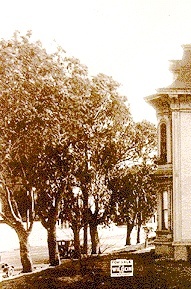
The same trees, late 1920s

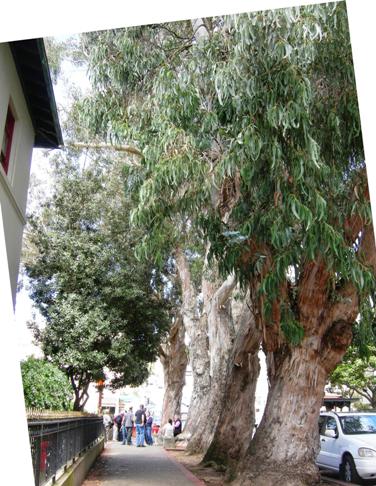
We started with six old eucalyptus trees planted by Mary Ellen (“Don’t call me Mammy”) Pleasant, an amazing character who was active in the underground railroad. A little research indicates the trees are probably around 120-125 years old, about as old as Sutro Forest. They were gnarled and large – much wider and more branched than our Sutro trees, though not as tall. I think this is all about light: forest trees have to grow tall quickly to get sunlight before nearby trees block it;  street trees in a sunny area need to grow bushy to take advantage of the available light, and develop thick trunks to support their heavily-branched structures.
The Canary Island Palms in the center of Dolores, about 175 of them, are landmark trees. Among them are four small endangered Guadalupe palm trees.

We saw a Moreton Bay Fig planted by Bancroft (of Bancroft Library fame); it has lost half its size owing to storms. It dropped a huge branch 2 weeks ago, making us wonder if it’s nearing the end of its life. [Edited to Add on Sept 16, 2010: Apparently it just dropped another branch, on top of a car. This site “Burrito Justice”  has pictures.]

Then we saw an ancient Brazilian Pepper Tree, growing on a traffic island. It had also lost branches after storms.

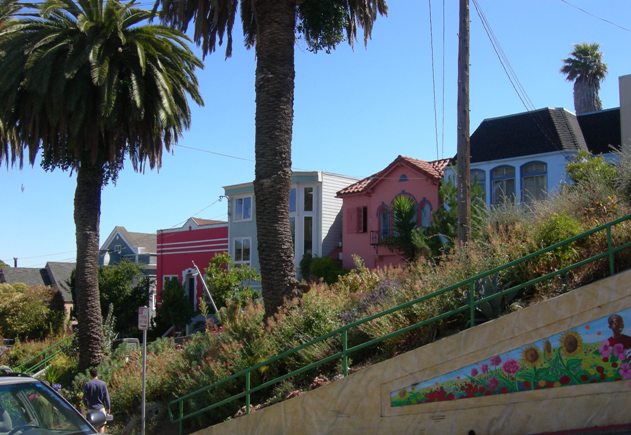
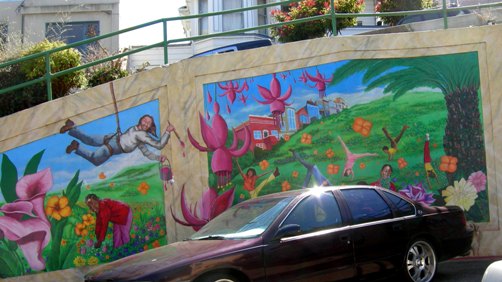
The tour ended at Quesada and 3rd street in Bayview Hunter’s Point, where the community saved a line of 13 Canary Island Palms in the median, planted around 1932. The city apparently wanted to fell them in the 1970s, because they needed too much maintenance.  A few years later, neighbors started Quesada Gardens along the length of the median, and then added a mural at a cul-de-sac at the street’s end.

The houses in the picture are just across the street

It was really inspiring, especially since one of the leaders explained that the median had been a trash dump before, and the cul-de-sac a place where people stripped down stolen cars. Overhead, squawking parrots flew in to feast on the palm fruit. It was sunny and pretty, and despite being in problem neighborhood, quite a few people on the tour thought they’d like to live there.

NATIVE TREES?

Mei Ling Hui, the cheery Urban Forests Coordinator who led the tour, remarked that most San Fran street trees were not native, and were similar species to street trees in Melbourne, Australia.  She commented that eucalyptus were planted (1) because people liked eucalyptus and palm trees back then, and (2) developers planted them to drain marshes and furnish lumber for building, but it turned out eucalyptus makes crappy timber. She specifically mentioned Sutro Forest.
We pointed out that Sutro is on record as saying they were for the enjoyment of people who walked among them; it was only after his death that his heirs tried to start a lumber operation.

“…people… will wander through the majestic groves rising from the trees we are now planting, reverencing the memory of those whose foresight clothed the earth with emerald robes and made nature beautiful to look upon.”

She kindly made the correction.

She said  non-native trees were planted because they did really well as street trees, and provided the benefits of urban forest trees,  unlike trees from nearer here that required much more care and herbicides. Two authorities in the city plant trees: the Department of Public Works, and the non-profit Friends of the Urban Forest.
On the tour, I saw a lot of newly planted trees. Most were doing well, though a few were leaning over despite the cage of wooden posts intended to hold them upright. It was encouraging.

SAN FRANCISCO’S LANDMARK TREES

Total trees visited: 6 eucalyptus; many Canary Island Palms; 4 Guadalupe palms; a fig and a pepper tree.  I’d expected to learn more about trees; instead I learned about local history, community gardens, and the Landmark tree program.

The Landmarking process is lengthy, and complicated, with an uncertain payoff. The result is that many truly spectacular trees are not landmarked. Some trees are landmarked because of a historical connection rather than because the tree itself is extraordinary. Some of the Presidio eucs are  larger and more impressive than the ones we saw. Many of the Sutro Forest eucs are taller. I’ve seen some glorious araucarias in the western part of the city. Even the city’s Christmas tree (in front of McLaren Lodge) isn’t landmarked because Rec&Park doesn’t want to.

Here’s the current list of landmark trees, updated March 2009:

  • California buckeye (Aesculus californica) at 730 28th Avenue
  • Coast live oak (Quercus agrifolia) at 20-28 Rosemont Place
  • Coast live oak (Quercus agrifolia) at 4124 23rd Street
  • New Zealand Christmas Tree (Metrosiderous excelsus) at 1221 Stanyan Street
  • Six Blue Gum (Eucalyptus globulus) adjacent to 1801 Bush Street
  • All Canary Island Date Palms (Phoenix canariensis) in the center island on Dolores Street
  • Brazilian pepper (Schinus terebinthifolius) at Third St. and Yosemite Street in the median triangle
  • Flaxleaf paperbark (Melaleuca linariifolia)at 1701 Franklin Street
  • Sweet Bay (Laurus nobilis) at 555 Battery Street
  • Thirteen Canary Island Date Palms (Phoenix canariensis) located throughout the Quesada Street median West of Third St. to the dead end.
  • Two Cliff Date Palms (Phoenix rupicola) in the Dolores Street median, one across from 730 Dolores Street and the second across from 1546 Dolores Street
  • The grove of Guadalupe Palm (Brahea edulis) in the Dolores St. median, across from 1608-1650 Dolores Street.
  • Moreton Bay Fig (Ficus macrophylla) at 3555 Cesar Chavez Street
  • Two Flowering Ash (Fraxinus ornus) at the Bernal Height Library at 500 Cortland Street
  • Blue Elderberry (Sambucus mexicana) in the Bernal Height Natural Area near the intersection of Folsom and Bernal Height Boulevard
  • Manzanita (Arctostaphylos hispidule) 115 Parker Avenue
  • Monterey Cypress (Cupressus macrocarpa) 2626 Vallejo Street
  • California Buckeye tree (Aesculus Californica) located behind 757 Pennsylvania Street.

(Three others have been nominated: A Norfolk Island Pine and two Canary Island Date palms at 2040 Sutter Street, and a Redwood Tree at 46 Stillings Ave.)

But I didn’t get to see the city’s most spectacular trees. I might start blogging about those. There are certainly some really wonderful trees in San Francisco. I’ll be looking out for them. The only problem is how to photograph really huge trees. Meanwhile, ‘BurritoJustice’ carried a great tree post on their blog. With photographs.

Fun Forest Knolls Playdate

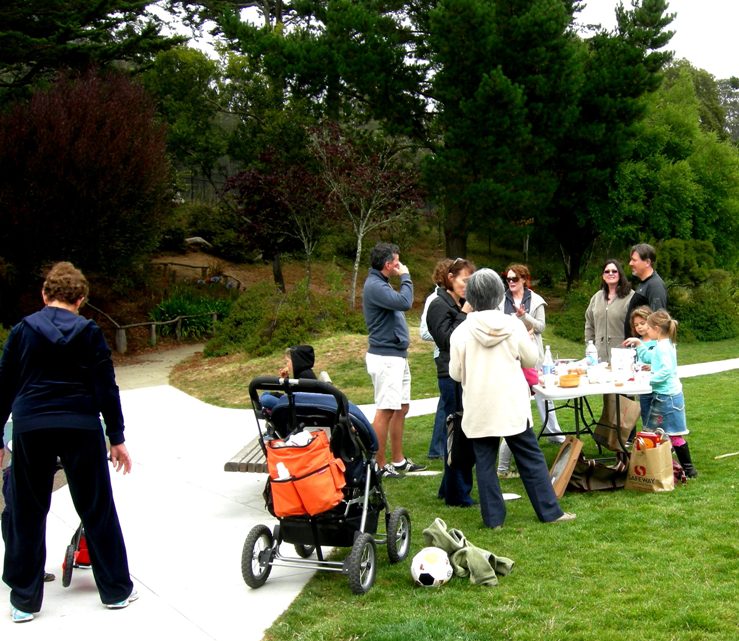
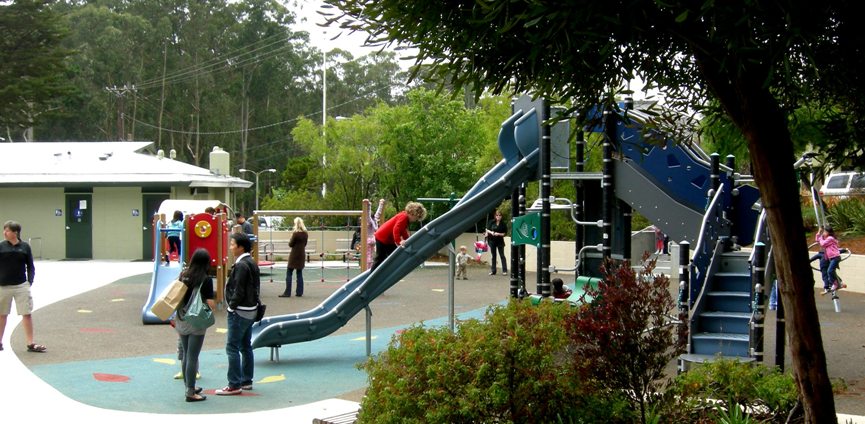
I dropped in on the Forest Knolls Playdate at Midtown Terrace Playground to find kids running around the play structures, and the adults standing around a table laden with snacks and drinks. Kids swooped by from time to time, foraged among the snacks, and disappeared back into the newly refurbished playground.

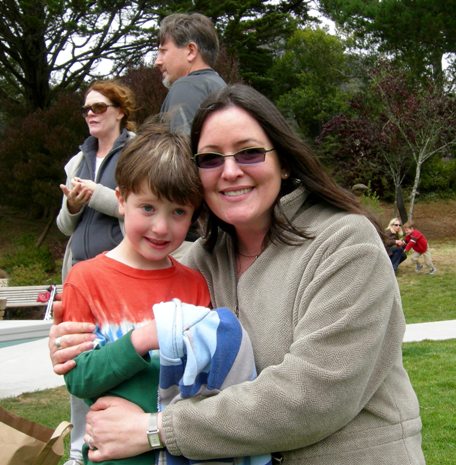
Ethan and Laura

It’s looking great and seems to be good for play. There’s no sand there any more, which the kids probably miss (mine used to spend hours digging in it) but the adults, not so much. (I used to spend hours afterward shaking sand out of their clothes, their hair, and my car.)

Laura Bloch, who organized the Playdate was there with her husband and two children. So were a number of other neighbors, of all ages.  I was in a rush, but I wish I could have stayed longer and chatted. Despite the grayness of the day, everyone looked to be having fun.