I attended a Community Action Group (CAG) meeting of UCSF last evening, mainly about their Long Range Development Plan (LRDP), 2014-2035. (It was a follow-up to the previous meetings, one of which is reported HERE.) This meeting covered three broad areas: The Space Ceiling; Parnassus Avenue Streetscape and traffic; and UCSF Shuttle bus operations. But first, an announcement, important for anyone following the Mount Sutro forest battle:
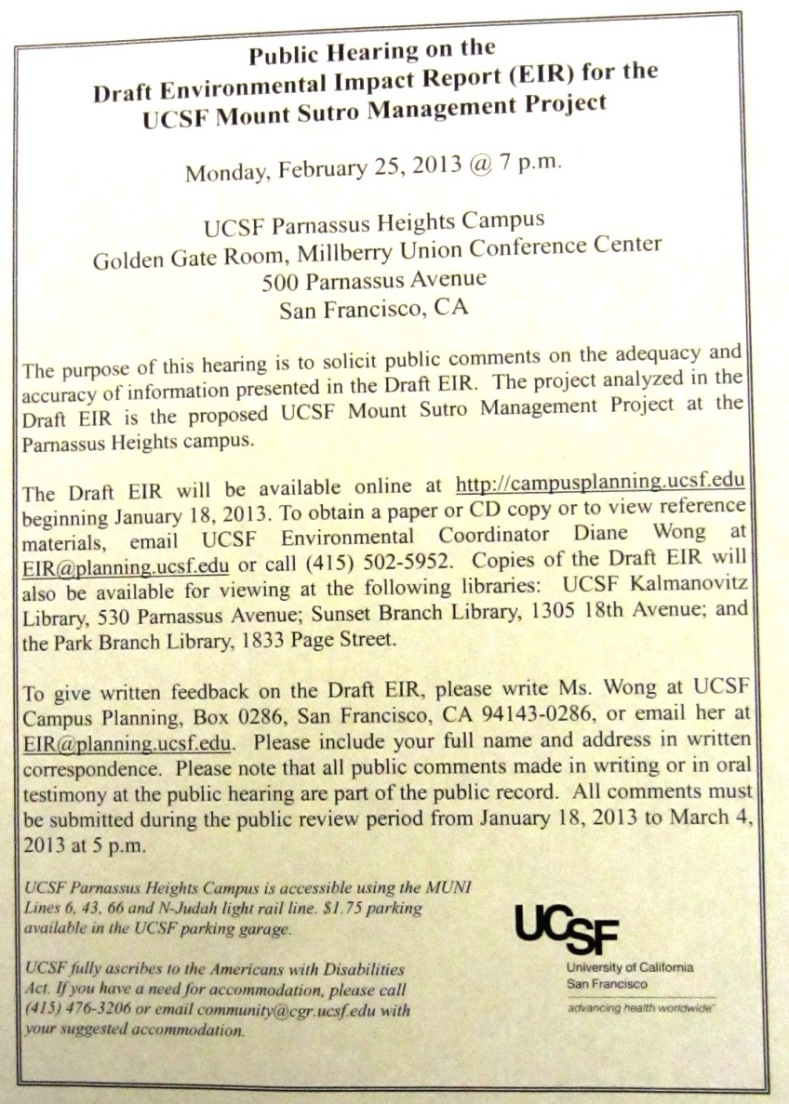
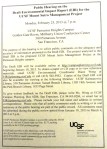 The Sutro Forest Draft Environmental Impact Report (DEIR) will be published on Jan 18th, 2013. Then UCSF will take comments for 45 days; respond to the comments; and then they plan to certify the EIR. There’s a meeting on February 25th, at 7 p.m. during which people can give comments and feedback. (Clicking on the thumbnail picture here will take you to a larger – and hopefully readable version of the notice.)
SPACE CEILING
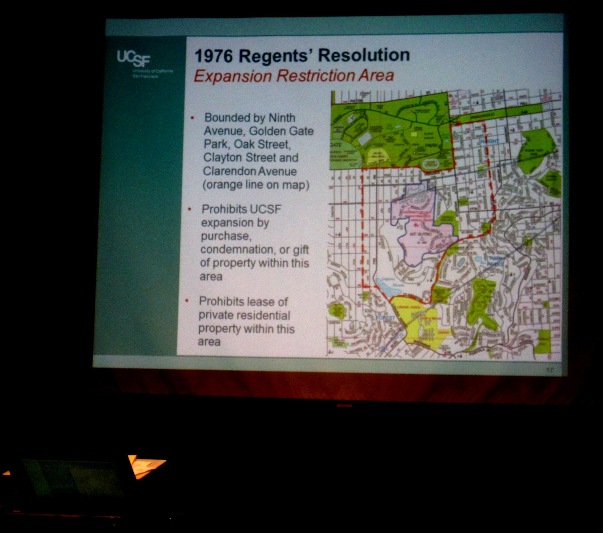
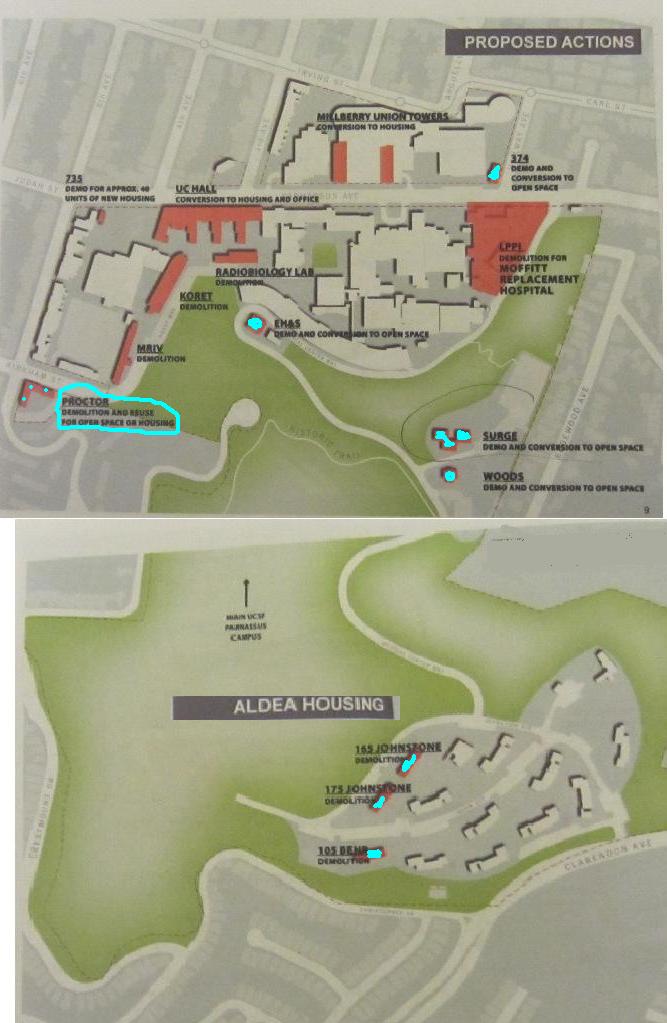 In that last article, I noted that UCSF had set itself a 3.55 mn square foot “space ceiling” in response to neighborhood anger at their expansion strategies in the 1970s. However, it shot past this space ceiling early on, and currently exceeds it by 8.2%. For many neighbors – especially those in the Inner Sunset – space ceiling compliance is one of the most important issues. They hoped the new LRDP would bring UCSF into compliance.
No such luck. It looks like it will actually go to as high as 9% over the limit when the existing Moffat Hospital is demolished and rebuilt, perhaps 10-12 years from now.
UC Hall, an old and historic building, was originally slated for removal. That would have reduced the excess over limit. But now they plan to convert it to a mix of housing and other uses. Since housing doesn’t come under the space ceiling, this helps – but it doesn’t actually reduce congestion and related concerns. Later, UCSF may convert UC Hall completely to student housing, thus taking it out of the calculation. They also plan a similar housing conversion for Milberry Union towers, which also will be gone from the numbers (though not from the campus).
Other minor reductions in the space ceiling will come from demolishing a bunch of small buildings, including several in the forest, and three blocks of student housing in Aldea campus. I’m finding this counter-intuitive. The main congestion impact is down in the Inner Sunset, so UCSF is demolishing buildings in the lightly-trafficked Sutro Forest, and adding housing along Parnassus?
Anyway, by a combination of housing conversions and minor demolitions, they expect to end 2035 at only 5% over the space ceiling, compared with 8.2% now. The map above shows the actual demolitions in turquoise; the pink buildings will either be demolished and rebuilt, or converted to housing. One building, Proctor, is undecided; it could be made Open Space, or converted to housing.
UCSF are also considering giving up their Laurel Heights space and co-locating those functions at Parnassus or Mission Bay (or both).
PEOPLE AND CROSSWALKS
The people numbers – which were originally supposed to be limited to 13,400 average daily population and then to 16,000 – is already at around 18,000. According to the forecast, it will rise to 18,500-18,900 in 2035. Members of the CAG were rather skeptical about this number.
In addition to construction and changes in use in the buildings along Parnassus, they plan to remodel the road itself to make it more pedestrian-friendly and give it a stronger sense of place. Better sidewalks and a huge cross-walk are in the plans. The tree plan involves removing some 60 trees that are hazardous or “poor quality” and planting around 70. They will also evaluate the redwood grove at Parnassus and 7th at some later date, if they haven’t removed it during their construction work first.
There was also a discussion of shuttle-bus operations, the upshot being that they may be better able to match demand (peak demand exceeds number of trips on some routes, but doesn’t match capacity on others) and supply.
If you want more details, UCSF has its website for the LRDP HERE.
















 FOREST KNOLLS NEIGHBORHOOD