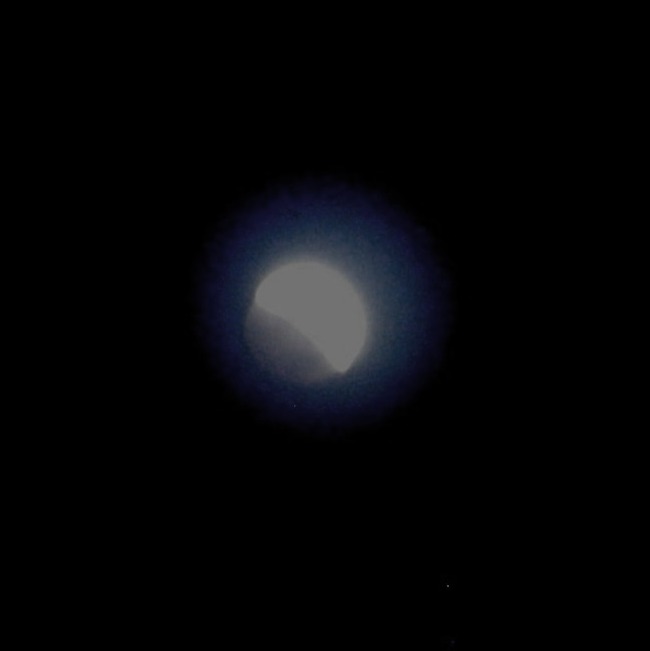
Years ago, I saw a reproduction of a painting: The Kanchenjunga Hidden By Mist. It was a piece of truly minimalist art, a pure pearly-white canvas with not even a hint of the iconic mountain visible through it. Readers of this article may think I’m emulating that painting, only in black, not white, and as a photograph not a painting.
I hope I’m doing better than that, if only marginally. In case you miss them, I’d like to point out the red dots at the bottom left, and the white crescent at the top right.
What this is (really!), is the lunar eclipse over Sutro Tower. It was taken at 11.23 p.m. on Dec 20, 2010.
No one expected the lunar eclipse to be visible, even though it was an important one. It was a total lunar eclipse on the night of the winter solstice, the longest night of the year. The forecast was for clouds and rain.
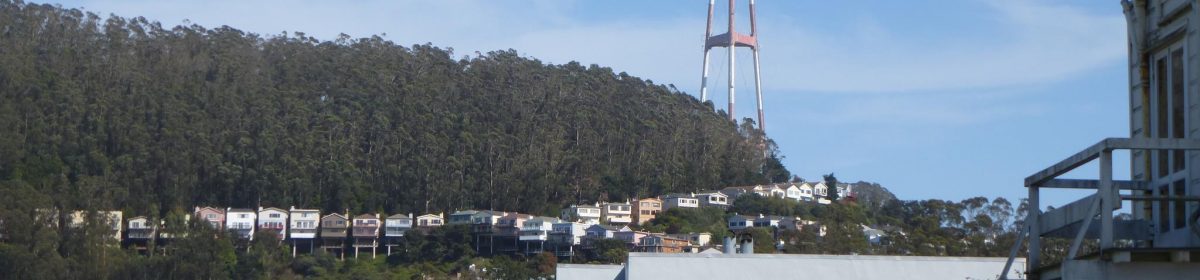
Miraculously at 9.30 or so the clouds broke. The portents were good as the full moon shone through the eucalyptus onto Forest Knolls.
11.24 p.m
So we waited… maybe this would be an eclipse we actually could see! (I missed the last one, a partial, because San Francisco was fogged in.) By 11.30 p.m., the eclipse was well under way, and it was still clear. It was exciting. I kept switching between my camera and my binoculars. Of course I knew full well the camera doesn’t have what it takes for good moon photographs, but I couldn’t resist documenting the moment. And the binocs are like a mini-telescope — I could see the lunar craters, I could see the shadow on its surface.
And then the clouds came back. By the time of the totality, our place was blanketed. We could see nothing of the moon.
I waited a while, then grew impatient. We jumped in the car, and drove in the direction of the clearest sky. I thought perhaps we’d have some luck near the ocean.
By the time we got to the bottom of Clarendon Avenue, the moon was clearly visible, just past the totality. A white rim shone over a duller yellow disk.
21st December, 1.29 a.m.
Photographing it was a problem. A thin drizzle kept blotching my lens with rainwater, since I was pointing my camera straight up. I tried from inside the car, which gave a somewhat better result, but multiple images (perhaps from the glass through which I was shooting, perhaps from a movement of the camera).
Back in Forest Knolls, I found a good spot to moon-watch for a while, and took a bunch of photos anyway. It was nearly 2 a.m. when I called it a night. The clouds were taking over again. Still, it was a gift: The Unanticipated Eclipse.
This was in the Park Station Police newsletter, and was looking for a signal boost. It’s of interest to all of us, living as we do in earthquake country. The SF Fire Department is offering classes in January through early March 2011. Most of them are six-session evening courses; but they also offer a couple of intensive weekend options. The classes are held all over the city. The one closest to our neighborhood is probably in the Sunset, at 5th and Irving. According to the newsletter, more classes will be added later on.
# # #
THE LETTER
Subject: Free NERT preparedness and response training by the San Francisco Fire Department
Hello,
My name is Erica and I am the current program coordinator for NERT, the Neighborhood Emergency Response Team. This program provides instructor-lead classroom training with hands-on components included to prepare San Franciscans for a disaster no matter how big or small.
Earthquake? Power Outage? Flooding on Shotwell Street? This all hazards approach begins with caring for oneself and family and includes training to become a volunteer emergency responder in your neighborhood.
I am writing to request your assistance to get the word out about this free training opportunity. We do not have an advertising budget and rely on word of mouth to spread this important information. We are now celebrating over 20 years of consistent emergency response team training and I still often meet people who are not aware of this opportunity.
New NERT classes are coming up and people should take the training that best fits their schedule. People can join their neighborhood team upon completion of the training. Participants should plan to attend all sessions of the training to gain the full scope and benefit. New students may begin no later than the 2nd week of a six week class and must begin on the 1st day of a two-day intensive class.
There is also a three hour introductory workshop that focuses on personal preparedness.
Thank you in advance for any assistance you can provide in telling people about NERT training.
_____________________________________ Lt. Erica Arteseros, NERT Program Coordinator
San Francisco Fire Department
2310 Folsom Street
San Francisco, CA 94110
phone (415) 970-2022
fax (415) 970-2020
Seven new classes are beginning in the new year. More will be added through the spring. Check back to the website if the scheduling does not fit your needs. Click the link or type in the following URL: http://www.sf-fire.org/index.aspx?page=859
CLASSES AND SCHEDULES
Inner Richmond: Zion Church and School, 495 9th Ave @ Anza
Wednesdays 6:30pm-9:30pm
Class session 1: January 5
Class session 2: January 12
Class session 3: January 19
Class session 4: January 26
Class session 5: February 2
Class session 6: February 9
Bayview: Bayview Police Station Community Rm 201 Williams @ Newhall
Two Day Intensive!
Saturdays 8:30am-5:30pm
Class sessions 1, 2, 3: January 8
Class session 4, 5, 6: January 22
Sunset: St. John of God Church Hall 1290 5th Ave @ Irving
Thursday evenings, 6:30pm-9:30pm
Class session 1: January 13
Class session 2: January 20
Class session 3: January 27
Class session 4: February 3
Class session 5: February 10
Class session 6: February 17
Civic Center/South of Market: San Francisco Federal Building 90 7th Street @ Market
North of Panhandle/Lone Mountain: USF Campus, use main entrance on Golden Gate Ave McLaren Conference Center, room 250
Two Day Intensive!
Saturdays 8:30am-5:30pm
Class sessions 1, 2, and 3: February 12
Class sessions 4, 5, and 6: February 26
Fisherman’s Wharf: Radisson Hotel Fisherman’s Wharf 250 Beach Street
Two Day Intensive!
Fridays 8:30am-5:30pm
Class sessions 1, 2, and 3: February 25
Class sessions 4, 5, and 6: March 4
Resilient Community Workshop
SFFD NERT and SF SAFE (sfsafe.org) want you to have skills to be prepared for emergencies big or small, and know your neighbors to maximize resiliency after disaster.
Risk Awareness
Disaster Supplies
Personal/Family Disaster Plan
Utilities Overview
NERT Overview
Community, block by block
San Francisco Jewish Community Center (JCC) 3200 California @ Parnassus
(Paid parking is available in JCC lot)
Tuesday February 4, 7pm-9pm
RSVP
I’m generally late putting up a Christmas tree. We use the real trees, and I’m always afraid that if I put it up too soon, it’ll dry out — especially since it’s usually January 2nd week before I take it down again.
This year’s no exception. Everywhere I go, windows are full of brilliant trees. The city’s live tree in Golden Gate Park is already lit. We got round to tree shopping only last night.
I always buy my tree at the same place: Emerald Forest, at Sloat and 19th. Clancy’s at 7th and Warren is closer, and I’m sure they’re pretty good. But where I go is Emerald Forest.
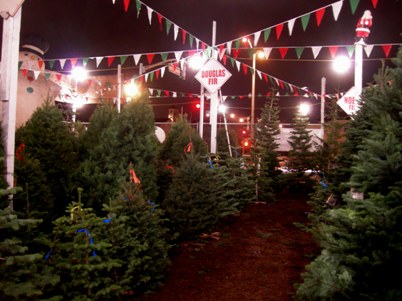
I usually go in the afternoon or evening. Parking isn’t a problem then, though they have only a few spaces just outside their lot, off of Sloat. The bright lights and flags and illuminated Santa and wreaths hanging by the gate all celebrate the season.
Inside, it does feel like a forest. The aisles of trees are sweet-scented with pine and fir. The ground’s always a little damp and covered in pine needles and mulch. Most of the trees tower over my head (which is admittedly not difficult to achieve). I know exactly where to look for our tree: In the aisle near the back, on the right.
And I know what I’m seeking: A tree that’s about 5 feet tall, springy and fresh, bushy and symmetrical. (The symmetry always seems important initially; by the time it’s covered with ornaments, it will matter far less. But each year, we forget that; each year we seek the perfect tree.)
I told the lady running the tree lot I’d blog about them. Were they a family-run business?
“Oh yes! And we’ve been here for twenty years,” she told me.
Was there anything they’d like to say? I inquired.
“Oh, I don’t know… maybe that we sell Silver Tips? Not many places have those. People come all the way from Marin and San Jose for them.” (They had a selection of Douglas Fir, Nobles, and Silvertips. We always get a Noble, ourselves.)
She attended to the purchase of our tree, and filled out the paperwork while in the background, some helpers put it on a vibrating platform to shake off the excess needles.
“And I guess we do flocking. Not many people do that any more.” I don’t want flocking on my tree, but I could see into the flocking tent, where they had trees in red, white and blue.
But I don’t go to Emerald Forest for flocking or Silvertips. My reason’s much simpler: They deliver.
Not only do they deliver, they bring the tree right into my living room, and set it up for me in the tree-stand I’ve had for years.
And they remember my name, even though I only see them once a year. Quite a feat, that. I don’t think I could match it.
# # #
This afternoon we stopped at the Manor Cafe at West Portal. It was all lights, garland, and festive display. A carousel turned, a Santa climbed a ladder, a toy box held moving miniature skaters. (“It’s a lot of work,” they said when I complimented them on the decorations.) If you like Christmas kitsch — as I do — it was worth it!
With coffee, I ordered the mango pudding. I was glad I did. It had an authentic mango flavor, and was drizzled with raspberry sauce and circled with berries.
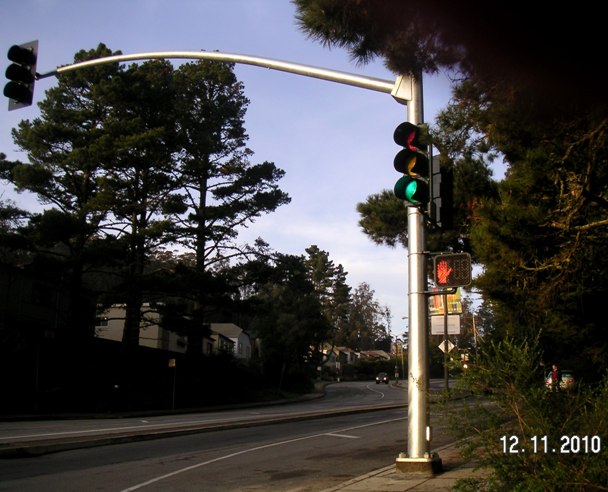
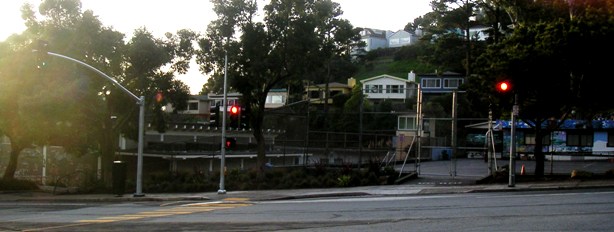
There’s a shiny new set of traffic lights at Clarendon x Panorama, opposite Clarendon Elementary School’s playground.
(Literally shiny! They’re so new the post hasn’t yet oxidised to the usual dull gray.) They appeared suddenly, like magic. I drive by there several times a day, usually, and didn’t see them go up. One day they were just there, like great steel and glass mushrooms that had sprung up overnight.
“A good thing,” I thought. It’s opposite the Clarendon Elementary School, and it should make our kids safer. It’s the suspenders in addition to the belt of the conscientious crossing guards who patrol the place when school gives out.
“I hate those new lights,” commented someone last evening as he waited at the lights, red against the Clarendon traffic. There wasn’t another car in sight. No one crossed the road, not even a raccoon. “It’s needed like maybe twice a day, on weekdays. What about the rest of the time?”
“He has a point,” said a passenger in the car. “There isn’t much cross traffic here. They should just switch off the lights at 6 p.m.”
“Or convert them to flashing beacons,” said another.
“And,” the first speaker added, “It doesn’t bother anyone below Panorama. It essentially just affects our neighborhood.” [Which is true if you assume that most traffic on Clarendon goes south toward Laguna Honda Boulevard.]
So what does everyone else think? (If you leave a comment, don’t worry if it doesn’t show up until the next day; all comments are moderated as an anti-spam measure.)
It rained this evening. It didn’t seem that bad, actually, umbrella weather not hide-inside-for-40-days-and-nights weather. But then, coming home from an evening out, we encountered the Flood.
I don’t know if there was once a river there. This evening, certainly, it felt like there was. Water poured down the street, the rivulets and tributaries meeting at the confluence at Clarendon and 7th.
The water rushed past. The traffic rushed past raising plumes of spray like Bangkok water-taxis. The lights changed in a pattern of colored reflections. (Click on the pictures to make them bigger, and again to make them larger still.)
It’ll all be gone tomorrow, probably.
(Edited to Add: It was. Around 11 p.m. on the 9th, it was like there’d never been a flood there. Though water was still running slowly off our mountain. The forest will probably be trickling water out for days.)
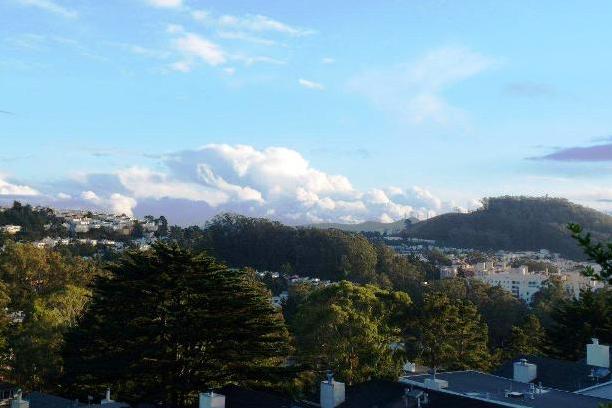
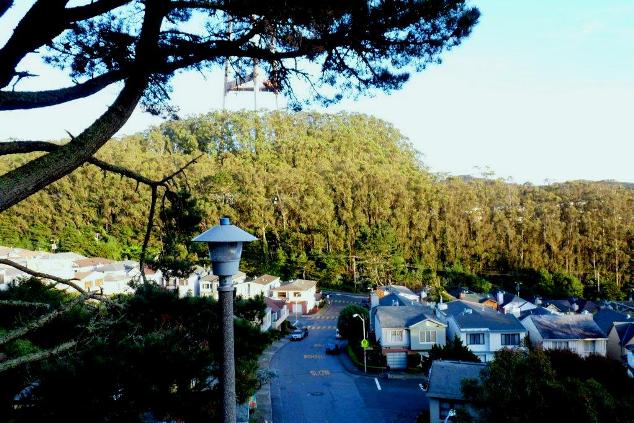
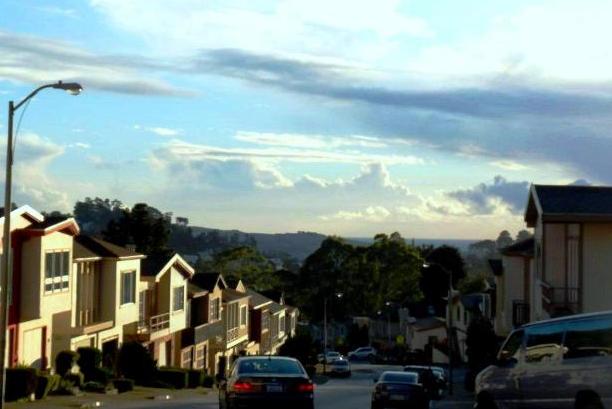
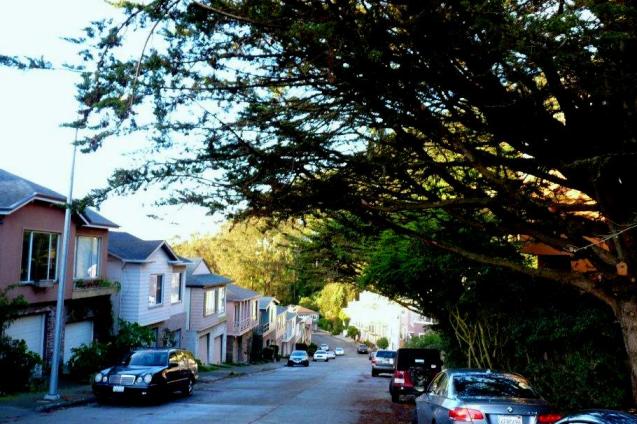
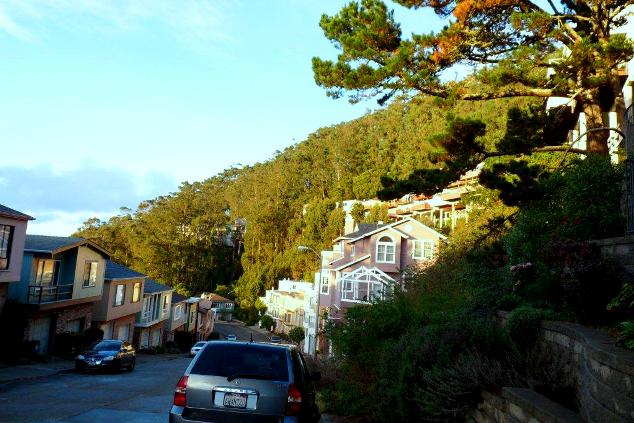
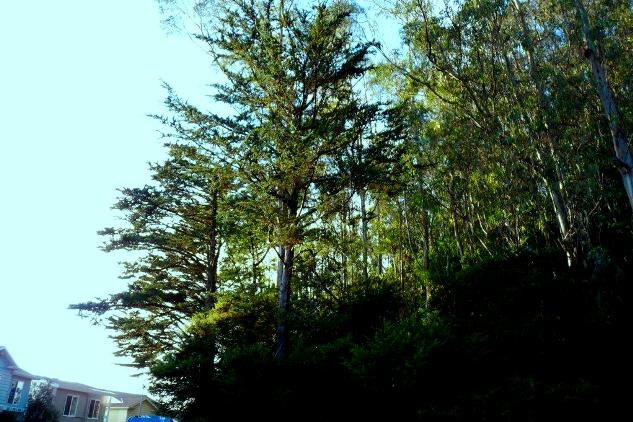
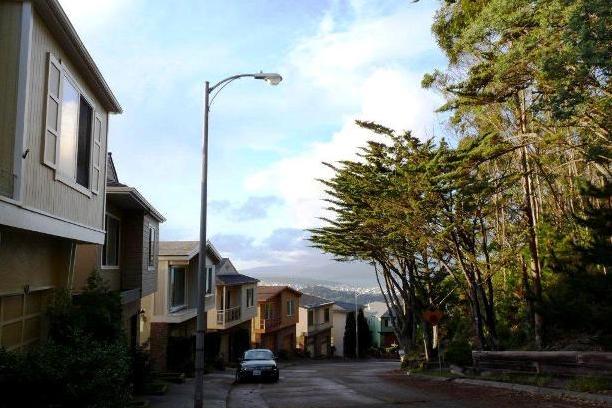
One of our neighbors, Lulu Carpenter, sent me a bunch of photographs she took on a walk around Forest Knolls. I was struck by two things. First, how much they resembled picture postcards. Any casual view seems to have a scenic quality to it. Second, how much the forest determines the character of our area — the look and feel and scent and sound — especially since, unlike Cole Valley or Forest Hill, we have hardly any street trees.
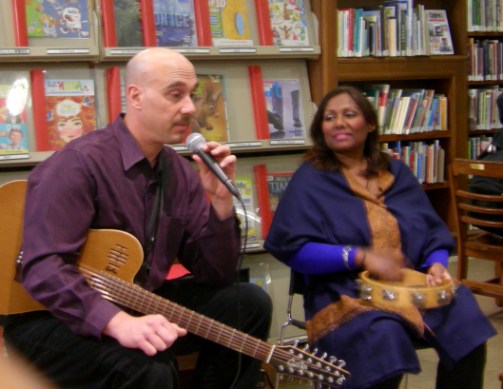
Our local library at West Portal isn’t just books. This evening, it put on a show : Singer Riffat Sultana and her husband Richard Michos, and talks from four local authors
Gerald Nachman
Henry Conserva
Diana Orgain
Mary F. Burns
I was surprised that an event of this quality was free. Later, Librarian Melissa Riley told me it was funded with a grant from the Friends of the Library. Melissa made it intensely local by inviting participants actually connected to West Portal or to the library, using it for writing or research.
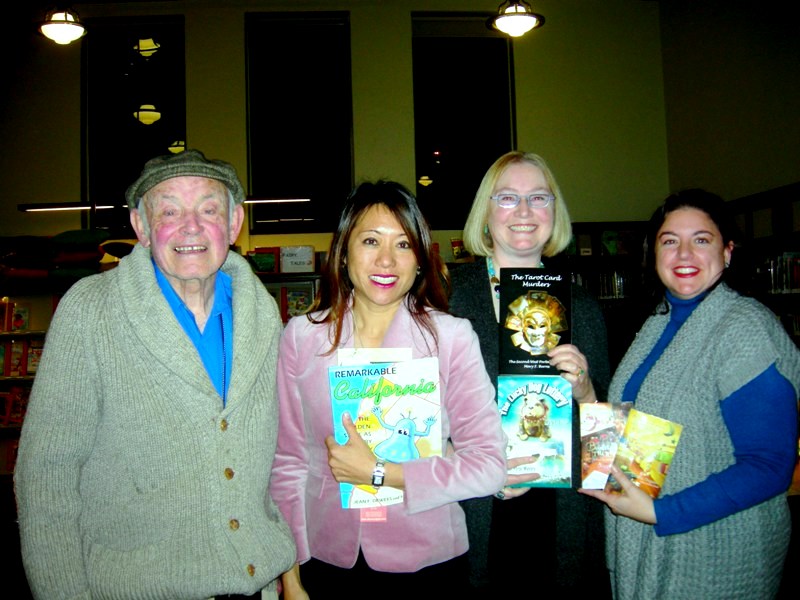
California State Assemblywoman Fiona Ma was there, showing her support.
Henry Conserva, Fiona Ma, Mary F Burns, Diana Orgain
This library is one of the charms of our area. It’s in a pretty building, sensitively remodeled in 2007 to be accessible to people with disability, and managed by friendly and helpful librarians. Events like this are a bonus. I was fascinated by the local focus: Who knew so many authors, not to mention musicians, were from around here?
LOVE SONGS TO GOD
In the first half, Riffat Sultana sang songs from Pakistan and India, all in Urdu, Punjabi and Hindi. (These are all related but not identical languages of the Indian subcontinent.)
She’s a world-class talent, originally Pakistani, from a 500-year old lineage of classical singers. Her husband, Richard Michos, who works at The Music Store in West Portal and teaches guitar, accompanied her.
Several of her songs were from the Islamic Sufi tradition, love-songs to God: You are my heart, you are my life, you are everything… She also performed a bhajan — Hindu devotional music — with the refrain God is truth, truth is Shiva, Shiva is beauty. Then she sang a “ghazal” (a poem set to music), in which a young woman laments a lover who doesn’t show up.
Later, I read her biography on her website. It’s a fascinating story of a born performer who started life in a conservative Muslim musical household where girls weren’t allowed onstage, and ended up performing with her own group and releasing her own records.
FROM HISTORY TO MYSTERY
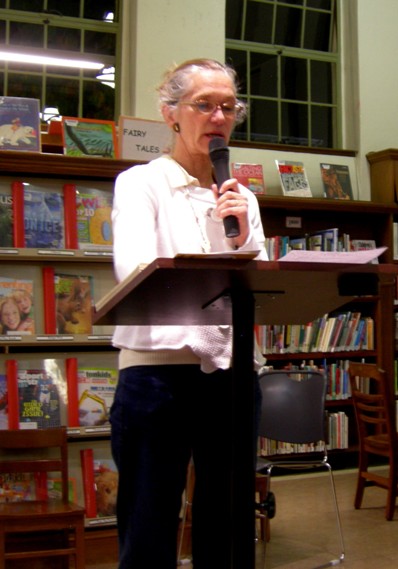
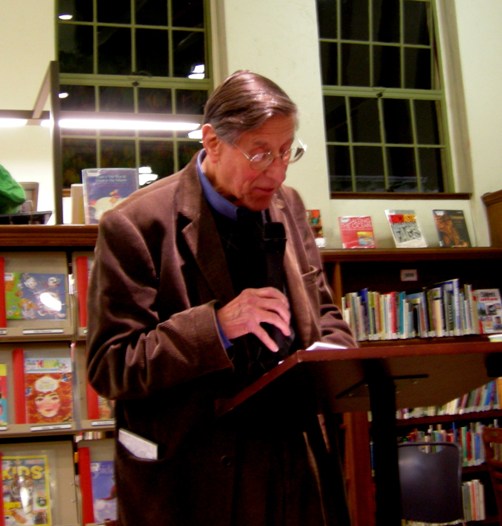
The second part of the evening was devoted to authors. It started with Gerald Nachman. Looking the quintessential author in corduroy and fair-isle and round-lensed glasses, he read a speech about how his career all started in libraries.
Later I looked it up: He’s been a humor columnist for the New York Post, and theater critic for the San Francisco Chronicle amongst other equally illustrious things. He writes about the golden age of radio and TV; his latest book is Right Here on Our Stage Tonight about the Ed Sullivan Show. “How TV’s most inept emcee created America’s most powerful popular variety show…” says his website.
Henry Conserva, the next author, formerly taught school at Lowell High. As befits a teacher, he was an interesting and relaxed speaker. Together with his friend photographer John Weir, he was involved in the Sunset magazine’s book, The California Missions. First published in 1963, it’s still in print. Since then he’s written a whole bunch of books, many for school children, on topics from Physical Geography to the Constitution to Propaganda.
Author Diana Orgain, whose Mystery books are published by Penguin, was inspired by motherhood. She didn’t want to go back to work in a corporate setting; she wanted to hang out with her baby. She wrote the Maternal Instinct mysteries, about a first-time mother who is a Private Investigator. Bundle of Trouble came out last year, Motherhood is Murder in March 2010, and Formula for Murder comes out next March. Diana’s a really local author; she lives on Ulloa. The books sound like fun, and I’m a sucker for mysteries.
The final author for the evening was Mary F. Burns, who headed the West Portal Neighborhood Association and authored “The Woman Who Wrote the Bible” about Janaia, a daughter of King David. But what she spoke of was her two earlier books, “cozy” mysteries actually set in West Portal (and subtitled A West Portal Mystery). The first, inspired by her friend’s bulldogs, is called the The Lucky Dog Lottery. The second is The Tarot Card Murders. Featuring such familiar places as St Francis Market and the Village Grill, they’re self-published and available from Ex Libris. And from our local West Portal library.
I left the library with an armful of books from each of the authors, looking forward to some good reading ahead. (Unfortunately, I’ve promptly lost one of them, probably at St Francis Market or Eezy Freezy. I hope someone returns it to the library so I can check it out again!)
ETA: Melissa told me I’d left the “lost” book at the library.
Having Golden Gate Park so close to home is a gift.
It was a beautiful afternoon, and we headed for Stow Lake. So did a number of winter birds, the ones that spend their summers in the Arctic and their winters in San Francisco.
I hadn’t brought my bird-book, and couldn’t ID them, being more of a wannabe birder than an expert; but they graciously posed for photos. After that, it was on to my Lone Pine Field Guide of the Birds of Northern California, and a little help from Google.
There were gulls. Most people consider gulls a white or brown-streaked aquatic version of crows and ravens. So I was surprised to discover several different species of gull at Stow Lake, besides the ubiquitous Western Gull.
Mew Gull
The first one I saw was a little self-conscious Mew Gull. These gulls visit San Francisco in winter, hanging out in Alaska and Canada during the summer.
Not a Thayer's Gull, but not yet identified
The Thayer’s gull, which resembled the snow owl from the Harry Potter books, was so pretty I took a bunch of photographs. It looked like it was covered in lace. It also spends summers in the Canadian arctic. This is probably a young gull in its first year. As it grows older, it’ll look quite different — more like the Western Gull. [Edited to Add: This gull apparently is not a Thayer’s. It may be a cross between two other species of gulls. I didn’t actually know there were such things as gull hybrids, which complicates an already tough-for-amateurs identification problem. Thanks to expert birders in the SF Birds Yahoo Group, where the discussion continues.]
Herring Gull
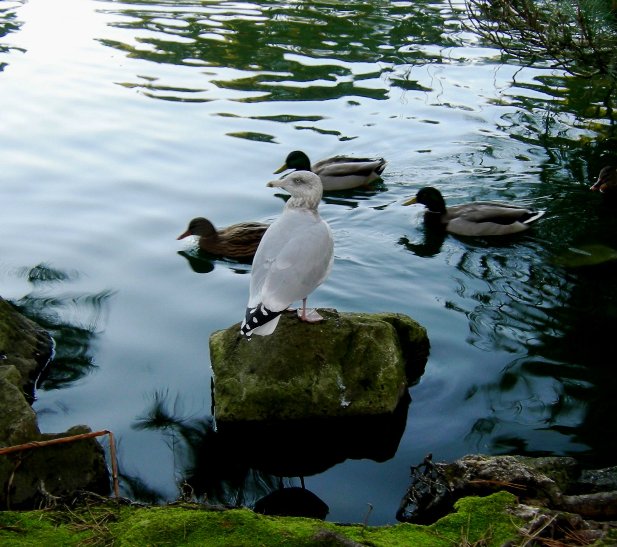
This herring gull really did look like it was posing on that rock, standing sentinel. It’s another winter visitor, just like the Mew and the Thayer’s.
Feeding Frenzy
Someone brought Cheerios for the birds. Gulls have no table manners. Lots of violence and swearing. Luckily the kid couldn’t understand gull-speak.
Mine!White-fronted Geese
Usually the geese out at Stow Lake are the big Canada geese everyone knows. But today, there were three White-Fronted Geese cropping at the grass on the roadside, and ignoring people passing within a few feet of them. Don’t know why they’re called white-fronted — they look very brown to me. (The black bird in the picture above is an American Coot.)
And finally, there was this odd duck with a brown head and white throat. I don’t know if it’s a species I couldn’t ID, or if it’s just a variant of the Mallards we see everywhere.
An unexpected bonanza for what was planned as a lovely afternoon walk .
It’s a beautiful night in San Francisco, with the air clear from the day’s rain and a full November moon. My little camera can’t deal with all that brightness, so my full moon pictures are pale discs of light. But tonight, it all came together in this view from Forest Knolls. (Of course, it’s still much lovelier than this picture.)
Edited to Add: Further reports on this are here and here.
——————————————————————————————–
Edited to Add: Rec & Park has called a meeting to brainstorm future directions for this clubhouse:
Monday, January 31st, 2011 from 5:30 – 7 pm at the JP Murphy Clubhouse.
———————————————————————————————
Recently, George Wooding, President of the West of Twin Peaks Council, sent around a letter concerning Rec and Parks plans to lease out a club-house that is currently public: The JP Murphy clubhouse. The playground was refurbished in 2008 at a cost of $3.85 million. (The PDF file with the project details and cost is here.) Not only is this specific action a concern, it could lead to other clubhouses also being leased out also.
This clubhouse is close to our neighborhood, at 1960 9th Ave (between Ortega and Pacheco).
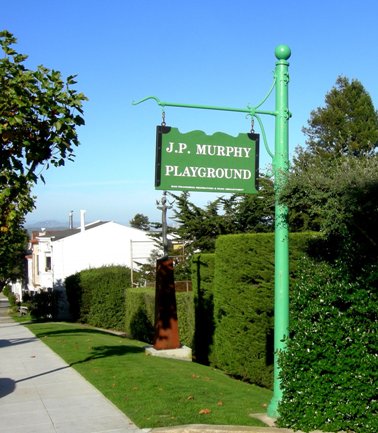
I couldn’t attend the public meeting held yesterday evening, but went to take a look today. It’s a very nice space. From the road, it looks quite small, with a low profile and an elegant 1950s look.
But if you go through the gate in the picture to the back, you realize it’s pretty big; the clubhouse extends behind the bushes visible on the right, and there’s another floor below.
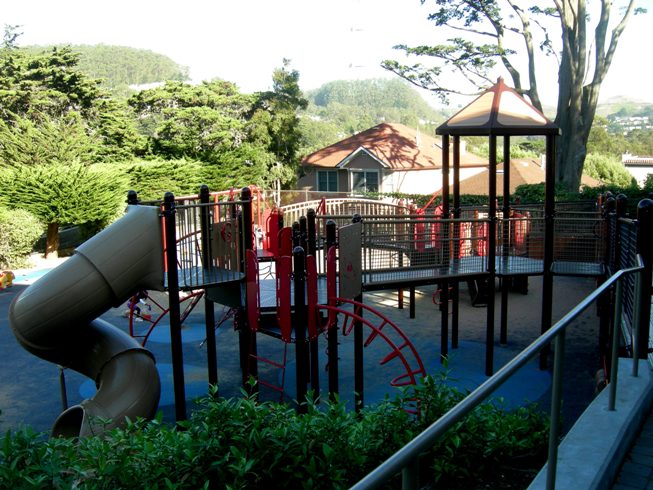
There’s also what looks like a brand new children’s playground at the back, with all kinds of cool equipment. (There’s more, which isn’t in the picture.) It also has several tennis courts.
When I read that $3.8 million had been spent in 2008 to refurbish this playground, I did wonder what on earth they’d done. The justification for the project, aside from ADA compliance: “The current assembly room, storage and kitchen are not sufficient to support multiple program activities for the latchkey, tiny tot, and teen/adult programs.” The project added a new activity room.
When I saw the space, it looked very good and very nicely done. It looked like a high-end job. In fact, it looks fancier than the newly redone Midtown Terrace playground.
So it’s ironic that — having spent all this money — they now plan to lease it out to a private entity.
It gets good review on Yelp, too; when it was closed for refurbishment, people were waiting for it to re-open. So it’s not exactly deserted. Today — on a weekday afternoon — there were people playing tennis, and kids in the playground. The clubhouse was closed and locked, because Rec & Park, after having spent all that money, closed it down and let go or moved the staff.
GEORGE WOODING’S LETTER
Here’s George Wooding’s letter (emphasis added):
PLEASE STOP THE THE RECREATION AND PARK DEPARTMENT’S (RPD’s) PRIVATIZATION OF JP MURPHY PARK
Dear Neighbors,
As you may know, in 2008 the Citizens of San Francisco spent $3,849,933, mostly from the Proposition A, Parks Project Bond to renovate the JP Murphy Playground & Clubhouse. The Clubhouse is located at 1960 9th Avenue/Ortega. Effective August 15th, 2010 the RPD also fired or relocated all of its Recreation and Park Directors. The RPD is now about to lease-out our newly, renovated JP Murphy Park. The RPD euphemistically calls this new leasing for profit scheme “park revitalization.”
RPD representative, Lev Kushner, the Assistant Director for Strategic Planning, has been holding meetings throughout San Francisco in an effort to rent out neighborhood clubhouses, parks and facilities. The RPD is trying to lease at least 24 of the 48 park clubhouses in San Francisco. Usually, the RPD’s citizens notification is very lax and few people realize that their local Park is going to be leased for a minimum 5 year period.
Mr. Kushner has scheduled a 6:00pm public meeting on Monday, November 15th at the JP Murphy clubhouse to discuss the RPD’s leasing of the JP Murphy clubhouse and park facilities. The Clubhouse is located at 1960 9th Avenue at the corner of 9th Avenue and Ortega.
It’s not that the groups that lease the parks are good or bad, the problem is that these private commercial groups take over large portions of the park at specific times and the neighbors who use these parks are not allowed to use the portions that are leased. The groups leasing the City parks often have nothing to do with recreation and are already working from an existing commercial location.
The RPD lease clearly states , “The tenant shall have the right to shared access of all playground and garden space in areas surrounding the premises.” Additionally , “The City shall use it’s best efforts to avoid interfering with the tenants quiet and exclusive use of enjoyment of the premises.”
Whatever happened to the neighborhoods right to “the use and enjoyment of premises” of our own park?
The RPD is claiming that this is its best way to generate revenue for now “underutilized” facilities. With usually only one potential tenant, the Parks are leased for ridiculously low amounts of money. The RPD started leasing parks throughout the City in July and is usually charging between $1.31 – 1.51 per square foot per month and allows full usage of the other park facilities. It is doubtful that the JP Murphy clubhouse will be leased for more than $1,500 per month. Apparently, the RPD now has a tenant for JP Murphy park or Mr. Kushner would not have scheduled a meeting.
The RPD’s quest for money has actually made them predatory. On July 15 the Rec & Park Commission voted to let an expensive private preschool displace a free, 38-year-old City College parenting class at the Laurel Hill Clubhouse. The clubhouse was leased to Language in Action (LIA), a preschool offering nine-month terms immersing two to five year olds in Spanish and Mandarin. LIA tuition ranges from $1,000—for two hours per day, two days per week—to $14,000 for full day , five day per week instruction. The RPD leased the Laurel Hills playground to LIA for only $1,427.00 per month.
“On the face of it, the RPD wanted to lease this property and they didn’t really care what the public thought,” stated City College Board of Trustee President, John Rizzo. “The RPD cared so little about the public that it was too late once they were notified.”
JP Murphy Park is our park, located in our neighborhoods and is used recreationally by the people in our neighborhoods. We don’t accept the premise that the Recreation and Park Department can have one meeting with the neighborhoods and then lease out our park for five years. We want to use our park the way we want to use them. The RPD has not even talked with the neighborhoods about how we might want to use our own facility. Without citizen protest/input the new RPD tenant will probably be moving into the park within a couple of months.
If the money that neighborhoods/voters are spending on public parks is being converted to support and subsidize commercial businesses and privatize public parks, voters will have to think long and hard as to why we would want to support the RPD’s proposed 2011 parcel tax or any other future bonds supporting the RPD.
This November 15 RPD meeting (next Monday night) is the neighborhoods only chance to stop the RPD from leasing the JP Murphy Park. The RPD will soon be leasing out other parks and clubhouses in our neighborhoods such as the Midtown Terrace park. If you love your park and want to save it from being privatized, please bring your friends and neighbors to this meeting. United we stand, divided we fall.
George Wooding
President
West of Twin Peaks Central Council
WHAT CAN WE DO NOW?
Even just financially, this doesn’t make any sense. An expenditure of $3.85 million should generate a return of at least $150,000 annually; so if the expenditure was justified, this is the minimum value of the use the neighborhood gets from the park.
Many of us couldn’t attend this meeting because of clashes or having learned of it too late. Perhaps the best option now is to call or write to Rec & Park.
Write to Rec & Park
Edited to Add: THE MEETING I DIDN’T ATTEND
A member of the West of Twin Peaks Council who attended the meeting sent me the following update:
There were more than 50 people at the meeting.
The consensus was that we need to write letters to the Board of Supervisors and the Park Commission urging them to reconsider the service cuts that have been made.
A suggestion was made that perhaps the neighborhood organizations could raise money to re-employ the playground directors and continue the needed programs.
Concern was expressed that not all areas of the city would be able to raise money.
Although the people from RPD told us they were trying to get neighborhood input to resolutions to the budget problems, none of the 4 RPD people who were there took notes. Not one of them took a pen to paper and wrote down any of the comments.
Someone took the sign-in sheets, and the RPD people are trying to get contact information about the people who attended the meeting.
I’d welcome comments and feedback here.
Edited to Add (2):
George Wooding wrote a follow-up article on the issue in the Westside Observer. That link is here.
On the Friends of JP Murphy Playground Facebook page (under “Discussion”) there’s a response to Stacy Sultana (who is the Group administrator) from Supervisor Sean Elsbernd. He says that the clubhouse was closed because Rec&Park didn’t have the funds to staff it — and he didn’t get a single neighborhood complaint. The clubhouse can still be rented for functions such as birthdays. They’re looking to renting it out to a private party during the week (during which the renter would have exclusive rights to the clubhouse) “but the playground and other facilities would absolutely remain 100% accessible” to the public. He thinks that this renting out is unlikely to happen over neighborhood objections — but the alternative is that the clubhouse will remain locked up.
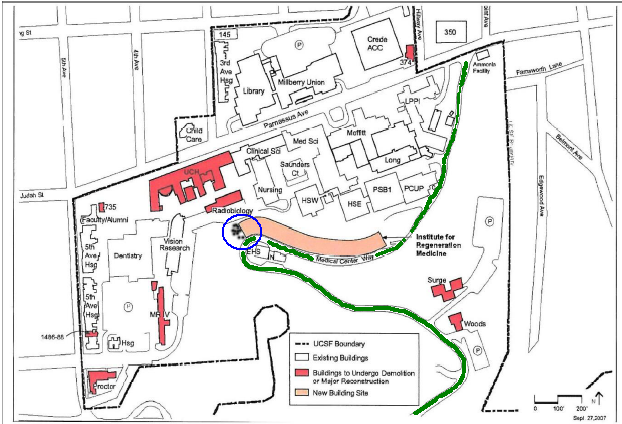
UCSF has sent out a notice that the newly re-opened Medical Center Way (i.e. the pretty Sutro Forest short-cut from Clarendon to Parnassus) will close for two days. From 8 a.m. to 5 p.m. Friday and Saturday, 26th and 27th November, the road will be blocked to traffic to allow heavy machinery through. They plan to re-open the road that Sunday morning. (In the map below, the green line indicates Medical Center Way.)
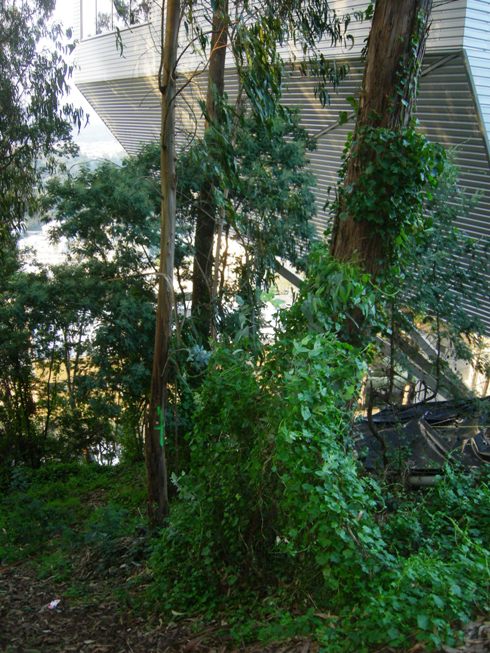
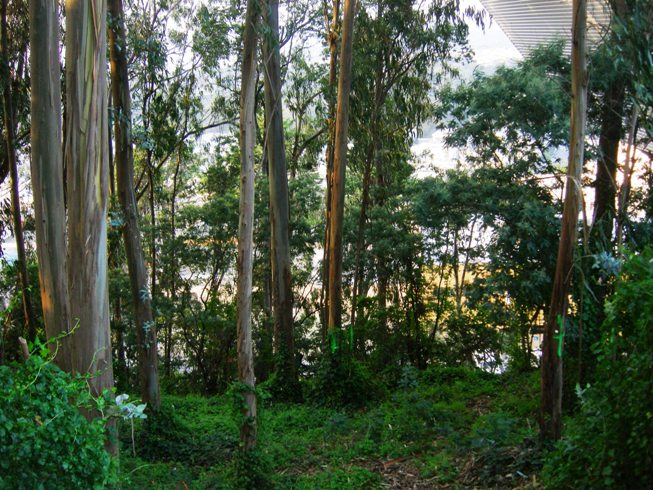
UCSF is removing 11 trees from the Western end of the new Regenerative Medicine Building (the “Stem Cell Research Building”). That’s the blue circle in the map above. The trees have been declared hazardous.
[Edited to Add Follow-up]
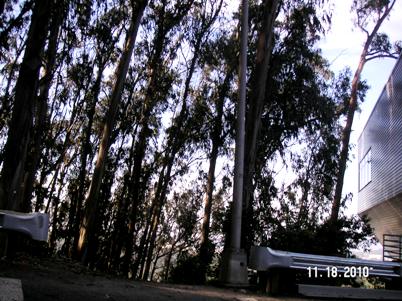
The trees have been removed; the road is open. Here are the Before and After pictures:
The best-selling author, Simon Winchester. In our little neighborhood independent bookstore.
Simon Winchester
Not only does Winchester write fascinating, well-researched non-fiction, he’s an entertaining speaker and raconteur. He was promoting his new book, Atlantic. Instead of reading from his book, as authors commonly do, he told us stories: The story of how he came to write the book; the story of how he decided to structure it (it’s based on Shakespeare’s ‘Seven Ages of Man‘); and then several stories from his book research, from places as far-flung as the Faeroe Islands, Tristan da Cunha (where he’s not allowed to land), and the Skeleton Coast. In between, he recounted how acetone was linked (via World War I, Chaim Weizmann and the Balfour Declaration ) to the founding of Israel.
Afterward, he autographed books for people. It was a great evening.
Bookshop West Portal also made an announcement about its knitting classes (and Simon Winchester has a funny story about knitting, too). The instructor’s holding some special classes for those who want to knit gifts such as scarves and fingerless gloves.
If you want to be kept informed about all the interesting authors and activities at a store only 2 miles from us — get on their email list. I’ve found this a pretty useful and painless way of staying in touch.
I went for a walk around our neighborhood last evening… Forest Knolls is easy night-time walking. Good sidewalks. Bright but not oppressive lighting. A dramatic crescent moon setting over a theatrical city-lights backdrop.
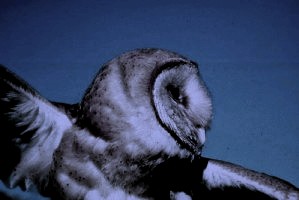
And a barn owl, flying overhead. They’re very silent, so I can’t say what made me look up, but there it was, winging its way over the neighborhood. It may have been hunting, but I think it was just checking the place out.
It’s easy to tell a barn owl from a great horned owl — our other neighborhood owl — even in the dark, even in flight. A barn owl appears white, and its head looks round. It’s sometimes called a “ghost owl.” It doesn’t have the “ears” or “horns” that a great horned owl has. It also flies more nimbly. Rodents, beware!
The picture here isn’t the owl I saw; that was moving too fast for my camera and my reflexes. It’s a public domain picture that I’ve tweaked to make it somewhat similar to that owl. I wonder if this was the same owl I saw some weeks ago on Twin Peaks.
UCSF’s Parnassus campus lies just on the other side of the hill. We were not aware of the existence of the “Parnassus CAG Action Team” – a sub-committee of the UCSF Community Advisory Group (CAG) – until now. On Nov 8th evening, there was a meeting to update people on several matters.
The Agenda items that were directly of interest to Forest Knolls/ Sutro Forest:
1. Clarendon Connector Trail. There is still a plan to punch a trail to Clarendon through the screen of trees that lies between Christopher and the Aldea campus. (The blue line above Christopher Drive in the map below.) We protested that the screen had already been thinned by the actions of SFWD: A Gash for the pipeline had been cut through the trees to the water tank; and all the trees removed behind the new Pump Station. Putting a trail through this already tattered screen of trees would be counterproductive.
[ETA: The map here is being removed, but will be replaced later … see here for the reason why.]
The justifications used were confusing.
The first reason was to route trails away from the UCSF campus. But the alternative is for hikers to just walk along Christopher Drive for a few yards, it doesn’t go into the campus. Second, two trails already originate on the campus: The Fairy Gates trail starts right outside the Chancellor’s House; and the East Ridge trail opposite the new Community Center. There’s no plan to close off those.
The second justification is that it brings hikers closer to the highest point of Clarendon Avenue, where it’s safest to cross the street to the trails on the other side because hikers can see cars coming up the hill in both directions. (It’s marked “Safe” in red on the map. ETA: Correction – the “Safe” point is not the highest point, but the place where the road narrows to half its width). But it doesn’t do that either. It only brings hikers to the same place they’d get to from Christopher.
Craig Dawson (of Mount Sutro Stewards) said they would plant the sides of the trail to conceal it from the houses along the road. We are unsure about this; the “screen plantings” meant to screen the Aldea campus from Clarendon have not been very successful, and the chain link fence remains visible there. He also said the perception of thinning — apart from the area around the pump station, and the pipeline Gash — was because ivy had been removed from all the eucalyptus trees.
2. The Community Center (to be called The Aldea Center) on the campus is expected to be ready by this summer. It will be used by Aldea tenants, the University Community, the Mount Sutro Stewards, and to a lesser extent by Neighborhood groups. A few parking spaces will be associated with it; but the main access is expected to be by Shuttle bus or hiking in.
3. The Native Plant Nursery (now called the Aldea Seed Propagation area) is planned to go ahead; the idea is to grow plants for the Native Plant Garden at the summit, and maybe for other locations. This is the pad surrounded by chainlink on the Aldea campus. It was supposed to be “planted to blend in with the forest” as promised in an agreement with the community in January 2000 and reiterated in August 2009. UCSF’s Maric Munn said there are no plans at present to do that, but use as a nursery doesn’t prevent it in the future. Apparently UCSF’s legal department has said that since no permanent structure is planned, it can be made part of the Open Space Reserve.
4. Bulletin Boards. Two bulletin boards, with maps and rules, are to be posted somewhere in the forest (not on the campus as originally discussed at the Agenda Planning meeting). One may be at the summit; another possibly on the historic trail.
5. Bike cage. A new bike cage is to be built on Parnassus Avenue outside Milberry Union, to provide bike commuters with safe storage. Three trees in the area will be preserved. UCSF has a $50K grant for this from SFMTA, and will match it with $50K of its own; vines will be grown over the front to improve its appearance.
6. The 68,500 square foot Regenerative Medicine Building (Stem Cell Research building) at the bottom of Medical Center Way is nearly ready; move-in could be in a week. It has a green roof, currently grass, but may be landscaped with other plants later. This building will have 250 people working there. UCSF has a 3.55 million square foot space ceiling for Parnassus; it was already 4% over this and planned to reduce that excess to 2%. Instead, it’s 6% over. This will have to be resolved in the new Long Range Development Plan, which will run to 2030.
———
Other neighbors’ concerns:
Traffic and congestion on Parnassus. Despite meetings and discussions and decisions, nothing had been implemented. Someone pointed out that unresolved issues remained from all the previous discussions and should not just be rolled over into the new Long Range Development Plan (to run to 2030).
Tree felling on Stanyan in connection with the Historic Trail opening. A number of trees have been cut down on the side of the forest behind Stanyan. Craig Dawson pointed out this was Rec and Park responsibility, and thought it might be in response to neighbors’ concerns about hazardous trees, expressed at meetings about the Historic Trail.
UCSF, plans, and the Long Range Development Plan. This is about to start now; the next meeting of the Community Advisory Group is on November 29th at 6.30 p.m. at Milberry Union.
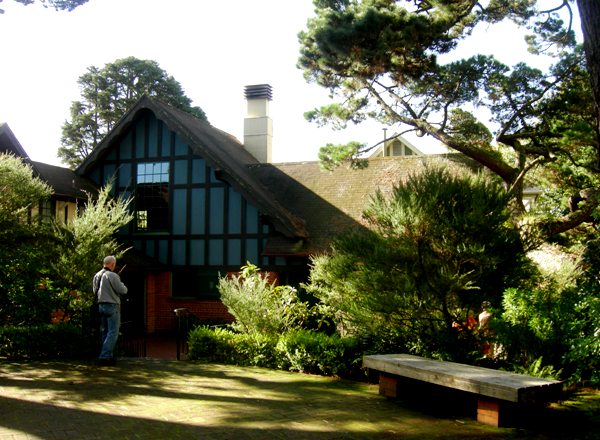
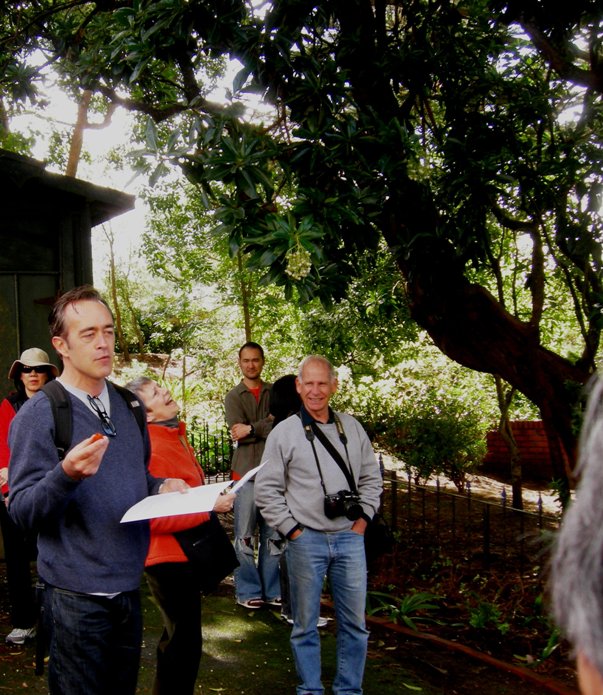
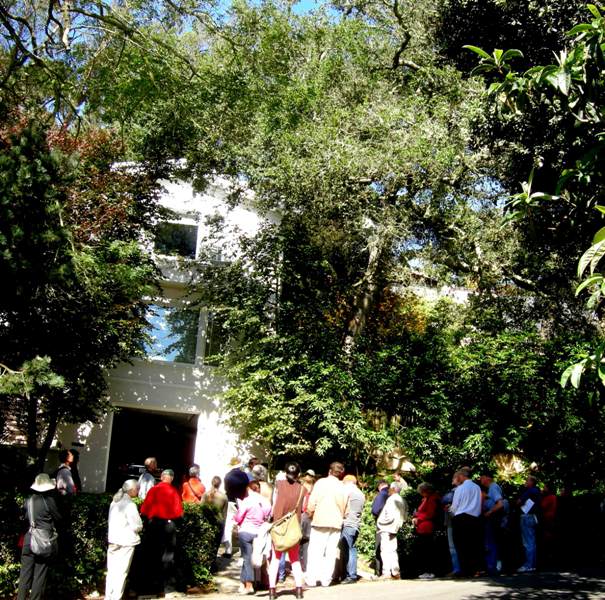
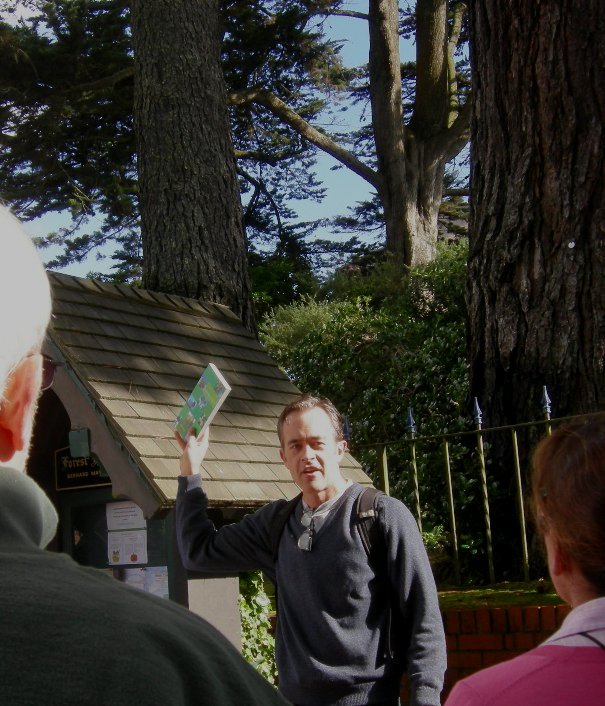
The San Francisco Forest Hill tree tour last Sunday, led by Mike Sullivan, had a great turnout. “I thought there’d be about ten or twelve,” said my companion. In fact, there were perhaps three times that number. The tour started at the Forest Hill club house, which is surrounded by big old Monterey cypress. It’s a strikingly pretty place; the Bernard Maybeck architecture and the tall trees give it a medieval air.
Forest Hill Club House - Maybeck
Mike had autographed copies of his book available for sale; since I’d already got one and blogged about it, I passed. Otherwise, it’s an opportunity I’d have grabbed.
We moved on to a strawberry tree just up the road. It’s native to Southern Europe — and surprisingly, southern Ireland. Mike explained that most likely, they had a wider range before, but climate change had pushed them southward. This was a common pattern: It explained the distribution of Monterey pine, in small pockets as far apart as the Monterey peninsula and San Luis Obispo. Trees changed their home ranges in response to changing climatic conditions.
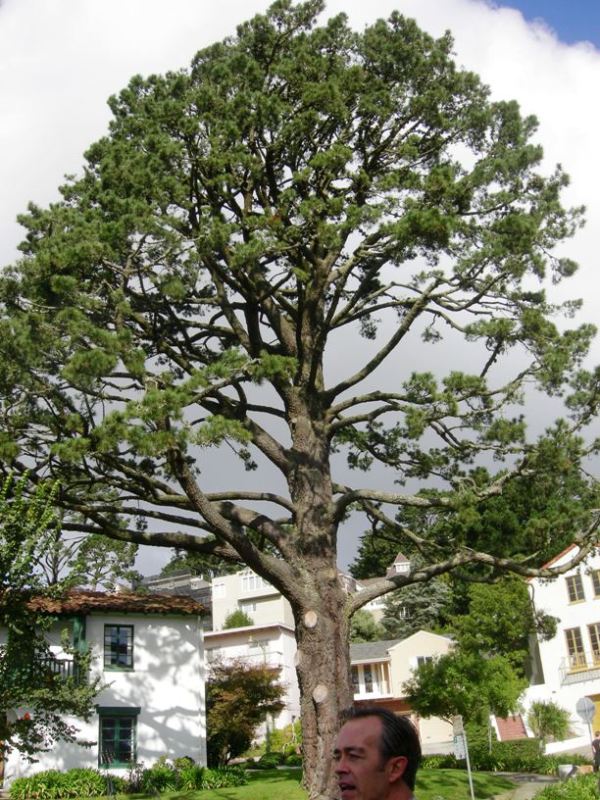
The next tree we saw was one I’ve been planning to photograph for a Memorable Trees post. It’s a Monterey Pine that towers above a white Spanish-style house. The house is handsome, but this tree is what makes it memorable. The tree has an almost manicured appearance. It’s been well-cared for and expertly pruned.
ARAUCARIA AND CONTINENTAL DRIFT
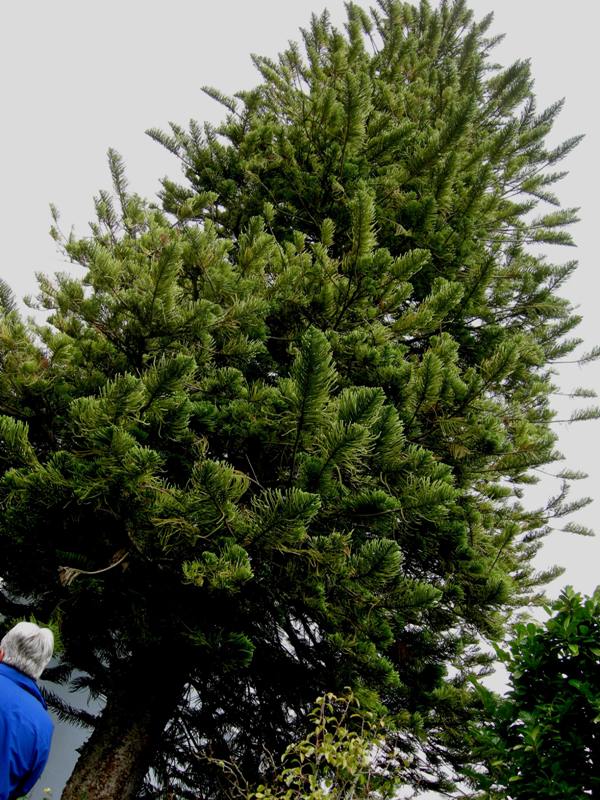
It’s almost impossible to think about memorable trees without considering the weird Araucarias, a age-old genus of living fossils that knew the dinosaurs. (Flowering plants didn’t. The dinosaurs lived in a world of horsetails and treefern — and araucaria.) They have wonderful names like bunya-bunya and monkey-puzzle and Norfolk Island Pine (though they’re not at all related to pines).
They come from the Southern Hemisphere, from places as distant as New Zealand to Chile in a scattered distribution. Mike’s explanation was continental drift: these trees were around before the continents split up, and traveled with the land masses as they moved. San Francisco has a number of them, of various kinds (including two of the Memorable Trees I posted about earlier).
NEIGHBORS AND STORIES
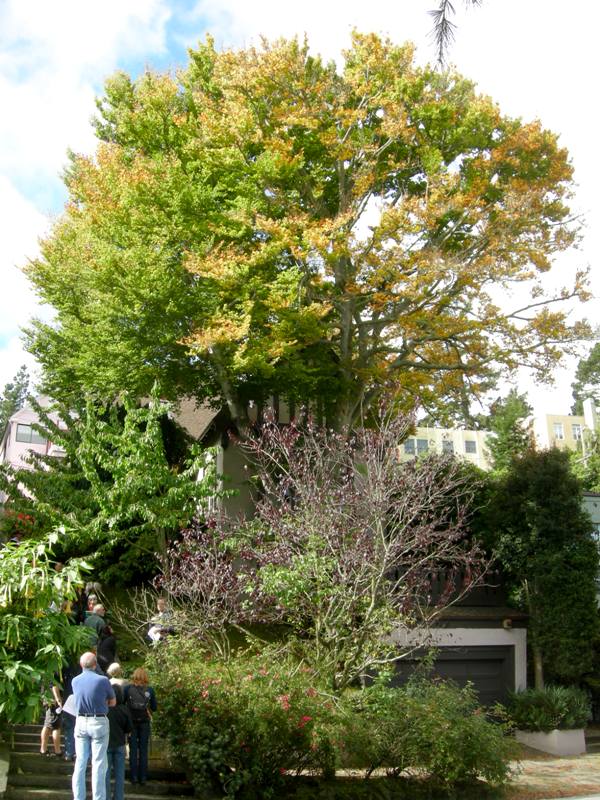
Most of the trees we saw were on private property, and some of the neighbors came out and told us about their trees. The owner of an English birch beech that I’ve often admired said the big window opposite the tree brought it right into the house, so it felt as though their living room was part of the tree.
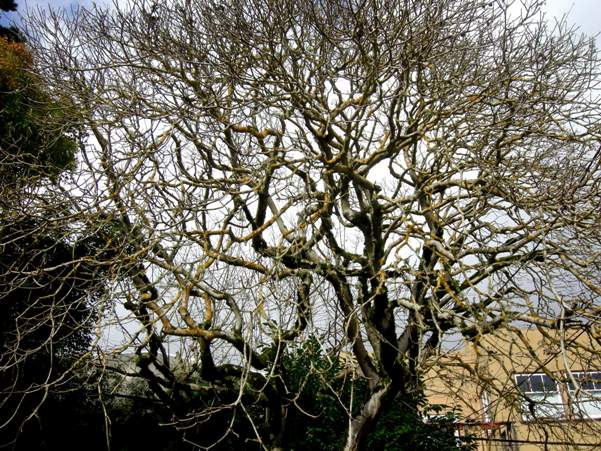
Elsewhere, someone invited us into his backyard to see a large buckeye, which was already bare – it shed its leaves as early as July – showing off the twisty branch structure. Mike told us that another buckeye is the subject of the only tree easement in the city — one that was saved from destruction when a builder bought the land on which it grows. Friends of the Urban Forest holds that easement.
Another neighbor told us about selecting sourwood trees – possibly the only ones in San Francisco – for the spot outside his home. Mike told us that the wood actually was sour, and jam could be made from the fruit. Later, we stopped to admire a rather large and twisted coastal live oak.
[Edited to Add: Forest Hill is proud of its trees; each one is tagged with a little metal accession number, and listed in a database. Someone explained that the neighborhood association cares for the trees; and will help a home-owner who wants to plant a tree to do so, free of charge. I have to say I was extremely impressed.]
One group of neighbors were trying to get support for a tree removal: A group of tall, stately, and possibly dangerous Monterey pines. They wanted to take down these trees, and replace them with smaller, younger ones.
WHAT NOT TO PLANT
One aspect of the tree tour didn’t appeal to me personally: Continual inputs about why various trees were bad. Invasive roots. Brittle wood. Dripping stamens and berries. Sensitivity to freezes. Pest vulnerabilities. (To be fair, most of these comments did not actually come from Mike.)
I think I’d want to know all these things if I were actually trying to select a tree for a street (a process Mike noted was extremely site-specific, depending on the micro-climate, the underlying soil, and the preferences of the owner).
But in the context of a tree-tour, a bit of a downer.
MIKE’S WEBSITE
In addition to his book, The Trees of San Francisco, Mike maintains a website at www.sftrees.com — including a list (no pictures, unfortunately) of interesting street trees by neighborhood, as well as ‘Mystery trees’ he wants to identify. It also has occasional updates about the particular trees mentioned in the book.
FRIENDS OF THE URBAN FOREST
The tour, which was free, ended with an appeal for support for Friends of the Urban Forest. This marvelous group helps plant street trees all over San Francisco.
The theme this Halloween seems to be spiders and pumpkins.
The pumpkins are a perennial favorite, of course, but the spiders? That’s new this year. Around our neighborhood, there were some bats and ghoulies and ghosties. And lots of giant spiders…
I’m hoping we have some kids coming round… those years I celebrate, I always end up with excess candy. (Except the year that the last callers were three teenage ghosts at 9.30, who kindly took most of the remnants. I didn’t feel guilty. At that age, they can handle it!)
Only a few days after the dense fog in the picture here – this is the view from Twin Peaks. City Hall glows orange, and so does the tip of the TransAmerica pyramid.
Our neighborhood pumpkin patch is at the foot of Warren Drive in Forest Knolls, at 7th and Lawton. For Halloween, the open space has been transformed into Clancy’s Pumpkins.
When I went down there to take some photographs, I found it was more than just a pumpkin sale.
The atmosphere was festive, with kids running around, some in costume, looking for the Perfect Pumpkin.
It had halloween decorations, a little zoo with white rabbits and white turkeys, and bales of hay stacked into mini-forts.
Of course there were loads and loads of orange pumpkins, with stocks waiting behind the scenes to replenish the stock that was sold.
And coming soon, I presume: Clancy’s Christmas Trees. Since the sign’s already up, though lined with pumpkins.
Mike Sullivan, author of the book The Trees of San Francisco that I wrote about, is giving a tree tour under the auspices of Friends of the Urban Forest (FUF). This is a fairly strenuous walking tour (unlike the Landmark Tree tour, which used a fairly large bus) and it’s in Forest Hill. Here’s the information from the FUF website:
Free Tour of Forest Hill
When: Sunday, October 31, 11am – 1pm
Description: Join us for a tour of landmark trees in the Forest Hill neighborhood led by Mike Sullivan, long-time tree tour leader, former FUF Board Chair, and author of The Trees of San Francisco. Forest Hill is one of San Francisco’s “best-treed” neighborhoods, and this will be the first-ever FUF tour of that neighborhood, so be sure to make this one! Meet at 381 Magellan (near Montalvo) in front of the Bernard Maybeck-designed Forest Hill Association Clubhouse.
Note: we will be traversing several staircases in the neighborhood, so be prepared for some strenuous walking.
Costumes optional.
This should be a great tour. Forest Hill has some really special trees.





















 FOREST KNOLLS NEIGHBORHOOD