Coyotes Among Us

Two neighbors have reported coyotes nearby in the last few days – one on Warren Drive, and one on Clarendon x Panorama.

“A very large coyote was seen at 11:30 a.m. today across from 101 Warren,” wrote Beverly.

“On 12/22/2012, approaching Clarendon from Panorama, waiting at the traffic signal, a rather frisky coyote crossed my path, going from south to north and into the undeveloped area bordering Clarendon on its East,” wrote John V.

Someone else saw one a few days ago on Mountain Spring Drive, which is just across Clarendon Avenue from us. In the last year, I’ve seen them myself on Twin Peaks, Glen Canyon, Diamond Heights, and in the grounds of Laguna Honda Hospital. They’ve also been sighted near West Portal, the Presidio, and elsewhere in the city. I’ve posted about coyotes here before, but I thought I’d do so again.

coyote looking at dog, San Francisco

From what I’ve been told, there are only about 10-12 12-18 coyotes in San Francisco. They are territorial, so it’s unlikely the number will increase very much. We know the Golden Gate pair had pups last year. (Click HERE for a cute picture of the pups at play; it’s from the RichmondSF blog.) The one (or ones) we’ve seen may be a Golden Gate pup grown up and seeking new spaces. (Coyotes look bigger in winter, when they grow their winter coats.) Or they could be any of the resident coyotes from the territories around us.

Coyotes cover great distances in their explorations, so it’s possible to see them almost anywhere in the city. The west side is particularly good for them; they mostly take gophers and rats and mice, available in the grasslands, and they need cover to hide from dogs and people. The west side of the city has both.

Generally, coyotes aren’t much bothered by people (and are shy of them). They are bothered by dogs, who they see as competitors and a potential threat. I’m told they remember dogs who chase them. Like dogs, they probably also can recognize individual people.

Though coyotes mainly prey on rodents (and are a much better solution than poisons like the ones that killed the Glen Canyon owl), they have been known to takes cats and even small dogs. They may fight even with big dogs who chase them, which is not good for either dog or coyote. So it makes sense to be careful – keep your cats indoors especially at night, and leash your dog if a coyote is around. Generally, don’t run from a coyote; it may trigger a chase instinct. Instead, walk away calmly. I’ve found yelling loudly at a coyote usually makes them run off in a hurry. (I’ve only done this once, when I was walking in Diamond Heights at night.) If  you’re concerned about coyotes, carry a “shake can” – a loud rattle made of some pennies sealed into a small aluminum can.

Please NEVER feed coyotes. A FED COYOTE IS A DEAD COYOTE.

[Edited to add: TV station CBS did a short video clip on Forest Knolls coyote sightings: Click HERE to see it.]

Janet Kessler, the Jane Goodall of San Francisco’s coyotes, spends a lot of time observing these animals and documenting her observations on www.coyoteyipps.com and she’s also written an article on peaceful coexistence for the Marina Times. You can see that HERE.

The precautions below are taken from her website.

coyote poster11

coyote poster21

Pelican K15 at Pacifica Pier

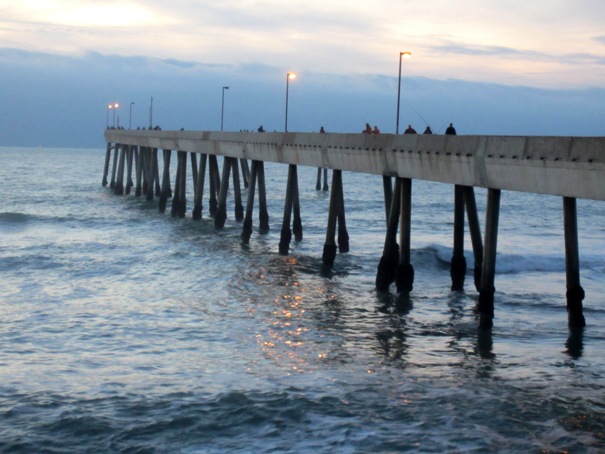
We’d gone for a walk to Pacifica Pier last month. It’s about 20 minutes from here, but feels like another world. When you walk all the way out and look down at the sea, it’s almost like being on a ship.

pacifica pier

It was late in the afternoon, and the fishermen were beginning to think about leaving. Suddenly, a [brown] pelican descended on the railing, quite fearlessly looking around for handouts.

pelican and fishers

pelican k15 I took a few snaps, then realized it was banded. I moved in closer, and could see the band was prominently marked K15.

It apparently knew the drill. A couple of people gave it their bait fish as they left.

One fisherman told me, as he packed up his gear, that this particular bird was often here. He’d been told, he said, that it was a youngster, and born late in the season. Mortality rates were high for such late-hatched birds.

I wonder if that’s true, and also wonder who banded the bird. It’s clearly meant to be read from a distance.

(If anyone knows, comment here or email me? I tried posting on the SFBirds group of Yahoo, but they only permit San Francisco posts.)

GULL RESCUE

As we were leaving, we saw a couple of wildlife rescue people armed with  net and a carry-box, rounding up an injured gull on the beach. I felt like cheering. (If you happen to read this, rescuers, thanks for your work!)

[Edited to Add: Later, I found out about International Bird Rescue. They have a form to report blue-banded birds on their website, so I did. Here’s what they wrote back.

K15 is one of our celebrities.  It hangs out at the Pacifica Pier a lot and unfortunately gets fed.  He has every ability to care for himself but he likes the snacks.   I am attaching some things for you and one is the poster for the banding project.  K15 is our poster bird.  K15 originally came into our rehabilitation clinic in Cordelia on June 23, 2011 with pouch lacerations and he was in a weakened state.   He was a first year bird and was rehabilitated and released on July 26, 2011 in Alameda.

K15 has been reported 10 times since his release.  It’s doing really well but I really hate people feeding it.  That makes them habituated and that always ends up bad for the bird.  Fingers crossed!
Thank you so much for reporting the bird.  I love your blog.

Thanks for the work you do!  (Here’s the poster – like the one below – as a PDF: BirdRescueBandedPelican)

pelican poster

And if you’re interested in more information about California’s brown pelicans, International Bird Rescue prepared a one-pager (attached here as a PDF): Understanding Brown Pelicans- final ]

Owls and Rat Poison

I have some further information about the owl that died of rat-poison. The chemicals were Brodifacoum and Bromadiolone, both of which are anti-coagulants.

These are “second generation” poisons, and cause death by internal bleeding. They’re both very potent, and are dangerous not only to rats, but to all mammals: cats, dogs, and small kids. And, as we’ve seen – birds, especially owls and hawks.

The antidote is Vitamin K, but it can take a 4-week course of treatment to cure a pet or a child.

The common brand names:

Brodicfacoum: FINAL, JAGUAR, PP-581, WBA 8119, d-con, Havoc, Ratak, Talon
Bromadiolone: Boot Hill, Bromone, Contrac, Maki, Rat-XB, Super-Caid, Super-Rozol

[Edited to Add: More information about the pesticides.]

In San Francisco, the SF Department of Environment permits the use of Bromadiolone on city-owned properties in the form of “Contrac All-weather Blox” — but only in a very restricted way:

For use only in City-owned sewer lines, San Francisco International Airport Terminal Areas, or for commercial lessees on city properties that are not adjacent to natural areas. In commercial establishments, use of product shall be a last resort after other, less-toxic measures have been implemented, including sanitation and trapping, and only where a significant public health hazard is recognized. In all cases, monitoring shall be used whenever feasible to minimize rodenticide use.

The other chemical, Brodifacoum, is not approved for use on city-owned properties.

The problem is that these chemicals are legal. San Francisco has a “Don’t Take the Bait” program in which they’re trying to get retailers and consumers to co-operate in not using the most dangerous formats for these poisons – but they’re still widely available.

Some of these poisons deliberately have delayed action, so that rats – who are pretty smart – will not realize that the bait is poisonous. That means that they go off after eating the bait, and then die over a period of days. They could die inside walls or under floors – or by being eaten by a hawk or owl or coyote or cat or dog when their weakness makes them easy prey. Then the bird or animal that eats them is at risk for poisoning. This happens a lot.

Sometimes, baits are set out in open trays, where any animal (or kid) who samples it can be poisoned.

Sad Death of Glen Canyon’s Great Horned Owl

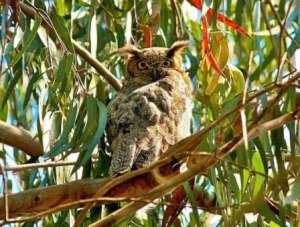
Great horned owl in eucs (Photo: Janet Kessler)
Great horned owl, Glen Canyon (Photo: Janet Kessler)

A few weeks ago, the Glen Park group had news of a Great Horned Owl found dead in Glen Canyon. There’s a well-known pair of owls that nest there every year, and typically raise two or three chicks. Neighbors fear this may be the male of that pair.

Of course people were upset, and they raised money for a necropsy – an autopsy for animals. This was conducted arranged by Wildcare, a wonderful organization that rehabilitates injured wildlife. (I’ve written about them before, HERE.)

The result came in today. The owl died from eating poisoned rodents.

According the Wildcare press release,

“Commonly available rodenticides [rat poisons] are consumed by rodents, the basic food source for a number of different predators all the way up the food chain. These poisons kill by making whatever animal eats them bleed to death internally – slowly and painfully. While the poisoned animals – targeted or not – are still alive, they can be consumed by other predators. It is a terrifying prospect; to kill many animals while targeting only one.”

three owlets (Photo: Janet Kessler)
Three Great Horned Owlets (Photo: Janet Kessler)

A Great Horned Owl eats about 5 rodents a day, and much more if it’s feeding young. Its favorite prey is skunk, but it also eats rats and mice, rabbits, and birds.  If someone poisons rats to get rid of them, they don’t die right away. Instead they wander around, increasingly weak and slow – and thus particularly attractive to predators. The poison can then kill the bird or animal that eats it – or even the next animal up the food chain. [Edited to add: More HERE about the specific poisons that killed this owl.]

PROTECTING OUR NEIGHBORHOOD OWLS

We have Great Horned Owls in our neighborhood. I’ve seen them in Sutro Forest, up on the hillside, and in trees along Crestmont and Christopher. I’ve seen one on a lamp-post on Clarendon Avenue.  We also have barn owls, which are even more vulnerable because they’re not large enough to eat skunks but eat more rats and mice instead. Every time we use rat poison, we’re endangering these birds.

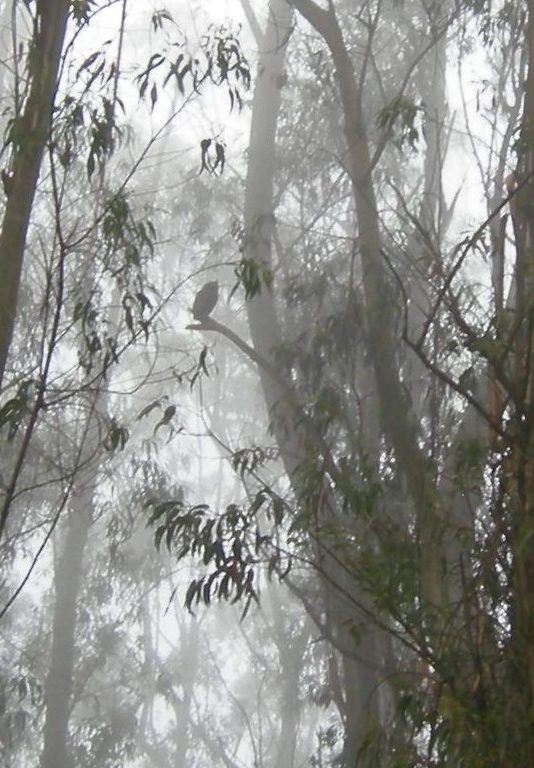
Eucalyptus, fog, Great Horned Owl (Photo: Rupa Bose)

Earthquakes and Ostriches: The Cutest California Academy of Sciences Exhibit

The California Academy of Sciences has an exhibit about earthquakes, so of course, it has ostrich chicks.

You don’t see the connection? Neither did I, actually, but I had to see the ostrich chicks.

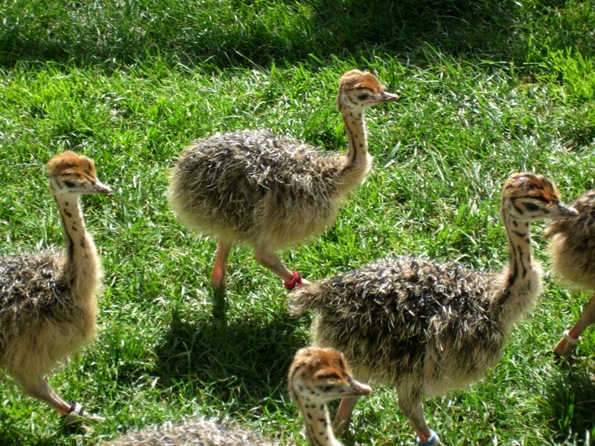
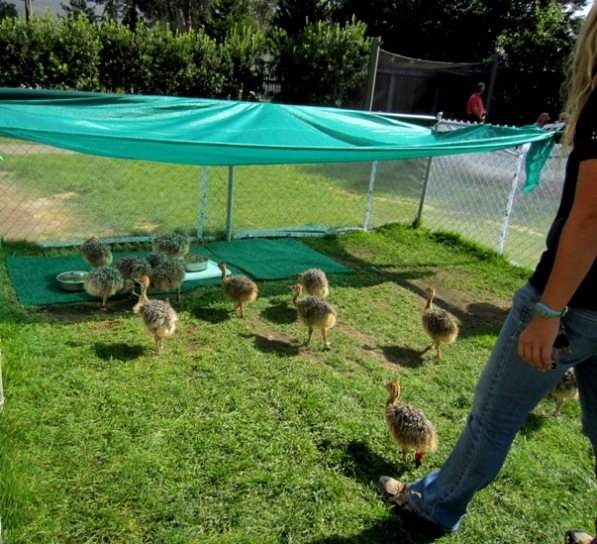
As a member of the Cal Academy, admission is free and I can guiltlessly just drop by. That’s what I did today, just to see the ostriches, and was directed to the end of the building. But the enclosure was empty. The ostrich babies were actually outside, being exercised in a large pen in the sunshine.

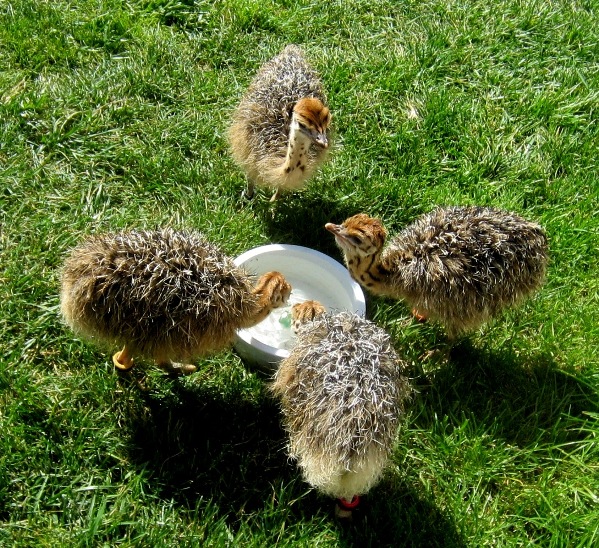
These little guys were 20 days old, and as you see here, still fuzzy. The fuzz is actually rather like dry grass in texture, and doubtless helps conceal them on the African plains. Ostriches form harems, with 6-7 females and a male, and lay eggs in a communal nest. The females incubate it in the day, the male in the night. When the chicks hatch, they’re ready to run with the flock. In nature, they’d be chasing their mother around the savanna, much like outsize chickens (or she’d be chasing them).

The Academy chicks are indoors much of the time, and so this outdoor exercise time is important to their development. They came as eggs from a ranch in Escondido, the docent explained, and were hatched in an incubator at the Academy. As they outgrow the exhibit, they’ll be sent to various zoos, or back to the ranch. The Academy hatches a new batch every few weeks.

I’m wondering if these little chicks are going to imprint on humans… I was reading on the internet that they do, sometimes, and then the males will direct its mating displays to its human attendant instead of the female ostriches.

Oh, and the connection with earthquakes? Well, it’s plate tectonics.

As the earth’s tectonic plates separated, they parted related birds onto different continents – emus and rheas and ostriches. They’re all flightless rattites, but each evolved flightlessness separately.

Plate movements also cause earthquakes.

And if the connection still seems a bit far-fetched, it’s a good excuse for a display of fuzzy ostrich-babies.

Stow Lake Photo Swap

At Stow Lake yesterday, we came upon a couple looking at something. We stopped to see what it was. There on the ground was a red crayfish. We’d never seen one at Stow Lake before, and neither had they, though they visit often. I pulled out my camera.

“You have a camera?” the lady asked. “We came from someplace else, so we didn’t bring ours.”

Even better, my companion had an iPhone. He could take the photo and instantly send it to their email address.  Which he did.

Here’s the iPhone picture of the crayfish.

(We’re still wondering what it’s doing there, on the dry dusty path.)

When they emailed back to thank us, they sent us this enchanting picture of three baby Great Horned Owls in Golden Gate Park.

When I asked for permission to publish it, they agreed. In a follow-up they said, “One of the really nice things in the park is sharing wildlife, especially with people who may not have ever seen owls, or herons, or bats…

Couldn’t agree more. We’re so fortunate to have this wonderful park ten minutes from our neighborhood.

Stow Lake Surprise

Stow Lake in Golden Gate Park on a golden summer evening… it’s one of my favorite places to walk.  It was past seven when I got there, not crowded at all, though a few joggers and walkers and families were still around.  So also a few ducks and gulls, and something that splashed from time to time.

What was it?

A single pied-bill grebe was diving around the boat island, but it didn’t splash hard, it just dived in and vanished. But walking along the water’s edge, I came upon a possible splasher: a large koi fish, I estimate over a foot long. It was white and gold, not the usual well-camouflaged gray. So maybe the splashing was from fish? I still don’t know.

Stow Lake August ducklingI crossed the bridge beyond the boat house, and was startled to see a little bird bobbing along the reeds on the other side: a duckling. It busily swam along the reads, reaching up into the overhanging bushes. Its mother floated patiently along, just supervising junior. I was surprised because it’s so late in the season. I wonder if mallards can hatch a second brood?

I watched it for a while as it explored, for all the world like a toddler running ahead and stopping and looking, while its mother looks on. Here is again, hiding in the shadows of the overhanging tree.

Strawberry Hill was busy with squirrels, showing off their white shirt-fronts as they sat up to people-watch. They moved with the confidence of the popular, knowing that humans were more likely to admire than threaten. And maybe there’d be a nut or two on offer.

There’s been undergrowth removal on Strawberry hill, and maybe tree-trimming as well. It seems rather bare by comparison to what I remember from previous years. Steller’s Jay’s, blue birds with charcoal gray heads and crests, flew around the trees; the work seems to have opened up hunting grounds for them.

On the way back, I came upon the last surprise. Two people were looking at this: A crayfish. Never seen those before at Stow Lake, either.

Missing Cat [FOUND] – Maine Coon – Jan 2012

A note from a neighbor:

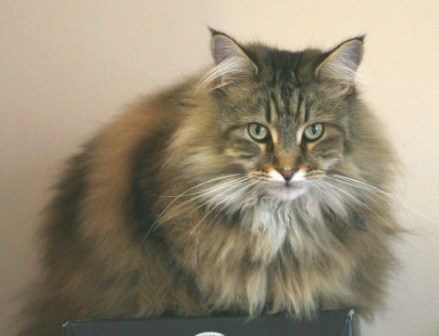
Our gray/brown/black Maine Coon cat, Rosie, has been missing since yesterday afternoon [6 Jan 2012] from her home at +++ Christopher, near Oak Park. She is an indoor – outdoor cat, but rarely stays out long. She has a collar and tag, but it’s hard to see under all her fur, and has been known to fall off. She is usually afraid of strangers, and has never been in a fight.

If you’ve seen her, please email  or call us at [Edited to remove] . Thanks!

Edited to Add:  Good news! Rosie is safe home. Here’s the note I received:

“Thank you to everyone who expressed concern. Rosie seems to have gotten accidentally detained in a neighbor’s garage. She’s fine, and we’re happy to have her home.”


Making Buildings Safe for Birds

“This is a local issue,” a neighbor said, asking for a response. San Francisco is in the process of finding ways to make buildings safe for birds. In fact, the Supervisors are right now in the process of figuring out what rules are needed (they’ve decided in principle that it should be done).

If you think it’s a good idea, write to your Supervisor. (Right now, ours is Sean Elsbernd; his email address is Sean.Elsbernd@sfgov.org )

More details below (this post is replicated from SutroForest.com)

——————————————————-

Bird-killers. More dangerous than wind-farms, more insidious than cats… it’s windows. (The glass ones, not the thing produced by Microsoft.) Birds can’t see normal glass, and crash into it. Either they die, or they become easy prey.

San Francisco, like Chicago and Toronto, is trying to introduce legislation to make glass buildings safer for birds. Here’s a quote from the Planning Department website:

The newly adopted Standards for Bird-Safe Buildings [Note: this is a PDF file] explains the documented risks that structures present to birds. Over thirty years of research has proven the risk to be “biologically significant” for certain bird species. Recent studies have determined that annual bird fatalities in North America from window collisions may be as high as 1 billion birds per year or 1-5% of all birds. While the facts are staggering, the solutions are within reach. The majority of these deaths are foreseeable and avoidable. The document summarizes proven successful remedies such as window treatments, lighting design, and lighting operation. The document proposes a three-pronged approach to the problem:

  1. establishment of requirements for the most hazardous conditions; ( page 28 of Standards for Bird-Safe Buildings )
  2. use of an educational checklist to educate project sponsors and their future tenants on potential hazards; and ( page 38 of Standards for Bird-Safe Buildings )
  3. creation and expansion of voluntary programs to encourage more bird-safe practices including acknowledging those who pursue certification through a proposed new program for “bird-safe building” recognition. ( page 33 of Standards for Bird-Safe Buildings )

If you’re living in San Francisco, please write to your Supervisor to support this.

SAVING CRASHED BIRDS

And meanwhile: If you find a crashed bird and it’s not dead — try to rescue it by providing a safe quiet place and some food and water. There’s a heart-warming story here on Walter Kitundu’s marvelous bird blog, wherein he saves a young Western tanager. It has some charming photographs.

Red-tailed Hawks in Forest Knolls

Mary Allen posted these two great pictures of red-tailed hawks on our neighborhood Yahoo Group. They’re reproduced here with her permission and her notes.
These were taken from my living room windows… south facing toward Laguna Honda Hospital. They like to rest at the top of the tree on Warren at the bottom of my hill. I have my camera set up ready to go and when I happen to see them, I quickly rush to open the window and click away before they fly off.
(Taken with a Nikon D5000 200 mm lens.)

San Francisco Butterfly Count Results, 2011

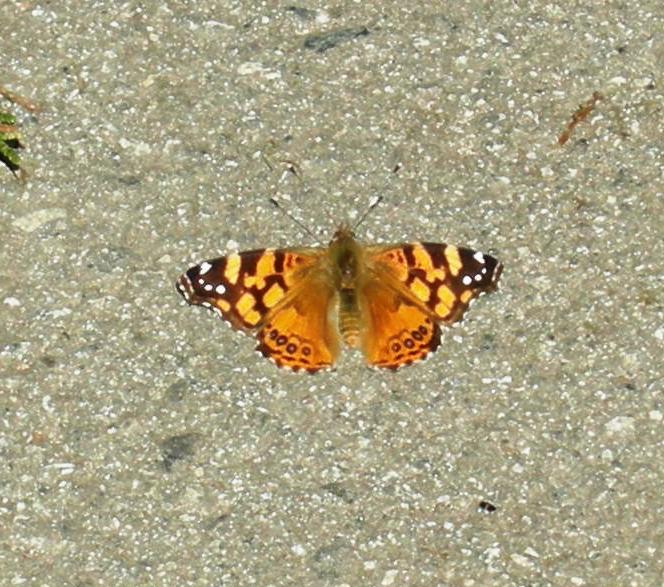
The results are in! The sunny day paid off; the teams (34 people) saw 990 967 butterflies of 26 species. Last year, it was 775 butterflies, 24 species. The count this year was a month later than in 2010, and in hot weather rather than on cold and foggy day. Also, they looked on Angel Island for the first time.

The Cabbage Whites were the most common. Next were the striking yellow Anise Swallowtails. These two butterflies accounted for nearly half the butterflies the teams observed.

If you’re interested in more detail, there’s a full list here.

You can Count Butterflies in San Francisco Tomorrow: 3 July 2011

The North American Butterfly Association is sponsoring the annual butterfly count in San Francisco. It’s usually in June, but had to be postponed this year because of the wet weather. So it’s tomorrow, July 3, from 9 a.m. to 5 p.m. If you’re interested, bring lunch, and contribute $3. They are happy to have amateurs.

One group meets at the Randall Museum (199 Museum Way), with Liam O’Brien coordinating. (Email: liammail56@yahoo.com).

Another meets at the Presidio and will be led by Matt Zlatunich. (Email him at  mbzlat@yahoo.com).

Cats, Lies, and the Smithsonian Catbird Study

Like many of us in this neighborhood, I like birds and animals, including cats. So I was dismayed to see the recent  SF Weekly with a huge cover picture of a demonic cat. It contained an article by the controversial journalist Matt Smith, using as fodder a press release from the Smithsonian about a study done in 2004.

That study implied that cats are the main cause of death of small birds. It’s become a talking point for those advocating stronger measures against feral and outdoor cats.  But did the study’s results justify it? No way.

It sounded pretty bad. According to the website of the Smithsonian, “The main determining factor was predation, which accounted for 79 percent of juvenile catbird deaths within the team’s three suburban study sites. Nearly half (47 percent) of the deaths were attributed to domestic cats…”  This makes it sound like cats killed a huge number, over a third of the birds. What huge number was it, actually?  Well, six.

The study followed 69 young catbirds (the name is a coincidence, it has nothing to do with cats really) by putting tiny radio transmitters on them. In the five months of the study (May-September 2004),  42 died from predators, glass-panes, or disease. Cats killed only 6 of them.

Here’s the real picture:

WHAT THE RESEARCHERS DID

Working in three Maryland suburbs filled with homes and gardens, the  researchers tagged a total of 69 baby catbirds with tiny radio-transmitters. They tracked the birds until the bird was found dead, or its signal disappeared, probably meaning it had moved on.

Of the 42 that died, the researchers figured 33 were killed by some kind predator. For 19 of them, the researchers thought they could make a good guess at what kind of predator got the bird. Besides the 6 actually killed by cats, they thought another 3 probably were because they were found headless. But it turns out that many hunting birds (owls, hawks, for instance) also bite off the head first, so assuming cats did it is a stretch.

Unfortunately, when the study was published, the abstract (the summary that’s the only thing most people read) said:

Why is this misleading?  Two reasons. First, it includes the headless birds that probably were killed by something else. Second, it compares the number with “known predation events” — which just means the number of cases where they guessed at who killed the catbird. What they should use is a comparison agains the whole bunch of tagged birds: 6 out of 69. That would be 8.7%.  The graphic below represents the real story.


And since it’s in the nature of predators to go for the weakest and slowest, it’s more than likely that if the cats didn’t get them, something else would have… an owl, a hawk, a rat, or disease.

What really hurts our birds is destroying their habitat. Everywhere in the city, bushes and thickets are being removed, even in the so-called “Natural Areas.”  Some ground-nesting birds like the quail are particularly affected. It’s easy to blame cats, especially feral cats. Though cats do hunt birds, they’re far more likely to get rodents. But small birds are prey to everything that hunts: hawks, owls, coyotes. They need places to hide and nest.

Not that I’m particularly advocating outdoor cats. Quite aside from the whole bird issue, they are themselves at risk from predators, whether with two legs or four legs or four wheels. As their reflexes slow with age, they face greater odds.

[A longer version of this article appeared on the Sutroforest.com site.]

Twilight Adventure in Golden Gate Park: Raccoons and Janet Kessler

There are a couple of really neat blogs I follow. One is Golden Gate Park: View From the Thicket, with articles about our neighborhood park.

The other is Coyote Yipps, an observational blog by Janet Kessler, who observes and documents a clan of San Francisco coyotes. (Had Jane Goodall kept a blog about her chimpanzees, it might have looked something like this.) [ETA: She’s been interviewed by the New York Times: click here for the story; and featured in an Associated Press story on coyotes by Robin Hindery, which has appeared in a large number of publications.]

Janet Kessler is also a wildlife photographer with a local focus; her website has wonderful animal pictures taken in and around the city. So imagine my delight when I found a convergence of the two: View From the Thicket published Janet’s story about photographing raccoons in Golden Gate Park. Here, for your enjoyment, is the article (reprinted with permission).

——————————-

a wildlife photographer shares twilight adventure in golden gate park


Janet Kessler took this delightful photograph of a raccoon in Golden Gate Park for an exhibit at the main San Francisco library last summer.  The following is her description of capturing these elusive animals on film  .  .  .

“I had been invited to put on a photographic wildlife exhibit at the main library — what an honor!  As I began preparing the photographs for the show, I realized that I really needed more animals — more animals that everyone would know about.  For starters, I decided that I needed a shot of a raccoon. Raccoons normally come out after dark, so I roped my husband Jack into coming with me, because, also, I would be visiting unknown parts of the park. We had an early supper and headed out well before dark: me with my camera, and Jack with a powerful emergency flashlight which we bought years ago for, well, not exactly this kind of activity, but it was the best we had. I had no special nighttime photography equipment — the emergency flashlight would have to do.

Jack also carried his brand new iPhone — it can do anything. We started walking in the park, not knowing anything at all about raccoons, just relying on hope. Jack wanted a little more guidance — he didn’t want to stay out all night, and we couldn’t decide on where to find raccoons. So, as we walked, he looked up “raccoon” on the internet. Of absolute relevance, but a complete surprise to us, was that raccoons live in trees. Come on, give me a break! We argued this, back and forth, but finally decided to “look up” as we walked — “just in case” — maybe we would see something. As it got darker, I eventually noticed a denser area up in one of the trees. I looked and looked, and decided, without really being able to see anything, that this might  be a raccoon way up there, 75 feet above the ground.

So, we settled down and waited — until Jack had had enough and said it was time to go. After all, there were unsavory fellas roaming around, too close for comfort, and they were even looking at us. He did not like it. But I felt safe with him, and decided we needed to stay a little longer — I think my enthusiasm and sense of adventure may have overpowered him. We decided to sprawl out on the ground at the base of the tree,  to avoid neck-cramps. Here we enjoyed looking up into the tree branches — the way we all have when we were little.

We had arrived in the park at 6:00pm, and now it was 10:00pm, when slowly we began to notice movement. Ahh, something was happening. The movements occurred infrequently at first, but slowly, ever so slowly, there was more. And then, YES, we saw a raccoon tail — you could barely make out the stripes, but they were there!  Yes, this would be my chance to take a raccoon photo. The raccoon was still high up in the tree, so we remained in our prone positions so as not to cause alarm. There was more movement. And then we noticed something very strange. That tail over there couldn’t possibly be connected to that raccoon, could it? Noooo — there were two raccoons! We could feel our excitement mounting.

The raccoons were still high up in the tree when, oh no, could it be? We now counted three of them!!  It is at this time that we got up. My husband shined the light on the raccoons and I tried taking photos as they all slowly made their way down the tree trunk. A flashlight hardly produces enough light for taking photos, but we were able to get some fairly decent shots. After reaching the ground, the mom moved off, as did the larger of the cubs. But the smallest, the runt, actually turned around and came back to examine us from a high log on the ground. Hi there! The shutter of my camera kept getting stuck because of the lack of light, but we did get the photos I wanted, which I am including here.

We went home that evening, not only with a few raccoon photos, but also with an adventure to remember and a story to tell!  Golden Gate Park at Twilight!”

Here’s a link to Janet Kessler’s [photo] website:   http://www.urbanwildness.com/urbanwildness.com/Index/Index.html

A Barn Owl’s Sad End

One of San Francisco’s ace birders, Dominik Mosur, works at San Francisco’s Randall Museum, and occasionally gets calls from people finding birds in distress. On this occasion, it was worse than distress. The barn owl in a pine tree at the Mission High School was dead. The bird had lived around there for some months, hunting and perching.  Now it was dead.

Photo credit: Dominik Mosur

He retrieved the body and found the cause of death. Some netting, possibly from a Christmas tree, had caught on the owl’s foot, and snagged on a branch, trapping it.

This is a message to please think about discarded materials  — particularly things like plastic netting, fishing line, or six-pack holders. If this had been rope, maybe the bird could have bitten through it and escaped. With plastic, there was no way.

According to Rebecca Dmytryk of WildRescue, a wildlife rescue organization in Moss Beach:

“Sadly, this sort of accident is not unusual. Birds can become tangled in discarded fishing line, kite string, or netting, then the material catches on a branch and then they’re stuck, sometimes hanging upside down. The worst part about this story though, is that no one knew it was in trouble I guess, and it starved to death.”

A press release on the subject said:

Dmytryk hopes this story will prompt people to be more vigilant and quicker to report wild animals in distress. If they do not know whom to call they can use Wildrescue’s toll-free hotline that will provide the number to the nearest rescue organization – that’s 1-866-WILD-911. They can also report injured wildlife directly to rescue@wildrescue.org or paging a rescue team at 831-429-2323.

Anyone interested in learning more about what to do when they find an injured wild animal may be interested in attending their Wildlife Search & Rescue class being given in coming weeks.

Learn what to do when you come face to face with a wild animal that’s in trouble and needs help. Learn how to become part of a team of trained and qualified rescuers who respond to emergencies involving wildlife on a regular basis. This class is the ONLY one of its kind and is tailored for those who work with animals and want to better their skills and those who have an interest in becoming a volunteer wildlife rescuer.

The lecture part of the class covers laws and regulations governing wildlife rescue, human safety and animal safety concerns, capture strategies, proper animal handling techniques, basic first aid for wildlife accident victims, and initial care of healthy wild babies. The afternoon portion of the program gives students the opportunity to try out equipment and practice their skills with Robo-Duck.
To REGISTER :  w i l d r e s c u e . o r g (831) 840-3896 rebecca@wildrescue.org

ALAMEDA:  FEBRUARY 5, 9:00 – 3:00, Shorebird Nature Center, 160 University Ave. Berkeley
SANTA CLARA: JANUARY 28, 9:00 – 3:00, Morgan Hill PD, 16200 Vineyard Blvd. Morgan Hill
MONTEREY:  JANUARY 15, 9:00 – 3:00 Elkhorn Yacht Club, 2370 Highway 1 Moss Landing
SANTA CRUZ: JANUARY 29, 9:00 – 3:00, Santa Cruz PD, 155 Center Street,Santa Cruz

Stow Lake with Winter Birds

Having Golden Gate Park so close to home is a gift.

It was a beautiful afternoon, and we headed for Stow Lake. So did a number of  winter birds, the ones that spend their summers in the Arctic and their winters in San Francisco.

I hadn’t brought my bird-book, and couldn’t ID them, being more of a wannabe birder than an expert; but they graciously posed for photos. After that, it was on to my Lone Pine Field Guide of the Birds of Northern California, and a little help from Google.

There were gulls.  Most people consider gulls a  white or brown-streaked aquatic version of crows and ravens. So I was surprised to discover several different species of gull at Stow Lake, besides the ubiquitous Western Gull.

Mew Gull


The first one I saw was a little self-conscious Mew Gull. These gulls visit San Francisco in winter, hanging out in Alaska and Canada during the summer.

Not a Thayer's Gull, but not yet identified

The Thayer’s gull, which resembled the snow owl from the Harry Potter books,  was so pretty I took a bunch of photographs. It looked like it was covered in lace. It also spends summers in the Canadian arctic. This is probably a young gull in its first year. As it grows older, it’ll look quite different — more like the Western Gull. [Edited to Add: This gull apparently is not a Thayer’s. It may be a cross between two other species of gulls. I didn’t actually know there were such things as gull hybrids, which complicates an already tough-for-amateurs identification problem. Thanks to expert birders in the SF Birds Yahoo Group, where the discussion continues.]

Herring Gull

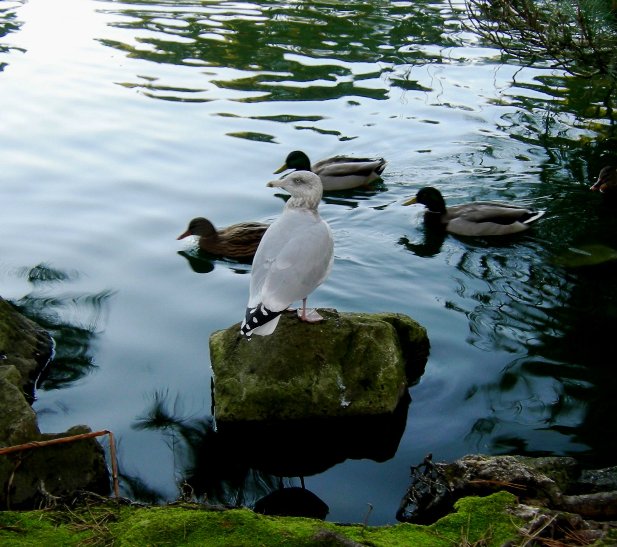
This herring gull really did look like it was posing on that rock, standing sentinel. It’s another winter visitor, just like the Mew and the Thayer’s.

Feeding Frenzy

Someone brought Cheerios for the birds. Gulls have no table manners. Lots of violence and swearing. Luckily the kid couldn’t understand gull-speak.

Mine!
White-fronted Geese

Usually the geese out at Stow Lake are the big Canada geese everyone knows. But today, there were three White-Fronted Geese cropping at the grass on the roadside, and ignoring people passing within a few feet of them. Don’t know why they’re called white-fronted — they look very brown to me. (The black bird in the picture above is an American Coot.)

And finally, there was this odd duck with a brown head and white throat. I don’t know if it’s a species I couldn’t ID, or if it’s just a variant of the Mallards we see everywhere.

An unexpected bonanza for what was planned as a lovely afternoon walk .

Evening Walk with Owl and Moon

I went for a walk around our neighborhood last evening… Forest Knolls is easy night-time walking. Good sidewalks. Bright but not oppressive lighting. A dramatic crescent moon setting over a theatrical city-lights backdrop.

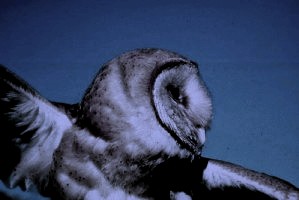
And a barn owl, flying overhead. They’re very silent, so I can’t say what made me look up, but there it was, winging its way over the neighborhood. It may have been hunting, but I think it was just checking the place out.

It’s easy to tell a barn owl from a great horned owl — our other neighborhood owl —  even in the dark, even in flight. A barn owl appears white, and its head looks round. It’s sometimes called a “ghost owl.” It doesn’t have the “ears” or “horns” that a great horned owl has. It also flies more nimbly. Rodents, beware!

The picture here isn’t the owl I saw; that was moving too fast for my camera and my reflexes. It’s a public domain picture that I’ve tweaked to make it somewhat similar to that owl. I wonder if this was the same owl I saw some weeks ago on Twin Peaks.

Wildlife Rescue

Living near the forest as we do, we have a fair amount of wildlife around us: birds, raccoons, skunks, opossums, coyotes and who knows what else. So what happens if you’re suddenly responsible for a small, injured creature?

Today I found out, when I volunteered as an ambulance for a Green Heron. You take it to WildCare in San Rafael (at  76 Albert Park Lane, San Rafael, CA 94901).

Actually, first  you find out if it actually needs help:

  • Call Wildcare at 415-456-7283 (9 a.m. to 5 p.m.)
  • If it’s after 5pm PST (Pacific Standard Time), call their 24-hour Nightline at 415-300-6359.
  • Read their very informative page.

Then you decide if you should take it in. It’s a long drive, but you might save a critter’s life. 

They’re open 9 a.m. to 5 p.m. every day of the year, and they have a wildlife hospital. They try to rehabilitate the animal or bird, and release it back to the area it was picked up. (California law does not permit relocation of wildlife.)

It’s a pleasant place, just across a little creek, which has tree-lined banks and a resident duck population. The courtyard is lined with cages, enclosing birds that cannot be released, usually because they have a disability that prevents them from fending for themselves. It also has a pond with a couple of resident pelicans (one brown, one white), a sea-gull, and an egret that may just have been visiting.

The Green Heron had flown into someone’s living room, and been brought to the Randall Museum. Though they do have an animal room, they don’t do wildlife rehabilitation, so the bird needed to go to Wildcare. [ETA: Wildcare sent an emailed update: “The Green Heron was suffering from wounds and I see a note of a fracture. I see from the log book that it was transported to International Bird Rescue up in Fairfield on the 7th. IBRRC have the facilities best suited to shore
birds and one of our fantastic volunteers gave the Heron a ride up there.”]

I took a photo of it, then dropped it off, and spent a few minutes looking round at the denizens of the courtyard. (Visitors are welcome.)  The birds were beautiful – a Swainson’s hawk, a spotted owl, and a turkey vulture among others.

Each was accompanied by naturalist’s notes. They were all informative, but my favorite may have been the one by the turkey vulture. “Don’t be surprised to see a melon in here with our Turkey Vulture,” it said. “Although they eat carrion, they do like a change once in a while. In fact, there have been cases where large numbers of Turkey Vultures have descended on a pumpkin patch.”

The image was irresistible, especially in this season.

Critter-Spotting on a Foggy Night

A foggy night in a city that knows how to keep its secrets… and me, prowling along in my little car, hoping it would share them. Not the kind of secrets found in City Hall or downtown in the dark alleys… critters.

Foggy nights are often good for critter-spotting. On Panorama Drive, I saw a trio of raccoons chase each other across the road and disappear into the shadows between two houses. And then, on Twin Peaks, which was densely swathed in fog, a barn owl!

I’ve been wanting to see one, ever since learning that they do inhabit San Francisco. This one was sitting by the side of the road, like a large white cat wanting to thumb a ride. Cursing myself for forgetting my camera, I stopped the car and put my flashers on to watch it.  I was afraid someone coming fast round the bend might take it out, and wished it would move. It walked down the road a bit, which didn’t help. Two cars went around me.  Then the  owl took flight, just a few feet, but thankfully onto the hillside.

I went home for my camera, but the owl had moved on. At least it wasn’t roadkill.

Our Neighborhood Owls

Yes, there's a great horned owl on the branch...

Out for a walk by Sutro Forest yesterday evening, we saw our neighborhood Great Horned Owls. They live and nest in the forest, and come out around dusk. I first noticed them some years ago, and I’d heard them even before that. (If you hear a soft resonant hoot, that’s them. Most other kinds of owls don’t hoot; they screech or cry out.)

Great horned owl, not a bunch of leaves.

One of them was perched in the fork of a big eucalyptus tree, looking out at the landscape, waiting for dark and hunting time. As we stopped to watch the watcher, its mate arrived, landed on a higher branch, and looked around with interest. As long as we chattered, they ignored us, but when we whistled softly, they bobbed their heads and turned to look at us.

No one had a camera, so these indistinct images are from a cell phone.

It was amazing, to see these splendid birds so near home. “I’ve never seen owls so close up before,” said my companion. We felt very lucky indeed.