Mary Allen posted these two great pictures of red-tailed hawks on our neighborhood Yahoo Group. They’re reproduced here with her permission and her notes.
These were taken from my living room windows… south facing toward Laguna Honda Hospital. They like to rest at the top of the tree on Warren at the bottom of my hill. I have my camera set up ready to go and when I happen to see them, I quickly rush to open the window and click away before they fly off.
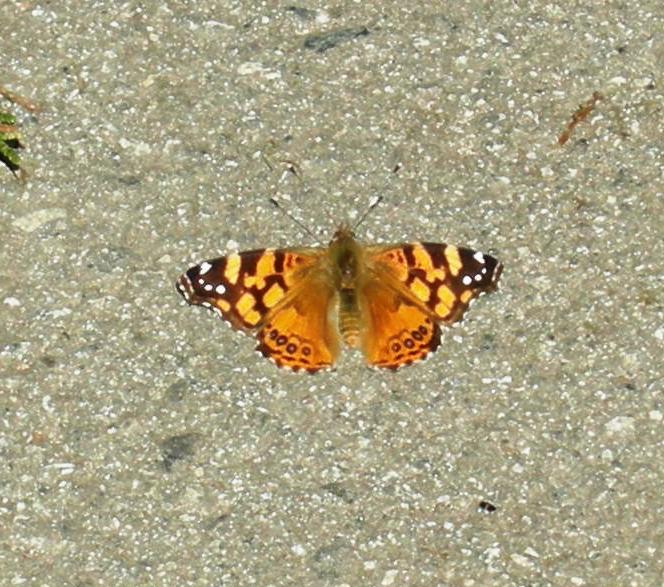
The results are in! The sunny day paid off; the teams (34 people) saw 990 967 butterflies of 26 species. Last year, it was 775 butterflies, 24 species. The count this year was a month later than in 2010, and in hot weather rather than on cold and foggy day. Also, they looked on Angel Island for the first time.
The Cabbage Whites were the most common. Next were the striking yellow Anise Swallowtails. These two butterflies accounted for nearly half the butterflies the teams observed.
The North American Butterfly Association is sponsoring the annual butterfly count in San Francisco. It’s usually in June, but had to be postponed this year because of the wet weather. So it’s tomorrow, July 3, from 9 a.m. to 5 p.m. If you’re interested, bring lunch, and contribute $3. They are happy to have amateurs.
One group meets at the Randall Museum (199 Museum Way), with Liam O’Brien coordinating. (Email: liammail56@yahoo.com).
Another meets at the Presidio and will be led by Matt Zlatunich. (Email him at mbzlat@yahoo.com).
One of San Francisco’s ace birders, Dominik Mosur, works at San Francisco’s Randall Museum, and occasionally gets calls from people finding birds in distress. On this occasion, it was worse than distress. The barn owl in a pine tree at the Mission High School was dead. The bird had lived around there for some months, hunting and perching. Now it was dead.
Photo credit: Dominik Mosur
He retrieved the body and found the cause of death. Some netting, possibly from a Christmas tree, had caught on the owl’s foot, and snagged on a branch, trapping it.
This is a message to please think about discarded materials — particularly things like plastic netting, fishing line, or six-pack holders. If this had been rope, maybe the bird could have bitten through it and escaped. With plastic, there was no way.
According to Rebecca Dmytryk of WildRescue, a wildlife rescue organization in Moss Beach:
“Sadly, this sort of accident is not unusual. Birds can become tangled in discarded fishing line, kite string, or netting, then the material catches on a branch and then they’re stuck, sometimes hanging upside down. The worst part about this story though, is that no one knew it was in trouble I guess, and it starved to death.”
A press release on the subject said:
Dmytryk hopes this story will prompt people to be more vigilant and quicker to report wild animals in distress. If they do not know whom to call they can use Wildrescue’s toll-free hotline that will provide the number to the nearest rescue organization – that’s 1-866-WILD-911. They can also report injured wildlife directly to rescue@wildrescue.org or paging a rescue team at 831-429-2323.
Anyone interested in learning more about what to do when they find an injured wild animal may be interested in attending their Wildlife Search & Rescue class being given in coming weeks.
Learn what to do when you come face to face with a wild animal that’s in trouble and needs help. Learn how to become part of a team of trained and qualified rescuers who respond to emergencies involving wildlife on a regular basis. This class is the ONLY one of its kind and is tailored for those who work with animals and want to better their skills and those who have an interest in becoming a volunteer wildlife rescuer.
The lecture part of the class covers laws and regulations governing wildlife rescue, human safety and animal safety concerns, capture strategies, proper animal handling techniques, basic first aid for wildlife accident victims, and initial care of healthy wild babies. The afternoon portion of the program gives students the opportunity to try out equipment and practice their skills with Robo-Duck.
To REGISTER : w i l d r e s c u e . o r g (831) 840-3896 rebecca@wildrescue.org
ALAMEDA: FEBRUARY 5, 9:00 – 3:00, Shorebird Nature Center, 160 University Ave. Berkeley SANTA CLARA: JANUARY 28, 9:00 – 3:00, Morgan Hill PD, 16200 Vineyard Blvd. Morgan Hill MONTEREY: JANUARY 15, 9:00 – 3:00 Elkhorn Yacht Club, 2370 Highway 1 Moss Landing SANTA CRUZ: JANUARY 29, 9:00 – 3:00, Santa Cruz PD, 155 Center Street,Santa Cruz
Having Golden Gate Park so close to home is a gift.
It was a beautiful afternoon, and we headed for Stow Lake. So did a number of winter birds, the ones that spend their summers in the Arctic and their winters in San Francisco.
I hadn’t brought my bird-book, and couldn’t ID them, being more of a wannabe birder than an expert; but they graciously posed for photos. After that, it was on to my Lone Pine Field Guide of the Birds of Northern California, and a little help from Google.
There were gulls. Most people consider gulls a white or brown-streaked aquatic version of crows and ravens. So I was surprised to discover several different species of gull at Stow Lake, besides the ubiquitous Western Gull.
Mew Gull
The first one I saw was a little self-conscious Mew Gull. These gulls visit San Francisco in winter, hanging out in Alaska and Canada during the summer.
Not a Thayer's Gull, but not yet identified
The Thayer’s gull, which resembled the snow owl from the Harry Potter books, was so pretty I took a bunch of photographs. It looked like it was covered in lace. It also spends summers in the Canadian arctic. This is probably a young gull in its first year. As it grows older, it’ll look quite different — more like the Western Gull. [Edited to Add: This gull apparently is not a Thayer’s. It may be a cross between two other species of gulls. I didn’t actually know there were such things as gull hybrids, which complicates an already tough-for-amateurs identification problem. Thanks to expert birders in the SF Birds Yahoo Group, where the discussion continues.]
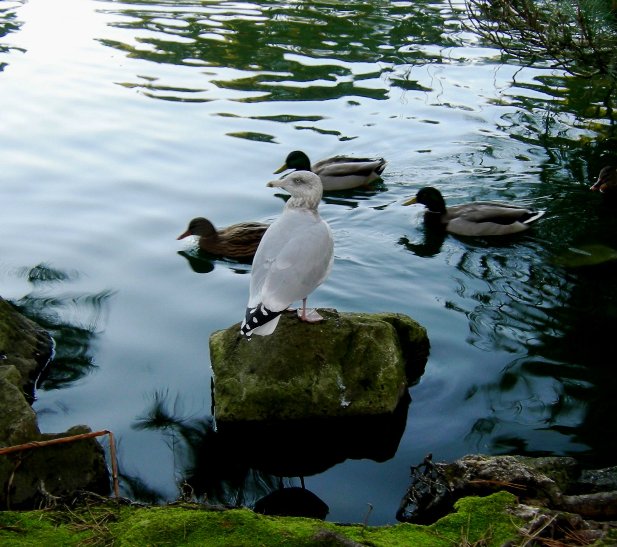
Herring Gull
This herring gull really did look like it was posing on that rock, standing sentinel. It’s another winter visitor, just like the Mew and the Thayer’s.
Feeding Frenzy
Someone brought Cheerios for the birds. Gulls have no table manners. Lots of violence and swearing. Luckily the kid couldn’t understand gull-speak.
Mine!White-fronted Geese
Usually the geese out at Stow Lake are the big Canada geese everyone knows. But today, there were three White-Fronted Geese cropping at the grass on the roadside, and ignoring people passing within a few feet of them. Don’t know why they’re called white-fronted — they look very brown to me. (The black bird in the picture above is an American Coot.)
And finally, there was this odd duck with a brown head and white throat. I don’t know if it’s a species I couldn’t ID, or if it’s just a variant of the Mallards we see everywhere.
An unexpected bonanza for what was planned as a lovely afternoon walk .
I went for a walk around our neighborhood last evening… Forest Knolls is easy night-time walking. Good sidewalks. Bright but not oppressive lighting. A dramatic crescent moon setting over a theatrical city-lights backdrop.
And a barn owl, flying overhead. They’re very silent, so I can’t say what made me look up, but there it was, winging its way over the neighborhood. It may have been hunting, but I think it was just checking the place out.
It’s easy to tell a barn owl from a great horned owl — our other neighborhood owl — even in the dark, even in flight. A barn owl appears white, and its head looks round. It’s sometimes called a “ghost owl.” It doesn’t have the “ears” or “horns” that a great horned owl has. It also flies more nimbly. Rodents, beware!
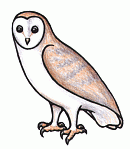
The picture here isn’t the owl I saw; that was moving too fast for my camera and my reflexes. It’s a public domain picture that I’ve tweaked to make it somewhat similar to that owl. I wonder if this was the same owl I saw some weeks ago on Twin Peaks.
Living near the forest as we do, we have a fair amount of wildlife around us: birds, raccoons, skunks, opossums, coyotes and who knows what else. So what happens if you’re suddenly responsible for a small, injured creature?
Today I found out, when I volunteered as an ambulance for a Green Heron. You take it to WildCare in San Rafael (at 76 Albert Park Lane, San Rafael, CA 94901).
Actually, first you find out if it actually needs help:
Call Wildcare at 415-456-7283 (9 a.m. to 5 p.m.)
If it’s after 5pm PST (Pacific Standard Time), call their 24-hour Nightline at 415-300-6359.
Then you decide if you should take it in. It’s a long drive, but you might save a critter’s life.
They’re open 9 a.m. to 5 p.m. every day of the year, and they have a wildlife hospital. They try to rehabilitate the animal or bird, and release it back to the area it was picked up. (California law does not permit relocation of wildlife.)
It’s a pleasant place, just across a little creek, which has tree-lined banks and a resident duck population. The courtyard is lined with cages, enclosing birds that cannot be released, usually because they have a disability that prevents them from fending for themselves. It also has a pond with a couple of resident pelicans (one brown, one white), a sea-gull, and an egret that may just have been visiting.
The Green Heron had flown into someone’s living room, and been brought to the Randall Museum. Though they do have an animal room, they don’t do wildlife rehabilitation, so the bird needed to go to Wildcare. [ETA: Wildcare sent an emailed update: “The Green Heron was suffering from wounds and I see a note of a fracture. I see from the log book that it was transported to International Bird Rescue up in Fairfield on the 7th. IBRRC have the facilities best suited to shore birds and one of our fantastic volunteers gave the Heron a ride up there.”]
I took a photo of it, then dropped it off, and spent a few minutes looking round at the denizens of the courtyard. (Visitors are welcome.) The birds were beautiful – a Swainson’s hawk, a spotted owl, and a turkey vulture among others.
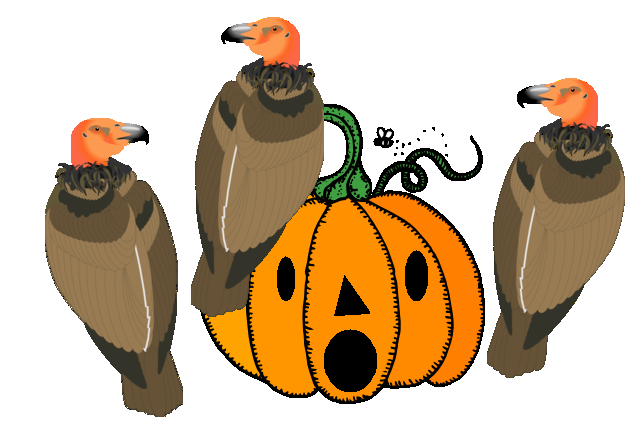
Each was accompanied by naturalist’s notes. They were all informative, but my favorite may have been the one by the turkey vulture. “Don’t be surprised to see a melon in here with our Turkey Vulture,” it said. “Although they eat carrion, they do like a change once in a while. In fact, there have been cases where large numbers of Turkey Vultures have descended on a pumpkin patch.”
The image was irresistible, especially in this season.
A foggy night in a city that knows how to keep its secrets… and me, prowling along in my little car, hoping it would share them. Not the kind of secrets found in City Hall or downtown in the dark alleys… critters.
Foggy nights are often good for critter-spotting. On Panorama Drive, I saw a trio of raccoons chase each other across the road and disappear into the shadows between two houses. And then, on Twin Peaks, which was densely swathed in fog, a barn owl!
I’ve been wanting to see one, ever since learning that they do inhabit San Francisco. This one was sitting by the side of the road, like a large white cat wanting to thumb a ride. Cursing myself for forgetting my camera, I stopped the car and put my flashers on to watch it. I was afraid someone coming fast round the bend might take it out, and wished it would move. It walked down the road a bit, which didn’t help. Two cars went around me. Then the owl took flight, just a few feet, but thankfully onto the hillside.
I went home for my camera, but the owl had moved on. At least it wasn’t roadkill.
Out for a walk by Sutro Forest yesterday evening, we saw our neighborhood Great Horned Owls. They live and nest in the forest, and come out around dusk. I first noticed them some years ago, and I’d heard them even before that. (If you hear a soft resonant hoot, that’s them. Most other kinds of owls don’t hoot; they screech or cry out.)
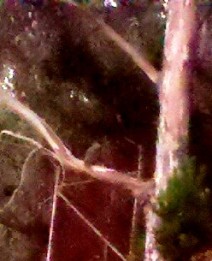
Great horned owl, not a bunch of leaves.
One of them was perched in the fork of a big eucalyptus tree, looking out at the landscape, waiting for dark and hunting time. As we stopped to watch the watcher, its mate arrived, landed on a higher branch, and looked around with interest. As long as we chattered, they ignored us, but when we whistled softly, they bobbed their heads and turned to look at us.
No one had a camera, so these indistinct images are from a cell phone.
It was amazing, to see these splendid birds so near home. “I’ve never seen owls so close up before,” said my companion. We felt very lucky indeed.
As many of you know, UCSF is planning some major changes in Sutro Forest, the dense eucalyptus forest behind our homes – the “Forest” in Forest Knolls. Many of these will affect our neighborhood directly. Details are on the SaveSutro website. A few people from our neighborhood – including Walter Caplan and Kristine Zaback from the Forest Knolls Neighborhood Organization – have been attending these meetings.
1) On South Ridge (the forest area above the junction of Christopher and Crestmont) UCSF plans to cut down around 2000 trees on 3 acres to space them an average 30 feet apart, mow down all the plants growing under the trees, and use Roundup/ Garlon on a 1-acre test site to prevent it from coming back.
Our concerns are the use of herbicides upslope from our neighborhood, potential for displaced wildlife (including rodents) to move into our area, micro-climate changes and how it will look. Drying out the forest by thinning the trees may also create a fire hazard similar to the forest in 1934, when it was being logged.
No other demonstration area lies directly above a residential neighborhood, and we had hoped UCSF would consider a different area. It hasn’t.
2) The trail leading straight up from Christopher into the forest will be re-routed into a hairpin trail that lies above Christopher. Houses below this route may lose some privacy as trail users will be able look down into them.
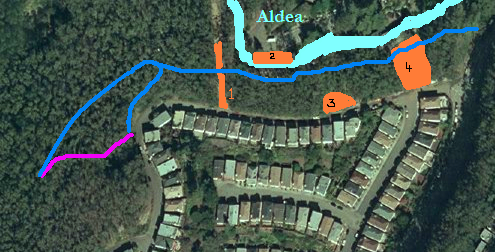
3) A new trail will be cut from Clarendon behind the new pump station and through the curtain of trees between the Aldea student housing and Christopher. This screen of trees has already been thinned considerably because of the PUC water project.
In the map above: 1 is the Gash cut into the forest for the water-line; 2 the concrete pad that was supposed to be returned to the forest but has instead been enclosed with a chain-link fence; 3 the area of the old pump station where the thinned trees make the buildings on the Aldea campus quite visible; and 4 the new pump station, with very few trees behind it. The blue lines are the planned new trails, and the pink one the existing trail. (Edited to Add: The aqua line shows the boundary of UCSF’s Aldea Student Housing.)
Residents nearby had hoped the screen would be regrown, not further thinned. In fact, there is no hope of a screen of trees between the new pump station and the Aldea campus; there’s no space. The pump station grounds extend nearly all the way to the Aldea campus boundary.
Pump Station on posterNew Pump Station in reality
The issue of hazardous trees along Crestmont was also raised. UCSF says they are the City’s responsibility; apparently the City, after staging the area (see the picture) has said they are UCSF’s problem and didn’t remove them. UCSF said they would discuss the matter with the city.
Edited to Add 2: We understand neighbors complained to the SF Fire Department. UCSF’s Barbara Bagot-Lopez sent out a message saying: San Francisco Fire Department had recently issued a “Notice of Corrective Action Required” stating that an area of the Reserve above Crestmont Avenue contains an “accumulation of combustible material”; UCSF will be resolving this issue.
We hope the corrective action will deal with the hazardous trees rather than merely further implementation of the predetermined plan.
Edited to Add 3: Kathleen asked for contact information. Here it is:
Whom to contact:
For UCSF, there are whole bunch of people. The Chancellor, Dr. Susan Desmond-Hellman, is at 3333 California Street, Suite 103, San Francisco, CA 94143. Here’s a link to others involved.
For SF PUC: Not sure, try Suzanne Gautier(SGautier@sfwater.org). Here’s a link to the meetings schedule of the SFPUC Commission. (If anyone has other contacts/ resources, please note them here.)
For the City, the Urban Forester is at (415) 641-2674.
Mayor Gavin Newsom and Supervisor Sean Elsbernd are at City Hall, 1 Dr. Carlton B. Goodlett Place, San Francisco, CA 94102.
It’s an ambitious project: a database listing every tree in San Francisco.
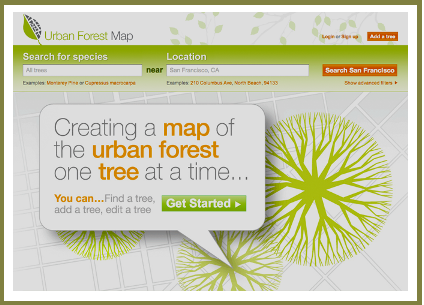
The new wiki in town is an Urban Forest Map that relies on crowd-sourced information, rather like Wikipedia. The project is live now (in beta), and anyone can play. You can go in and enter information on any tree you are familiar with – on the street, near your home, near your office or school.
The software will allow all the different organizations that track San Francisco’s trees to share information. According to an article on KQED’s website, developer Amber Blieg says 17 different entities in the city manage and track trees, but had no easy way to share information. The software will also allow citizen scientists to add trees to the database. There’s even a software to help identify tree species: The Urban Tree Key.
CAL FIRE funded the project, and Blieg developed it in co-operation with Friends of the Urban Forest, and the City of San Francisco. If they can pull this off, it will yield information about tree species, sizes, and allow users of the database to derive information about tree-cover, risk from pest infestations, and climate change effects. Trees help cities by mitigating urban heat islands, reducing and purifying storm water run-off, as well as providing habitat for birds, animals, and insects. And making the urban landscape lovelier and raising property values.
If you live near the forest, perhaps you’ve heard the soft hoots at dusk, or in the early morning. Soft, but a sound that carries. Those are our Great Horned Owls; they nest in Sutro Cloud Forest.
Recently, we were up in the forest at dusk, and along a trail, as the light faded, we saw them. First we noticed one on a branch high overhead. It saw us, looked down, and decided we were neither threatening nor edible. Then there was an almost noiseless flapping, and another owl settled into a tree on the other side of the trail.
... and its mate
We didn’t want to use a flash, of course; that would disturb the birds. But we got something of a picture without one.












 FOREST KNOLLS NEIGHBORHOOD